What is the appearance of a giant salamander?
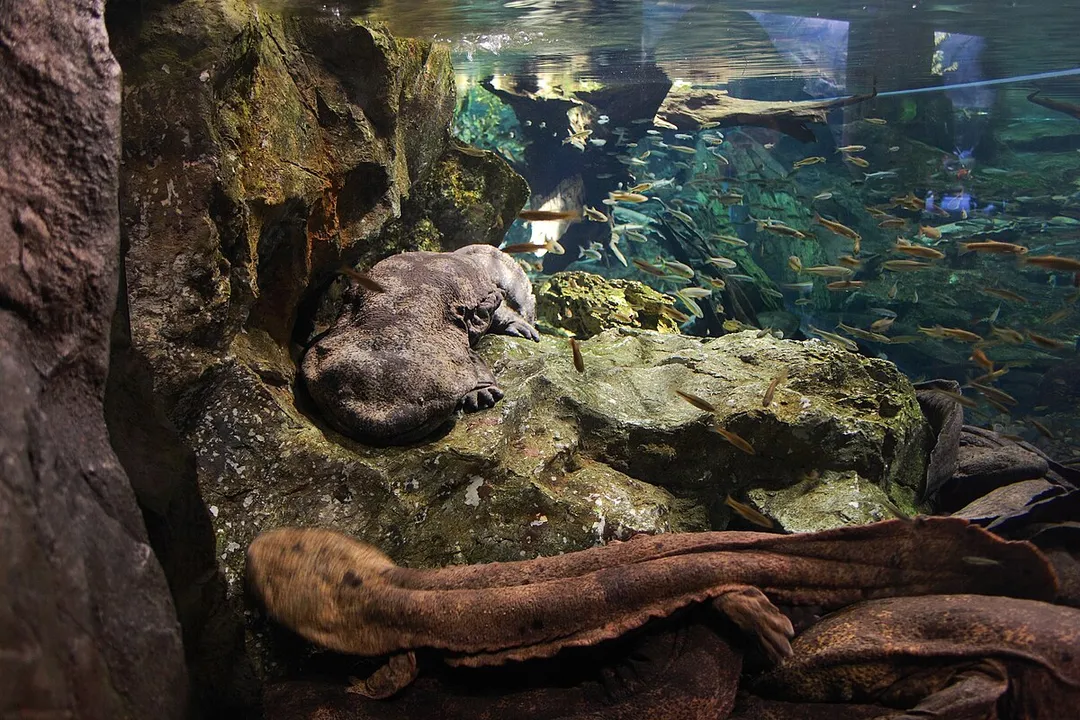
The appearance of a giant salamander immediately conveys an impression of immense, ancient design, placing them among the most striking amphibians on Earth. These creatures are immediately identifiable by their sheer scale, their dark, often mottled skin, and a body structure clearly built for a life spent largely in cool, flowing water. While the term "giant salamander" applies to a few different species, the visual characteristics that dominate the group center on size, color, texture, and robust physical features designed for aquatic stealth and power. [1][2][4]
# Sheer Scale

When people discuss the appearance of giant salamanders, they are often referring to the members of the Andrias genus—the Chinese and Japanese species—which command immediate attention due to their tremendous size. [1][2][4] The Chinese Giant Salamander (Andrias davidianus) holds the title for the largest living amphibian globally. [4][5] These magnificent animals can achieve lengths approaching 6 feet, or about 1.8 meters. [4][5] To put that into perspective, an adult Chinese Giant Salamander can be longer than many standard dining tables. [4] Their weight is equally impressive, potentially reaching up to 120 pounds (55 kg). [4]
The Japanese Giant Salamander (Andoias japonicus) is a close second in terms of size, recognized as the second-largest amphibian alive today. [2] While slightly smaller than its Chinese cousin, it still presents a massive figure, capable of growing to around 5 feet, or 1.5 meters in length. [2]
It is helpful to contrast these titans with the native North American species, such as the Pacific Giant Salamander (Dicamptodon ensatus). While large for a salamander in its region, its appearance is dwarfed by its Asian counterparts; the Pacific species typically maxes out around 12 inches (30 cm). [7] Thus, the defining feature of the "giant" group is predominantly a metric reserved for the Asian species. [1][2][4][7]
# Coloration Range
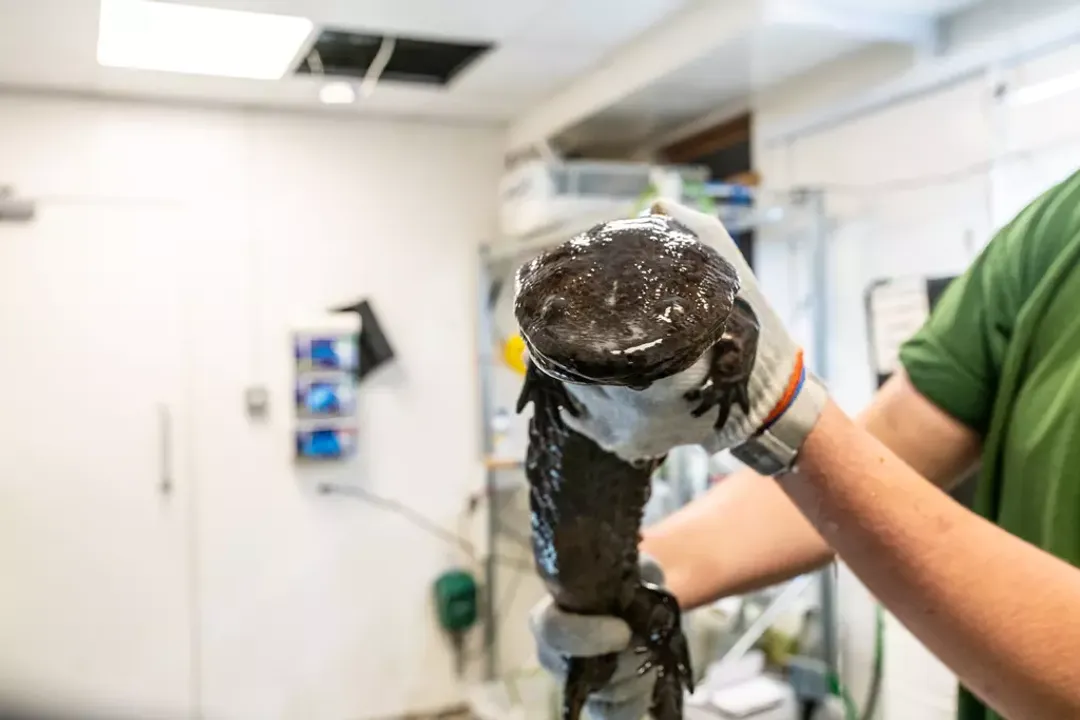
The coloration of the largest species is generally subdued, serving as excellent camouflage in the rocky, shaded streambeds they inhabit. [4] The Chinese Giant Salamander commonly displays colors ranging from black, brown, or gray. [4][5] Often, this base color is not uniform but features mottled or spotted patterns. [4][5] Some descriptions note that the skin color is usually dark brown or black. This varied patterning allows them to blend into different substrates, whether it be dark mud, submerged logs, or shadowed rocks. [4]
The Japanese Giant Salamander shares this muted palette, typically appearing dark brown to black, though some individuals may present as blackish-brown. [2] This reliance on dark, earth-toned camouflage suggests a shared evolutionary pressure for concealment while waiting for prey in low-light, freshwater environments. [2][4]
Even smaller relatives like the Pacific Giant Salamander exhibit dark pigmentation, often appearing dark gray, brown, or black, sometimes with distinct blotches. [7] The consistency of dark coloration across various giant and large terrestrial salamanders points to a deep-seated need to avoid detection from both above and below in their aquatic habitats. [4][7]
# Wrinkled Coat

One of the most tactile aspects of a giant salamander's appearance is its skin. [2][4] Amphibians require moist skin for respiration, and these species have evolved a highly specialized surface to manage this while living submerged or in damp environments. [4] The skin of the Chinese Giant Salamander is characteristically loose and wrinkled, and it is constantly covered in a protective layer of mucus. [4][9] This copious slime coat helps prevent desiccation and may also offer some defense against parasites or bacteria. [4]
The Japanese Giant Salamander’s skin is also described as thick and folded. [2] When viewing high-definition footage or close-up images of these animals, the folds of skin are pronounced, lending them a rugged, almost leathery look, despite the constant moisture. [2][4] This loose, draped skin increases the overall surface area relative to the animal's core volume, an efficient design for cutaneous respiration—breathing through the skin. [2][4] If you were to handle one—which is strongly discouraged due to their protected status—the texture would feel slick and pliable, far removed from the smooth texture of many smaller newts or salamanders. [7]
# Facial Details

The head structure of the giant salamanders is perhaps their most primitive and imposing feature. [2][4] They possess a broad, flat head that seems disproportionately large compared to their often-hidden body mass when resting on the substrate. [2][4]
Their eyes are remarkably small and notably lack eyelids, which is common among many aquatic amphibians. [2][4] This poor eyesight is significant; it dictates how they interact with their environment. Because vision is not their primary sense, they rely heavily on their acute senses of smell and touch to locate food and navigate their dark homes. [4] Their mouths are wide, capable of engulfing prey whole, which aligns with their ambush predator lifestyle. [4]
A useful point of contrast emerges when considering how their sensory apparatus reflects their lifestyle. Because they spend so much time motionless, waiting for a meal to pass within striking distance, relying on lateral line-like senses (touch and smell) is far more energy-efficient than actively searching with limited vision. [4] A simple way to visualize this is to imagine a large, living, mottled rock resting on the riverbed, waiting for a vibration to signal dinner—that is the visual impression created by their face and head structure. [4]

# Tail Propulsion
The body plan of these salamanders is completed by their limbs and tail, both perfectly suited for their environment. They possess short, stout limbs. [2][4] While these legs are functional for walking along the bottom or bracing against currents, they are not designed for fast terrestrial movement, especially given the animal's mass. [4][7]
The tail is the true engine for aquatic movement. It is described as long and muscular, critically flattened from side to side. [4] This shape functions like a powerful, organic rudder and propeller, enabling them to swim effectively through rivers and streams using strong side-to-side sweeps. [2][4] For an animal this large, this powerful caudal appendage is essential for moving against or within strong currents, allowing them to maintain prime foraging positions in the water column. [4]
# Species Contrast
To better appreciate the visual differences, even among the "giants," a quick comparison is useful. While both Asian giants are massive, their appearances vary slightly in texture and measurement, as seen in the table below.
| Feature | Chinese Giant Salamander | Japanese Giant Salamander |
|---|---|---|
| Maximum Length | Nearly 6 feet (1.8 m) [4] | About 5 feet (1.5 m) [2] |
| Max Weight | Up to 120 lbs (55 kg) [4] | Not specified, but large [2] |
| Skin Texture | Loose, wrinkled, covered in mucus [4] | Thick, folded [2] |
| Tail | Long, muscular, side-to-side flattened [4] | Robust [2] |
It is interesting to note that the descriptions often focus on the robustness of the Japanese tail versus the emphasis on the flatness and length of the Chinese species' tail, suggesting subtle differences in their preferred swimming styles or local current conditions. [2][4]

# Adaptation Insight
The appearance of these giant amphibians is a masterclass in environmental specialization. Consider the extreme contrast between their large, heavy bodies and their smooth or granular skin surfaces, constantly damp and slimy. [2][4][7] A critical aspect of their look is purely functional: the wrinkles and folds are not just aesthetic; they are integral to survival in oxygen-poor, cold streams. [2][4] By having excessively loose skin, they maximize the surface area available for absorbing dissolved oxygen directly from the water flowing over them. An animal this large needs an efficient system, and their entire external appearance—the dark camouflage, the thick mucous, the expansive skin folds—speaks to an existence where slow, steady, high-efficiency life in the dark, cool water is the rule. [2][4] Observing one is to see an evolutionary solution to living large while breathing mostly through your exterior shell.
#Videos
BIGGEST Salamander in Japan! - YouTube
Related Questions
#Citations
Giant salamander - Wikipedia
Japanese giant salamander - National Zoo
BIGGEST Salamander in Japan! - YouTube
Chinese Giant Salamander | San Diego Zoo Animals & Plants
Chinese giant salamander | London Zoo
Japanese Giant Salamander - Honolulu Zoo Society
Pacific Giant Salamander | Burke Museum
Chinese Giant Salamanders (Andrias spp.) Fact Sheet - LibGuides
Chinese Giant Salamander The BIGGEST Amphibian! This massive ...