Walrus Physical Characteristics
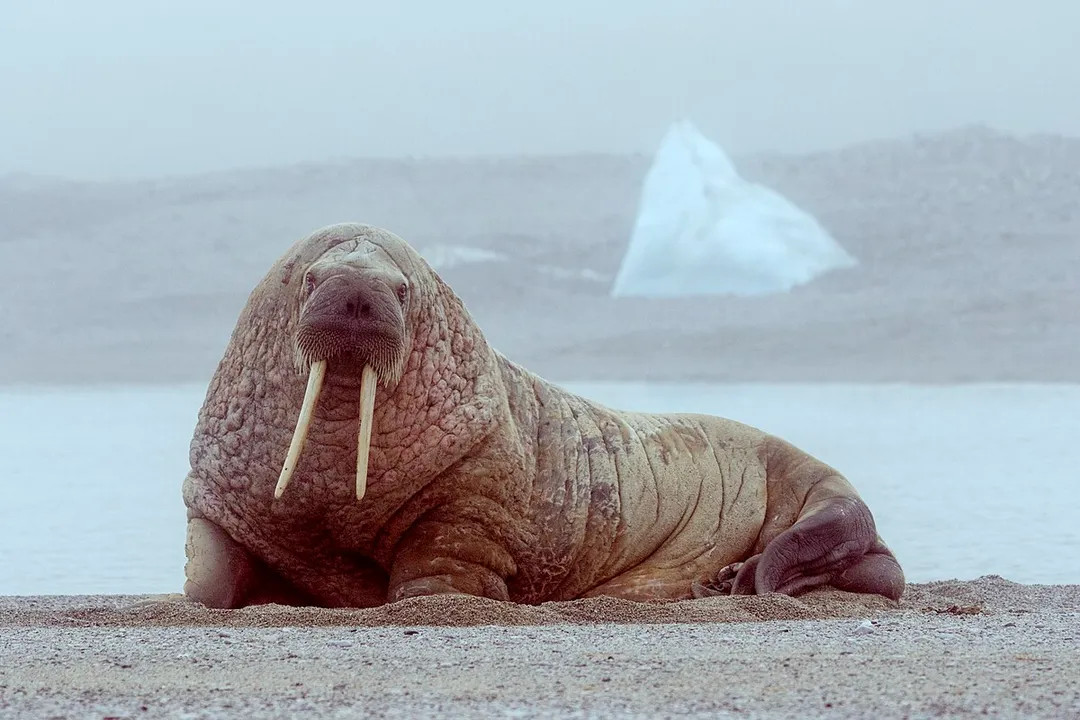
The walrus, Odobenus rosmarus, is an unmistakable behemoth of the Arctic and subarctic seas, instantly recognizable by its sheer mass and those prominent ivory appendages. It stands alone as the sole living species in its family, Odobenidae, making its physical characteristics a study in specialized survival in some of the planet's harshest marine environments. While related to both true seals (Phocidae) and eared seals (Otariidae), the walrus possesses a suite of traits that set it apart, from its sensory apparatus to its unique methods of moving between water and ice.
# Gigantic Bulk
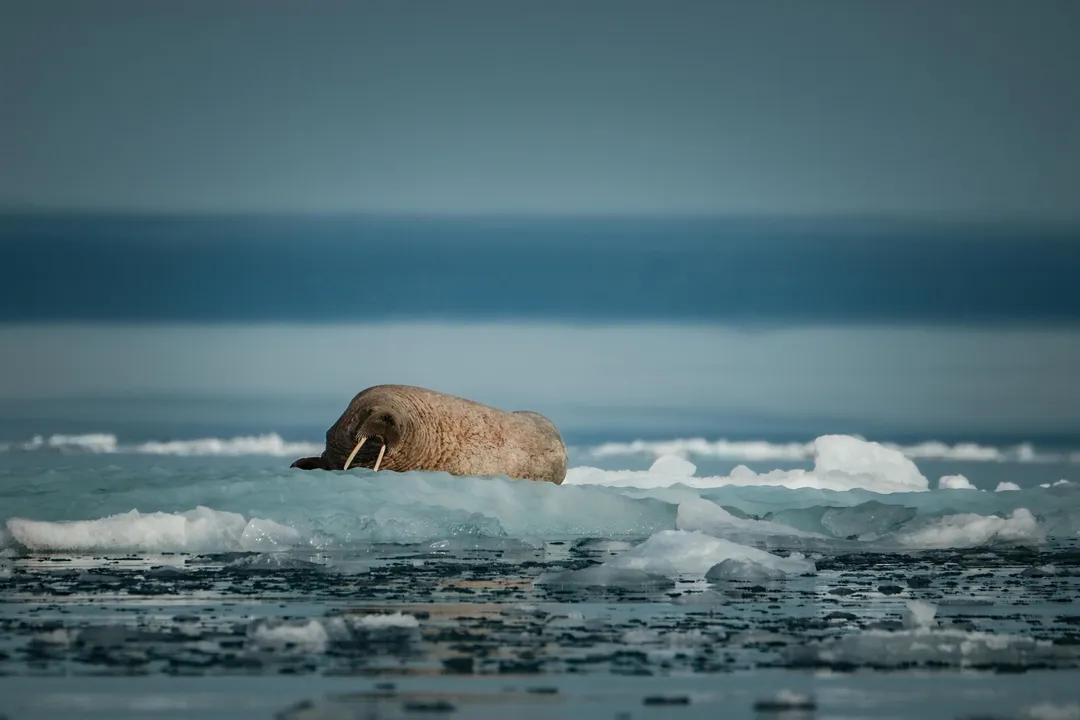
Walruses possess an imposing stature, making them true giants of the pinniped world. Adults are built heavily, with males, or bulls, generally exceeding females in both length and mass. Pacific walruses represent the larger extreme of the species; a bull can reach lengths up to () and weigh in excess of (). Some historical records suggest Pacific males have exceeded (). Only the two species of elephant seals surpass the walrus in overall size among pinnipeds.
The Atlantic subspecies, O. r. rosmarus, is typically a touch smaller than its Pacific counterpart, with Atlantic bulls averaging around (). Female walruses, or cows, weigh significantly less, usually around two-thirds the weight of males. Pacific females average about (), while Atlantic females average closer to (). Newborn calves are surprisingly large, often weighing between $33$ and () and measuring over a meter in length. This high body weight is supported by a thick insulating layer of blubber beneath the skin, which serves both for warmth in the icy waters and as an energy reserve.
# Ivory Spears
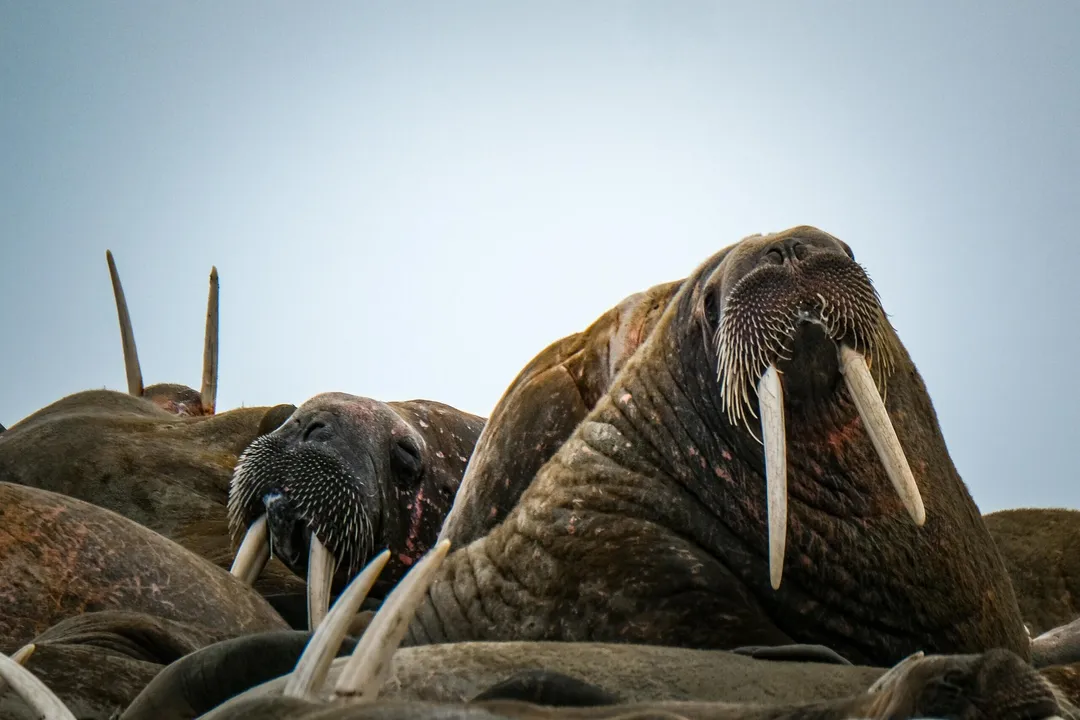
The most conspicuous features, present in both sexes, are the long, downward-projecting tusks. These impressive structures are, in fact, elongated upper canine teeth that grow continuously throughout the animal's life. In males, they tend to be longer, thicker, and straighter, sometimes reaching lengths near one meter () and weighing up to (). Female tusks are generally shorter and may exhibit more curvature. The species name Odobenus even hints at this feature, coming from Greek roots meaning "tooth-walker," based on early observations of how they use these teeth.
Despite their formidable appearance, analysis of abrasion patterns on the ivory reveals a clear functional specialization: tusks are not used for digging up prey from the seabed. Instead, their primary roles revolve around social structure and navigating the ice environment. Males utilize them heavily in establishing dominance displays and fighting rivals. Furthermore, tusks are essential for hauling the massive body out of the water onto ice floes or rocky shores, and for maintaining open breathing holes in the ice during winter.
The remaining dentition is relatively simple, with individuals typically having only about 18 teeth, though the total theoretical count is higher, with many cheek teeth being rudimentary or absent in the modern species. The cheek teeth are conical or flattened, well-suited for crushing the shells of the invertebrates that form the bulk of their diet.
# Sensory Mask
The walrus face is dominated by a very wide, flattened muzzle. Lacking the external ear flaps (pinnae) seen on eared seals, their hearing apparatus is reduced to small, inconspicuous openings. Their eyes are small and positioned high and to the sides of the head.
However, the defining facial feature, aside from the tusks, is the dense mat of stiff bristles called vibrissae. These whiskers, which can number between 400 and 700 and be arranged in 13 to 15 rows, extend up to () long, though wear often shortens them in the wild. These vibrissae are far more than just stiff hairs; they are supplied with blood and nerves and are attached to muscles, making them highly sophisticated tactile organs. They are sensitive enough to differentiate shapes as small as thick. It is with this incredible tactile sense, located on the snout, that the walrus roots along the seafloor to identify and manipulate its prey, effectively "seeing" its food in the often murky substrate.
# Skin Pigments
The hide of the walrus is thick, rough, and heavily creased, providing a durable outer layer. Around the neck and shoulders of adult males, this skin can reach up to () in thickness, offering protection during tusk clashes. Beneath this tough skin lies the critical blubber layer, which can be up to () thick.
Coloration in walruses is dynamic and highly dependent on their immediate thermal state, providing a visual clue to their environment. Generally described as yellowish-brown or cinnamon-brown, the skin tone shifts based on blood flow near the surface. When they enter the frigid Arctic water, the blood flow constricts peripherally (peripheral vaso-constriction), causing the animal to appear pale, almost ghostly gray or white. When they haul out and warm up, vaso-dilation occurs, bringing blood closer to the skin, which can make them appear distinctly pink or reddish—a temporary "sunburn" effect. Calves are born a darker slate gray or deep brown, paling as they age.
A distinctive secondary sexual characteristic in older males is the development of large lumps or nodules, often referred to as "bosses," particularly on the neck and shoulders. In older males, these nodules can become quite pronounced, leading to a warty appearance, and they may become nearly hairless compared to females.

# Movement Puzzles
The walrus's body shape presents a fascinating anatomical compromise, sharing characteristics with both the sea lion family and the true seal family. Like sea lions, walruses possess large, paddle-like foreflippers, and critically, they can rotate their hind flippers forward under the pelvic girdle. This rotation allows them to use all four limbs to support their weight and walk or clamber across land or ice.
However, when swimming, their propulsion method more closely resembles that of true seals, relying primarily on side-to-side sculling movements of the rear flippers rather than the wing-like strokes of eared seals. The soles of their flippers are rough and thick, which is a pragmatic physical trait that aids traction on slippery surfaces like ice or rocks. The necessity of having powerful limbs capable of walking for haul-outs, while maintaining the efficient underwater propulsion needed for foraging, results in a build that sacrifices the streamlined hydrodynamics of a dedicated swimmer like a phocid for greater terrestrial mobility. This ability to walk on all fours, rather than just wriggle, is likely a significant evolutionary advantage when navigating the heterogeneous landscape of fractured pack ice or when hauling out onto high, steep banks, an increasingly common necessity as floating ice diminishes.
# Internal Oddities
Beyond the visible characteristics, the walrus has several internal and accessory features vital to its specialized life. Males possess a particularly large baculum, or penis bone, which can reach lengths of (), making it the largest of any land mammal both in absolute size and relative to body mass.
A less obvious but acoustically important structure involves the neck region. Males possess a pair of elastic pharyngeal pouches located in the neck that can be inflated with air. These pouches act as resonance chambers, allowing the males to produce the loud, bell-like sounds essential for competitive vocal displays during the winter mating season. Beyond their use in communication, inflation of these air sacs also provides supplementary flotation when a walrus is resting vertically in the water.
Considering these features—the sensitive vibrissae for finding food, the powerful suction mouth for extracting it, and the massive tusks for leverage on ice—the walrus exhibits a highly integrated physical design. It's an animal where no major external feature is wasted; the whiskers feel the seabed, the mouth slurps the meat, and the tusks haul the weight. This division of labor among its complex anatomy allows it to thrive in a niche few other large mammals can access.

# Subspecies Variation
While they share the core physical characteristics detailed above, the two widely recognized subspecies—the Pacific (O. r. divergens) and the Atlantic (O. r. rosmarus)—show moderate differences in physical manifestation. The Pacific population is generally larger overall than the Atlantic population. As noted, Pacific males reach greater maximum weights and lengths, and their tusks tend to be larger and thicker than those of Atlantic males. The Atlantic subspecies also tends to have a slightly more flattened snout compared to the Pacific form. A third, less-studied population in the Laptev Sea (O. r. laptevi) is sometimes recognized, though some authorities link it genetically to the Pacific group.
The skin itself is sparsely covered in hair, which is short and coarse, becoming sparser and less dense with age. This combination of thick blubber, limited hair coverage, and vascularized skin demonstrates a reliance on physical adaptations that manage the extreme thermal gradient of their environment, shifting their appearance from pale white underwater to rosy pink on the ice. These physical traits—size, tusks, whiskers, and skin—are the tools that enable the walrus to maintain its "keystone species" status within the Arctic marine ecosystem.
Related Questions
#Citations
All About the Walrus - Physical Characteristics - Seaworld.org
Walrus - Wikipedia
Odobenidae (walruses) | INFORMATION - Animal Diversity Web
Odobenus rosmarus - Walrus - OBIS-SEAMAP
Walrus Fact Sheet | Blog | Nature - PBS
Pacific Walrus (Odobenus rosmarus divergens) Printer Friendly
Walrus | Description, Size, Habitat, Diet, & Facts | Britannica
Walrus - Polar Latitudes Expeditions