Vine Snake Scientific Classification
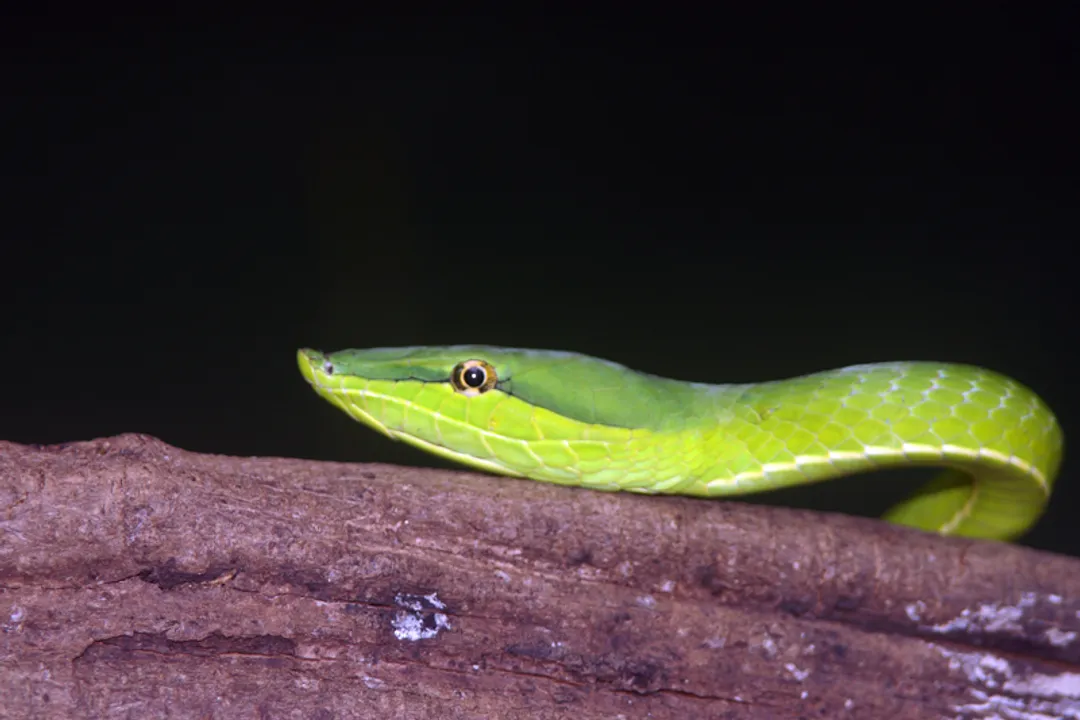
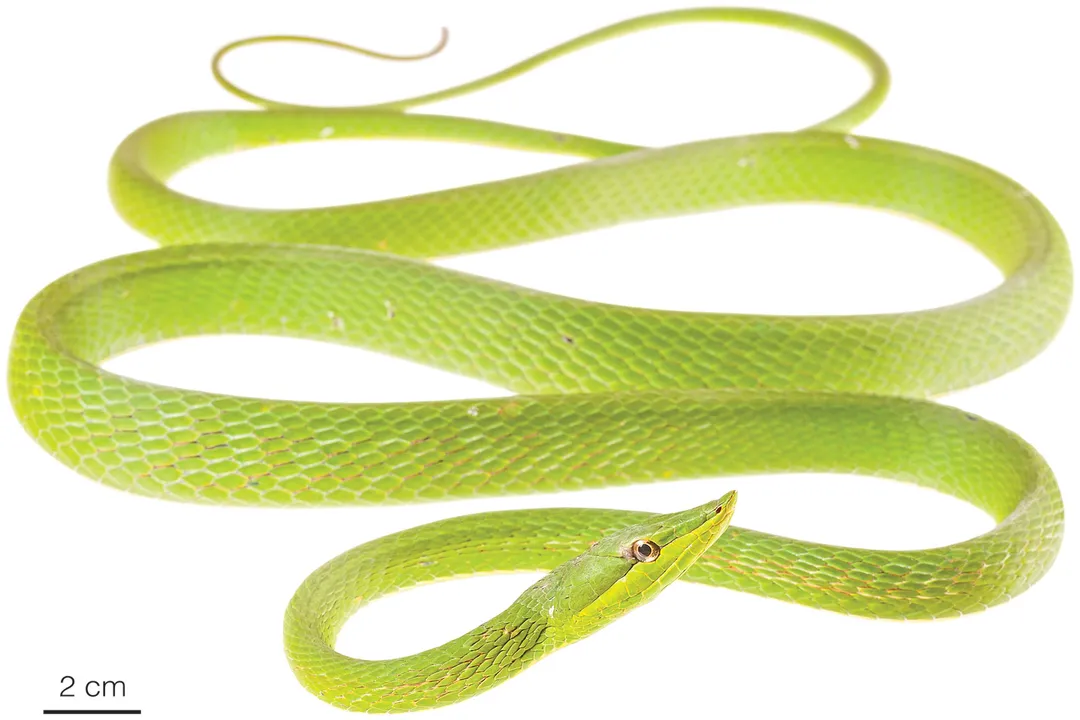
The classification of the vine snake begins high up the tree of life, placing these arboreal, often rear-fanged reptiles within the largest snake family known to science, the Colubridae. To properly situate the New World vine snakes, which primarily fall under the genus Oxybelis, one must appreciate the broader grouping of snakes that share the common moniker "vine snake." These snakes are characterized by their remarkably slender bodies, narrow heads, and pointed snouts, all adaptations for moving through tangled foliage.
# Taxonomic Hierarchy
The hierarchical organization of any snake, including the Oxybelis species, follows a standard Linnaean structure, detailing its evolutionary relationship from the broadest domain down to the specific species name.
At the top, the vine snake belongs to:
- Kingdom: Animalia—the grouping for all animals.
- Phylum: Chordata—organisms possessing a notochord at some stage of development, which includes all vertebrates.
- Class: Reptilia—the class encompassing turtles, lizards, crocodilians, and snakes.
- Order: Squamata—this order contains all lizards and snakes.
- Suborder: Serpentes—the suborder dedicated solely to snakes.
- Family: Colubridae—This is the family of "typical snakes," often characterized as being generally non-venomous, though vine snakes are an important exception, possessing rear fangs and venom.
- Genus: Oxybelis—This genus is specifically reserved for the New World vine snakes found in the Americas.
This placement within Colubridae is significant because it groups Oxybelis with many other diverse, non-venomous or mildly venomous snakes, rather than with the highly venomous Elapidae or Viperidae families.
# Genus Identity
The genus Oxybelis itself is endemic to the Americas, ranging from the southwestern United States down through Central America and into the northern parts of South America. These snakes exhibit clear physical traits that distinguish them from their Old World counterparts, such as the Asian genus Ahaetulla or the African Thelotornis. A key diagnostic feature for Oxybelis within the broader vine snake grouping is the round pupil of the eye. In contrast, Ahaetulla species are known for having a horizontal, keyhole-shaped pupil.
The etymology of the name itself offers a visual clue to the snake’s form; Oxybelis is derived from the Greek words oxys, meaning "acute," and belos, meaning "arrow," perfectly describing the snake's sharp, elongated snout. These snakes are slender and laterally compressed, with tails that often constitute more than one-third of their total length. Physical descriptions note that the head is distinctly elongated and set off from the neck.
It is important to note that the Oxybelis genus is not small; there are eleven widely recognized species within it as of recent taxonomic work. However, a significant portion of this diversity is concentrated within one complex of species that has only recently undergone rigorous taxonomic revision.
# Complex Taxonomy
The classification of many New World vine snakes, particularly the brown-colored varieties, was historically confusing, often lumped under the name Oxybelis aeneus (the Brown Vine Snake). New molecular and morphological studies have driven a substantial taxonomic split, revealing that this single widespread "species" actually comprised numerous distinct taxa. This revision increased the species count recognized in this particular lineage, highlighting how visual crypticity can mask real biodiversity.
This complex is distinguished from the green-colored clade, which includes Oxybelis fulgidus and Oxybelis wilsoni, suggesting a significant divergence event, possibly dating back to the Mid-Miocene. The Central American origin of the O. aeneus clade, followed by an invasion into South America after the closure of the Panamanian isthmus (around 2.8 million years ago), provides a fascinating biogeographical context for understanding why these closely related species are distributed as they are today.
Recent efforts have formally recognized species like Oxybelis koehleri, Oxybelis potosiensis, and Oxybelis rutherfordi as distinct, splitting them from the previous concept of O. aeneus. Furthermore, research has resurrected Oxybelis acuminatus from southeastern Brazil and described an entirely new species from the Peruvian Amazon, Oxybelis inkaterra.
# Distinguishing Morphological Traits
The key to separating these very similar brown/gray species lies in minute morphological differences, as their general appearance and habitat overlap considerably. A comparison among eight members of the O. aeneus complex reveals specific character states that taxonomists use for validation, such as:
| Character State | O. acuminatus | O. inkaterra | O. aeneus | O. potosiensis |
|---|---|---|---|---|
| Upper Labials Bordering Orbit | 3 (4-5-6) | 3 (4-5-6) | 3 (4-5-6) | 2 (4-5) or (5-6) |
| Second Upper Labial Contacting Preocular | Yes | No | No | No |
| Chin Heavily Mottled | No | Yes, with white spots | No | Yes, in females |
| Stripes on Venter | Indistinct | No | No | Variable |
| Second Pair of Chin Shields Contacting | No | Yes | Yes | Yes |
| Lower Labials contacting first chin shields | 5 | 4 | 4 | 4 |
| Supraocular Longer than Prefrontal | Yes | No, equal in length | Yes | No, equal in length |
| Ventral Scales (Example Range) | 197 | 173–205 | Variable | Variable |
The data clearly shows that morphology is subtle but reliable. For instance, O. acuminatus is uniquely separated from most others in this complex by having the second upper labial scale in contact with the preocular scale, whereas the others typically have the third upper labial making that contact. When faced with a snake that is perfectly camouflaged and difficult to observe in its natural environment, relying on these precise scale counts, though requiring careful examination, moves identification from guesswork to scientific certainty. It’s fascinating to consider that a difference in the number of scales touching a single point on the face can be the deciding factor that separates two endemic species in South America, demonstrating the high value placed on minute differences in systematic biology.
# The Green Specialist
While the O. aeneus complex covers the brown/gray variants, Oxybelis fulgidus, the Green Vine Snake, stands out due to its consistently bright green coloration, which strongly correlates with its typical habitat in rainforest areas. This species is famous for its striking, leafy appearance, featuring a bright green dorsum and a lighter, yellowish-green ventrum, often accented by a pair of bright yellow ventrolateral stripes. The specific epithet, fulgidus, is Latin for "shining," a nod to this vibrant hue.
O. fulgidus is a diurnal, arboreal predator, known to reach impressive lengths, sometimes exceeding 6 feet (nearly 2 meters). Its hunting strategy heavily relies on its camouflage, acting as a sit-and-wait ambush predator. It employs a unique luring tactic, extending its bright-colored tongue back and forth, mimicking an insect or worm to draw in unsuspecting prey.
# Venom and Diet Specificity
The Green Vine Snake is venomous, possessing rear fangs located below the eye, characteristic of its opisthoglyphous dentition. However, its medical significance to humans is typically low, causing only mild local effects like slight swelling or numbness. This contrasts sharply with the African vine snake, Thelotornis, which is known to have caused human fatalities.
The venom of O. fulgidus contains fulgimotoxin, a neurotoxin that exhibits a strong preference in its lethality. This toxin is particularly potent against birds and reptiles—the primary components of its diet—but is noted as being non-toxic to mammals. This specialization in toxicity is a remarkable example of ecological evolution. When we observe that an O. fulgidus might position itself near a flower specifically to capture hummingbirds, it becomes clear that its entire physiological toolkit, including its venom chemistry, has been refined over evolutionary time to efficiently subdue its preferred prey types, rather than developing broad-spectrum toxicity for defense against large mammals.
# Classification and Conservation
The difference in coloration between species groups—green for rainforest dwellers like O. fulgidus, and gray or brown for savanna or dry forest inhabitants—is a macroscopic ecological sorting that generally aligns with the formal taxonomy. The fact that Oxybelis fulgidus is listed as Least Concern by the IUCN reflects its wide distribution, presence in many protected areas, and stable populations, even adapting to secondary growth forests.
Conversely, the extensive taxonomic splitting within the O. aeneus complex illustrates a concerning trend in herpetology: many widespread, cryptic species, once thought to be well-studied, are now being recognized as multiple, distinct entities. The paper detailing the splitting of O. aeneus noted that such species, now newly recognized, often default to a Data Deficient conservation status because, while we know they exist, we lack sufficient data on their specific population sizes or ranges beyond museum records.
The genus Oxybelis represents a dynamic area in herpetological study. The ongoing integration of molecular phylogenetics with detailed morphology—like the comparisons of preocular-labial contact points or chin shield arrangement—is rapidly refining our understanding of this group. This continuous refinement in classification, moving from 1 species to perhaps eight or more in a single complex, is vital not only for documenting biodiversity but for targeting conservation resources effectively towards those newly delimited species facing the highest risk. The ability of these snakes to cross significant geographical barriers, like the Andes, also raises questions about historical dispersal patterns that classification helps us trace.
Related Questions
#Citations
Vine snake | Tree-dwelling, nocturnal, slender. | Britannica
Oxybelis - Wikipedia
Green Vine-Snake (Oxybelis fulgidus) - Reptiles of Ecuador
Vine Snake - MBGnet
A new vine snake (Reptilia, Colubridae, Oxybelis) from Peru and ...
Oxybelis fulgidus (Green Vine Snake) - Animal Diversity Web