Vine Snake Physical Characteristics
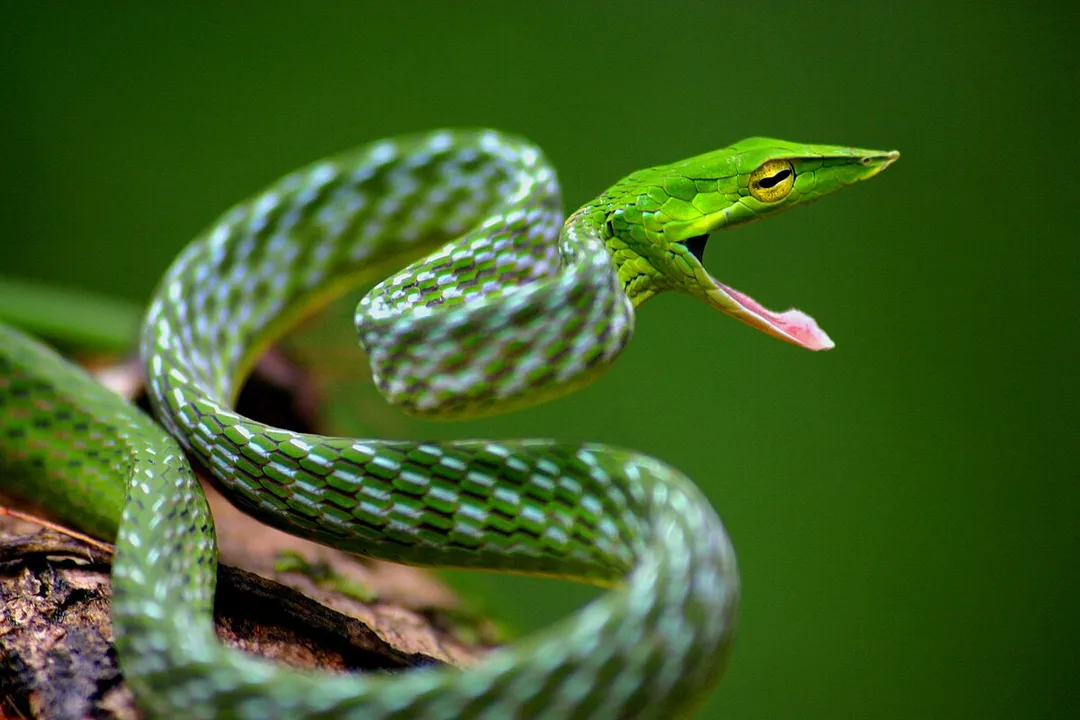
The vine snake, particularly the species commonly known as the Green Vine Snake or the Asian Vine Snake (Ahaetulla nasuta), presents one of nature's most convincing examples of cryptic mimicry. [2][5][8] These reptiles are masters of disguise, perfectly evolved to blend into the dense, sun-dappled vegetation of their arboreal homes. [1][4] To the casual observer, they may appear to be nothing more than a stray leaf stem or a slender, hanging tendril, an illusion that is crucial for both avoiding predation and positioning themselves for an unseen strike on unsuspecting prey. [2] Understanding their physical attributes reveals a suite of adaptations tailored exclusively for life spent almost entirely above the forest floor. [1][4]
# Slender Build
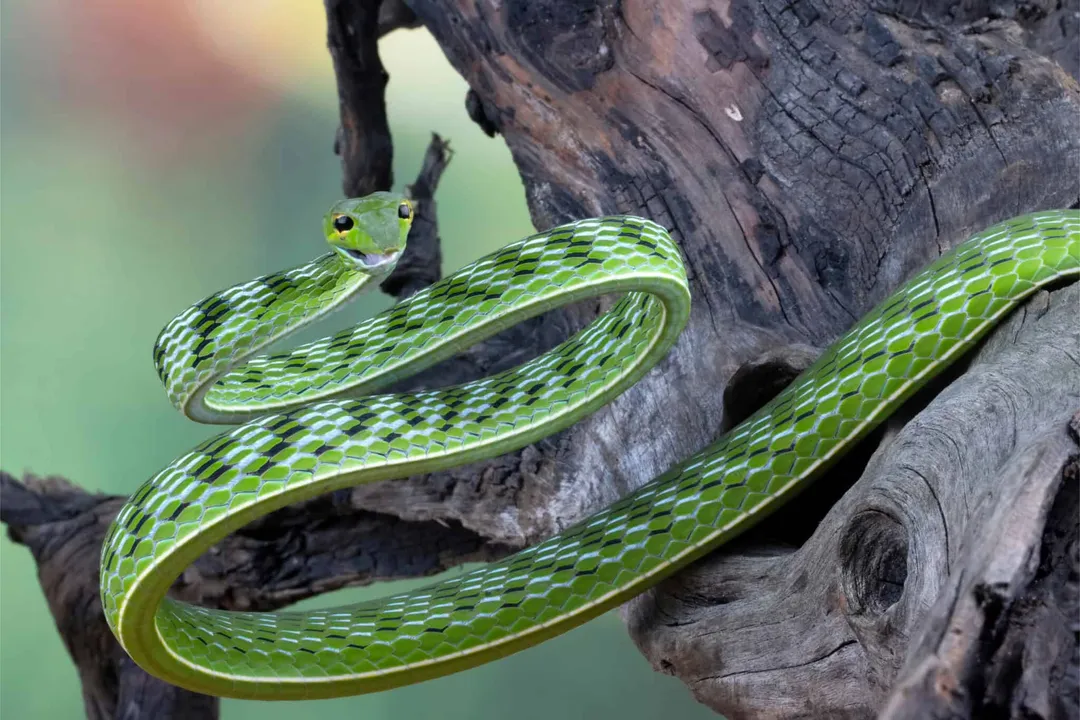
Perhaps the most immediate characteristic of any vine snake is its astonishingly slender body profile. [4][5] These snakes are exceptionally long relative to their girth, giving them that characteristic "vine-like" appearance. [1][2] While exact sizes can vary between subspecies and geography, they are generally considered large, slender snakes. [5]
Measurements often indicate that mature adults can reach lengths exceeding 1.5 meters (about 5 feet) or even approach 6 feet in total length. [1][5] Despite this impressive length, their diameter remains remarkably small. This attenuated body plan is not just for show; it allows the snake to move through the tangle of branches and leaves with minimal disturbance, moving much like a whip or an extension of the plant life itself. [4] Interestingly, sexual dimorphism is present in their sizing, with the females typically growing larger and heavier than the males of the same species. [1][5]
The way they utilize this slenderness in locomotion is fascinating. When navigating complex three-dimensional space, such as the canopy layer, this narrow structure permits a kind of specialized lateral undulation that maximizes contact with multiple anchor points simultaneously, allowing for a secure, almost physics-defying traversal across thin supports. [4]
# Green Camouflage
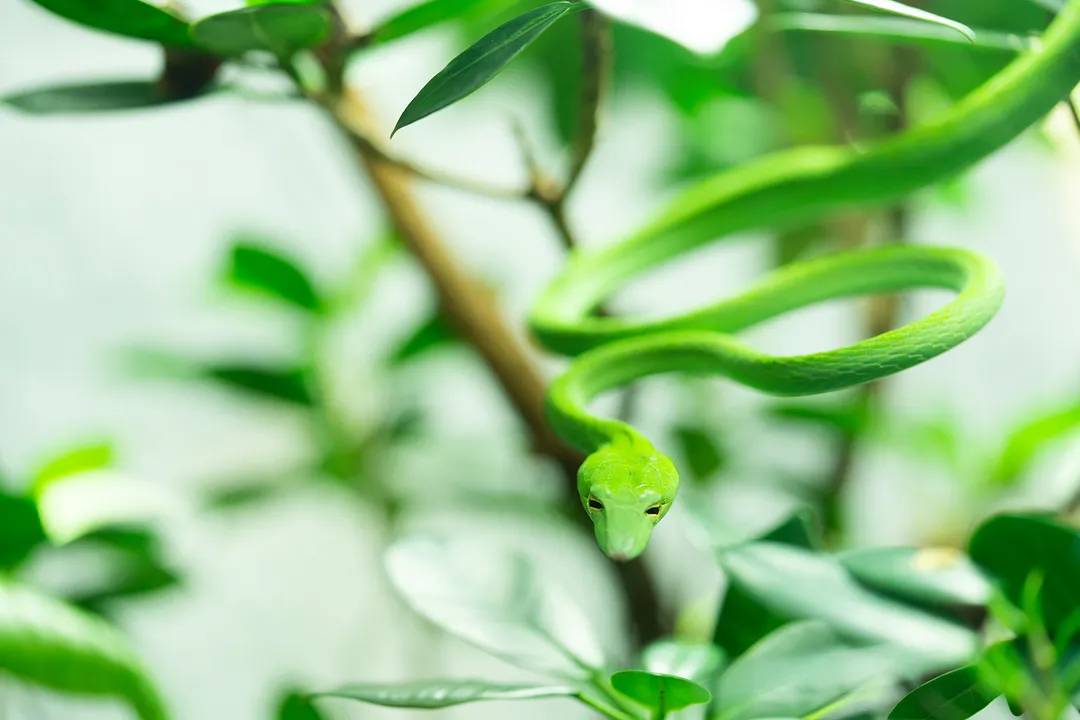
The primary color of the Green Vine Snake is, unsurprisingly, a vibrant bright green. [1][2][8] This pigmentation provides near-perfect background matching among the lush leaves they inhabit. [1][5] However, their coloration is not static, which speaks to an important physiological mechanism tied to their physical state.
While green is dominant, observers often note that these snakes can shift their appearance based on environmental factors or their condition. [2][5] They may exhibit shades of yellowish-green, or, notably, take on brown or reddish-brown tones. [2][5][6] This shift is often observed during the dry season when foliage naturally browns, or as a reaction to stress or when the snake is preparing to shed its skin. [2][5] This ability to subtly alter color provides an extra layer of adaptability that simple, fixed coloration would lack.
# Distinctive Snout
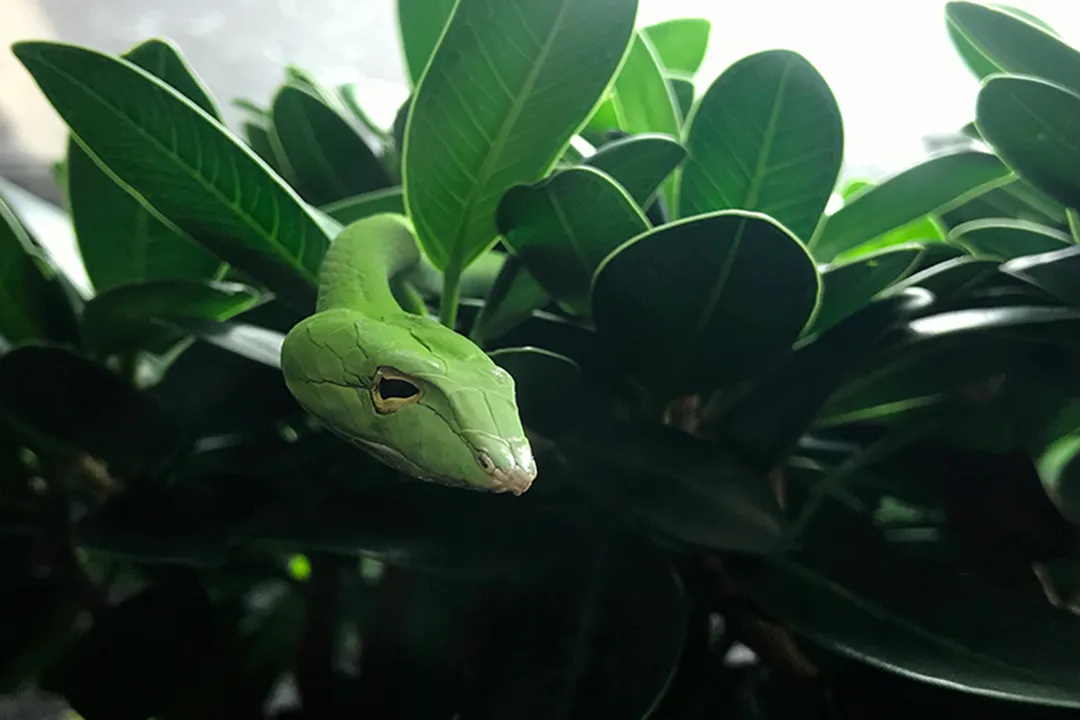
One of the key identifiers separating Ahaetulla nasuta from other arboreal snakes is the structure of its head, specifically the projection extending from its nose. [1][5] This is the nasuta portion of its scientific name, referring to the elongated, pointed snout. [5][6] This extension is rigid and pointed, contributing significantly to the overall disguise, often making the snake look like the tip of a broken twig or a spent seed pod hanging from a branch. [1][4]
While the snout is prominent, it is important to note that this feature is not used for piercing or defense in the way a venomous fang is. Its function is purely morphological—it enhances the illusion of an inanimate piece of vegetation. [1] It is a physical trait evolved solely for camouflage enhancement, working in concert with the body length and coloration. [4]
# Horizontal Pupils
The eyes of the vine snake are another area where specialized physical characteristics grant a major advantage for its hunting style. [1] They possess very large eyes relative to their head size. [1][5] This large ocular structure gathers ample light, which is vital for hunting successfully in the often dappled or dim light filtering through dense foliage. [5]
More remarkable than their size is the shape of their pupils: they are distinctly horizontal. [1][5][6] Furthermore, the pupils often appear slit-like or diamond-shaped when constricted. [5] This horizontal orientation is strongly associated with predators that require precise binocular vision and accurate depth perception for striking targets at varying, but relatively close, distances in a complex, three-dimensional environment. [1][5] In contrast, many nocturnal ambush predators rely on vertical slits for extreme light control in low light, but the vine snake's adaptation prioritizes the spatial awareness needed for movement through branches rather than just waiting in the dark. This visual system allows the snake to judge the exact distance to a bird or lizard perched on an adjacent leaf before launching its strike. [4]
# Rear Fangs
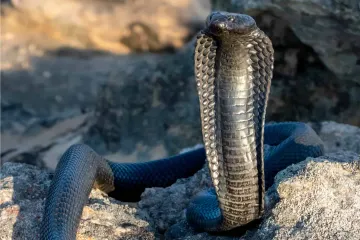
While highly adapted for camouflage and hunting vision, the vine snake also possesses a specialized dentition. [4] Vine snakes belong to the family Colubridae and are classified as rear-fanged snakes. [1][6] This means their venom delivery system is anatomically different from highly venomous snakes like vipers or elapids, whose fangs are situated at the front of the mouth. [4]
The fangs used to inject venom are located toward the back of the upper jaw. [1][5] They are mildly venomous, and their venom is generally considered not life-threatening to humans. [1][4] Bites usually result only in localized swelling, mild pain, or transient symptoms. [4][6] For the snake, these specialized fangs are perfectly positioned to deliver a dose while manipulating prey, such as small birds or tree frogs, often held crosswise in the mouth during the initial capture phase. [1][5] The structure of the fangs and the mild nature of the resulting envenomation reinforce their classification as less medically significant reptiles compared to front-fanged species. [4]
# Body Texture
The texture of the snake’s skin and scales contributes to its overall deceptive appearance. [5] The scales are often described as being keeled, meaning they have a slight ridge running down the center of each scale, rather than being smooth. [5] This texture helps reduce the sheen or glare that smooth scales might produce under direct sunlight, further enhancing the matte, organic appearance of a vine or twig, thereby completing the physical package necessary for its highly specialized, arboreal existence. [2][5]
Related Questions
#Citations
The Vine Snake Is a Slender, Tree-climbing Carnivore
Vine Snake Animal Facts
Green Vine Snake - Facts, Diet, Habitat & Pictures on Animalia.bio
Vine snake | Tree-dwelling, nocturnal, slender. | Britannica
Ahaetulla nasuta - Wikipedia
Narrow-headed Vine Snake - Anywhere Travel
Oriental Vine Snake (*Ahaetulla prasina*) Habitat and Identification ...
Asian Vine Snake - The Living Planet Aquarium
Vine Snake - Distribution, Appearance, Threat, Diet and Nutrition