How many San Francisco garter snakes are there?
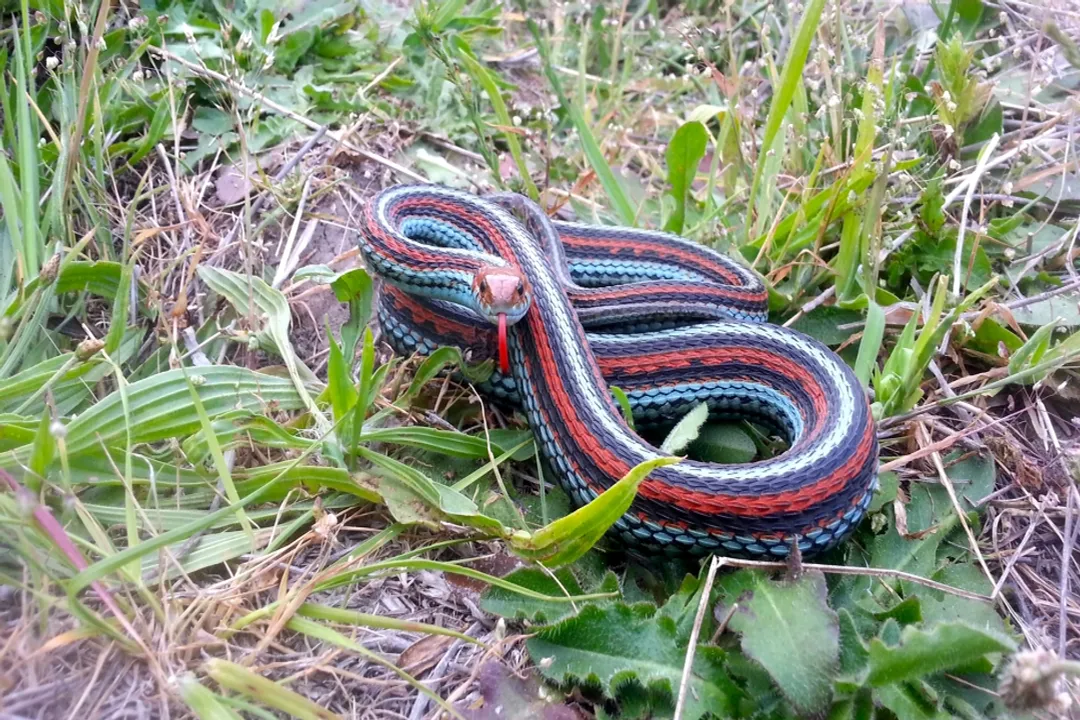
The precise count of San Francisco garter snakes remaining in the wild remains an elusive figure, yet the status of this subspecies is clearly defined by its extreme rarity. Current assessments suggest that there may be only between 1,000 and 2,000 individual San Francisco garter snakes (Thamnophis sirtalis tetrataenia) left in existence today. This range reflects the difficulty inherent in accurately surveying a secretive, endangered reptile confined to fragmented pockets of coastal California habitat.
# Listing History
This snake has been recognized as imperiled for decades, long before modern population estimation techniques were routine. The San Francisco garter snake (SFGS) was among the first species placed on the U.S. Fish and Wildlife Service (FWS) endangered list on March 11, 1967. It was then grandfathered onto the federal Endangered Species Act (ESA) when it was formally signed into law in 1973. A formal Recovery Plan was approved by the FWS in 1985, outlining necessary conservation steps to secure the subspecies’ future.
# Population Numbers
The most recent figure suggests a total wild population in the low thousands. An earlier estimate placed the number at approximately 1,500 snakes older than one year, with the caveat that the population was thought to drop back to this number each spring due to high mortality of the young. The current estimate of $1,000$ to $2,000$ may, therefore, be closer to the stable adult population count, considering the poor survival rates for neonates.
Where these snakes exist paints a stark picture of decline. Historically, the range spanned from the San Francisco/San Mateo County line south into northwestern Santa Cruz County. While the overall extent of the historical range has not decreased drastically, the number of populations within it has plummeted. Some data suggest that at one point, there were as many as 65 "permanent" reproductive populations across the peninsula. Today, that number is far lower; reports indicate only six known significant populations remain, with at least four of these having experienced declines in recent decades. The snakes persist in isolated pockets, primarily along the coast of San Mateo County. The fragmentation is severe, meaning that genetic or demographic connection between these remaining groups is likely limited or nonexistent.
# Critical Habitat
The small number of remaining snakes is intrinsically linked to the highly specific habitat requirements they possess. The San Francisco garter snake requires a distinct interface between water and land to complete its life cycle.
# Aquatic Requirements
The snake relies on freshwater aquatic habitat—ponds, creeks, marshes, or slow-moving sloughs—for critical activities like foraging and basking. They are specialists, with their diet heavily dependent on amphibians such as the California Red-Legged Frog (CRLF), which is itself a threatened species. For the snakes to access their preferred prey in the necessary stages (e.g., metamorphosing frogs), the water must be shallow near the edges, ideally less than $5$ cm deep, from May through July. Furthermore, emergent vegetation like cattails or bulrushes is needed to provide cover.
# Terrestrial Needs
The aquatic zone is only half the story. Once ponds dry up in late summer, the snakes retreat to the uplands for hibernation or summer dormancy (aestivation). They require open grassy hillsides or shrub-dominated scrub adjacent to the wetlands for basking and cover. Crucially, they need underground refugia, typically in mammal burrows, to maintain stable temperatures during winter hibernation and summer heat.
The challenge for conservationists is that the ideal habitat is a mosaic of these features in close proximity. Historical land uses, like intensive grazing or agriculture, can lead to habitat degradation, such as the loss of small mammal burrows or the destruction of shoreline vegetation by cattle traffic. In areas studied, such as the La Honda Creek Open Space Preserve, historical ranching has resulted in bare ground rings around wetlands, creating barriers for snakes moving between foraging and refuge areas.
# Factors Shrinking the Population
The contraction of the population is directly attributed to the rapid development of the San Francisco Bay Area since the 19th century, which has destroyed or fragmented prime habitat.
# Development and Roads
Urbanization and road construction are primary culprits, leading to habitat loss and fragmentation. Roads act as physical barriers, discouraging snake movement between necessary wetlands, or worse, leading to direct mortality from vehicle strikes. The development of former sag ponds along Skyline Boulevard, which once held "hundreds" of individuals, represented one of the "larger blows" to the population before 1966.
# Poaching
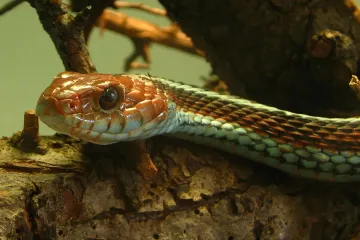
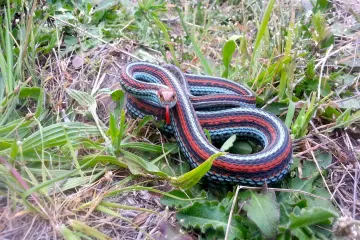
Compounding the threats from habitat loss is the snake’s striking appearance. Its bright colors—blue/green belly, black and red lateral stripes, and orange/red head—make it one of the most beautiful snakes in North America. This beauty unfortunately makes it a target for illegal collection for the pet trade. Since owning native reptile species in California is illegal, this collection represents a direct, illegal removal of individuals from already fragile wild stocks.
# Interspecies Competition
The health of the snake population is also vulnerable to issues with its prey base and invasive predators. Non-native American bullfrogs pose a dual threat: they prey on juvenile San Francisco garter snakes and compete with the snakes for shared amphibian prey like the California Red-Legged Frog. Studies suggest that the spread of bullfrogs is a much greater threat to the threatened frog populations (the snake's main food) than the presence of the snake itself.
# Conservation Strategies
Because natural recolonization of lost habitat is unlikely due to barriers like highways and development, active human intervention is considered necessary for recovery. The 1985 Recovery Plan calls for conserving the existing populations and establishing four new populations, aiming for a baseline of 200 adult SFGS in a $1:1$ sex ratio across 10 populations for at least 15 consecutive years before the species is considered recovered. This recovery benchmark sets a minimum viable population target, which many current populations fall short of.
One management tactic focuses on identifying suitable but unoccupied habitat, such as the La Honda Creek Open Space Preserve (LHC), and using demographic models to simulate reintroduction success. These modeling efforts have yielded important, counterintuitive insights for managers. For example, simulations suggest that releasing a fixed number of head-started juvenile snakes annually for 15 to 20 years into a single subpopulation yields the highest viability, as opposed to spreading the initial numbers across multiple smaller groups.
This modeling work implies a significant management decision point: it is generally better for a founding population to start with a single, strong core group rather than multiple small, easily extirpated clusters. If the goal is to achieve a census of 200 adults, concentrating initial efforts might be crucial for reaching that density threshold faster, even though habitat fragmentation suggests future connectivity is desirable. The focus on head-starting juveniles—raising them in captivity until they are one year old—is another management decision aimed at boosting the initial survival probability compared to releasing wild-caught neonates.
# Working Landscapes
The reality of SFGS conservation is that its remaining strongholds often exist in complex, human-modified environments, which presents a challenge unlike preserving a pristine wilderness area. For instance, the Russian Ridge Open Space Preserve (RR) and Cloverdale Ranch Open Space Preserve (CR) support extant populations and are actively managed as cattle ranches. The maintenance of open grassland/shrub matrix, preferred by the snakes, has been linked to the presence of grazing, provided it is managed below an overgrazing threshold.
The need to balance land use with conservation is a recurring theme. Some of the snakes have historically utilized artificial water features, like golf course water hazards, which creates a precarious situation: shutting down the course might revert the area to an unsuitable environment, yet the maintenance of the course may involve threats like lawnmowers. This dynamic highlights that achieving population stability may depend on long-term, negotiated management of these "working landscapes" rather than simple protection of static land parcels. Successfully supporting SFGS populations requires an adaptive management approach where monitoring data informs adjustments to habitat management, such as installing cattle exclosures around wetlands to restore necessary cover and connectivity. While precise counts are difficult, the conservation focus remains on managing the factors—habitat quality, connectivity, and genetic diversity—that support a steady, upward population trend, even if the exact "how many" remains an educated guess.
Related Questions
#Citations
Endangered Species Act profile - Center for Biological Diversity
San Francisco Garter Snake
The San Francisco Garter Snake has been on the endangered list ...
San Francisco Garter Snake (Thamnophis sirtalis tetrataenia)
[PDF] San Francisco Garter Snake (Thamnophis sirtalis tetrataenia)
SAN FRANCISCO GARTER SNAKE Thamnophis sirtalis tetrataenia
Assessing the Feasibility of Reintroducing San Francisco ...