Does the Paradise Flying Snake have venom?
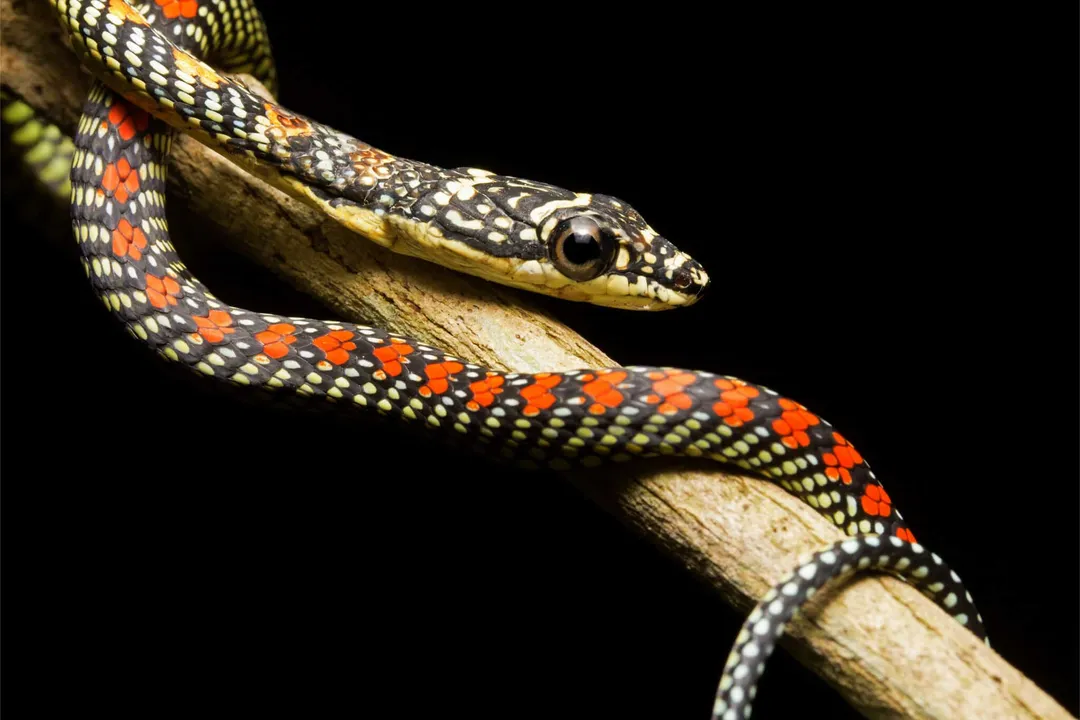
The remarkable creature known as the Paradise Flying Snake, scientifically classified as Chrysopelea paradisi, often sparks immediate fascination due to its incredible aerial capabilities. While most discussions revolve around its gravity-defying, gliding descent from high perches, a more subtle but equally important question arises regarding its biochemistry: does this tree-dweller possess venom? The answer, as often happens in the world of herpetology, is more nuanced than a simple yes or no, depending entirely on how one defines "venomous" in a practical sense. [1][2]
# Gliding Feats
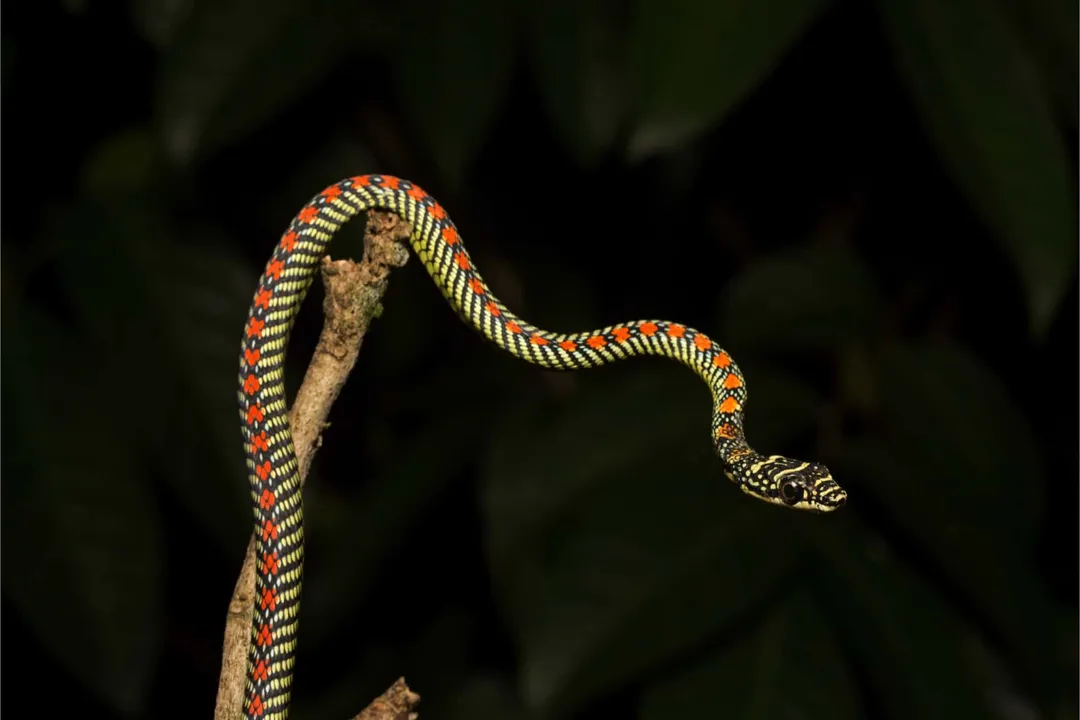
Before diving into the chemical aspects, it is important to appreciate why this snake garners so much attention in the first place. This snake is famously capable of gliding, a behavior that allows it to traverse distances between trees effectively. [3] It is not truly flying in the way a bird does, but rather executing a controlled glide. [3]
The mechanics behind this feat are extraordinary. To initiate a glide, the snake, which is diurnal and active during the day, [3][9] launches itself from a branch. Once airborne, it flattens its body into a concave, ribbon-like shape. [1] This flattening dramatically increases its surface area, turning its cross-section from a typical round shape into a D-shape. [1] Studies of this process reveal that the snake generates lift by undulating its body side-to-side in a wave-like motion while airborne. [1] This allows the snake to cover horizontal distances significantly greater than the height from which it launched, making it a highly effective method of escape or movement within the canopy. [1] Found across Southeast Asia, including areas like Malaysia and the Philippines, [4][8] its arboreal lifestyle necessitates such adaptations for navigating the dense forest structure.
# Toxin Reality
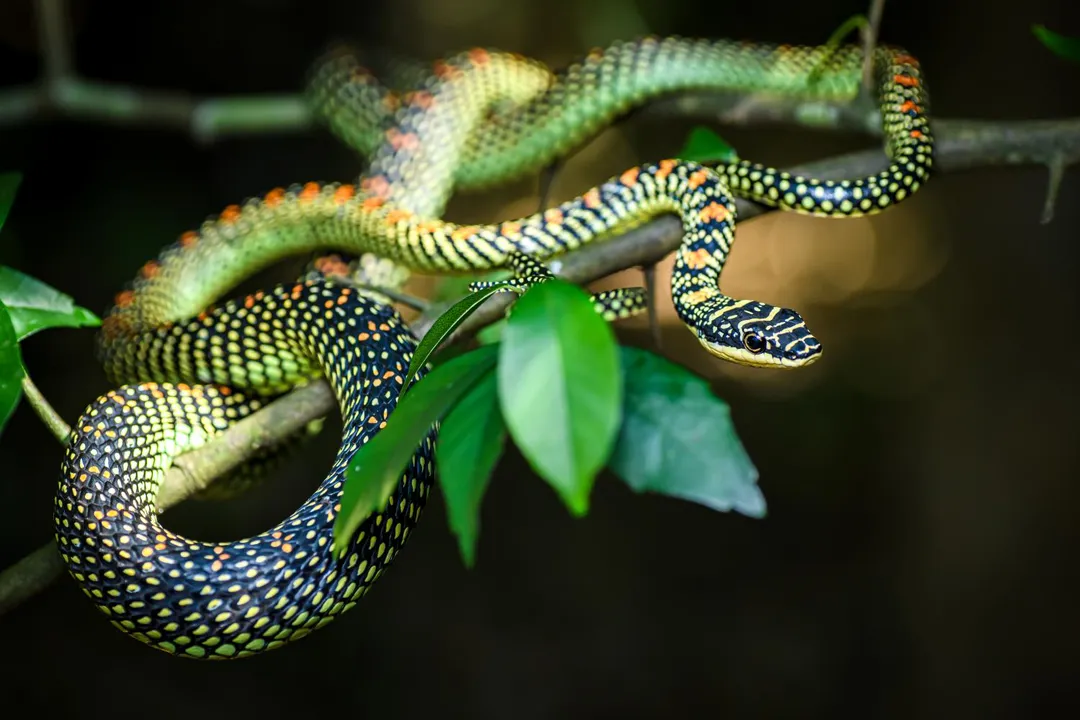
The core issue of whether the Paradise Flying Snake has venom hinges on specific biological definitions versus public perception of danger. On one hand, several general informational sources often classify Chrysopelea paradisi as non-venomous. [2][9] This classification is typically made with the human observer in mind, suggesting that any oral secretions it produces pose no substantial threat to people. [2][9]
However, dedicated scientific inquiry paints a different picture. Research confirms that C. paradisi does indeed produce venom. [6][7] Abstracts from biological studies specifically analyze the composition and effects of this snake's venom. [6][7] This means, biologically speaking, the snake is venomous, as it possesses specialized glands and ducts to deliver toxic saliva upon biting. [1][6]
The crucial difference lies in the potency and delivery system of this toxin. Unlike the highly pressurized, forward-pointing fangs of medically significant vipers or cobras, the Paradise Flying Snake possesses small fangs located in the back of its upper jaw—a characteristic often referred to as opisthoglyphous dentition. [1][2] This means that to successfully inject venom, the snake usually has to chew or hold onto its prey for a longer duration than front-fanged snakes. [1] Furthermore, the venom itself is described as mild. [2] Scientific investigation into its venom suggests it is primarily suited for subduing small prey, such as lizards or small mammals, rather than posing a serious medical risk to larger animals like humans. [6] Therefore, while it is venom-producing, for the general public observing this snake in a park or backyard, labeling it as harmless or non-venomous is often done for safety context. [1][2]
# Dental Mechanics
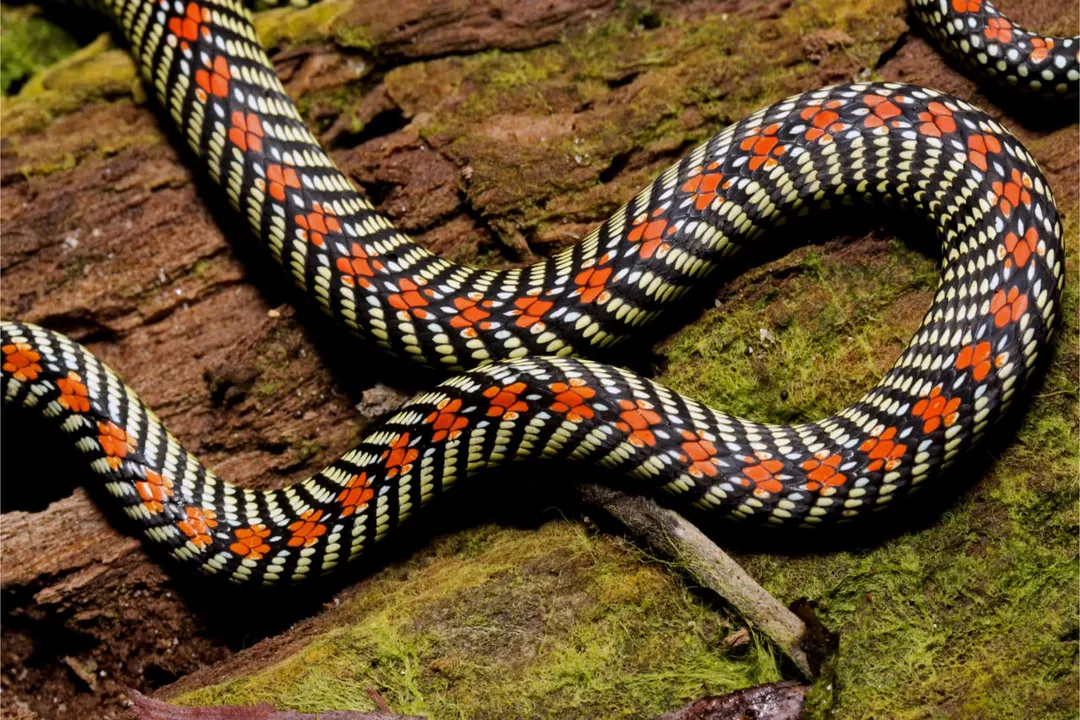
The physical apparatus used for envenomation is key to understanding the snake's impact. As mentioned, the presence of rear fangs is significant. [1][2] This setup requires a specific engagement with the target. For a snake that mainly subsists on small creatures that are consumed whole, this method is perfectly adequate for incapacitation. [6] The venom acts to quickly subdue or begin breaking down the prey internally, making it easier to swallow. [6]
It is worth noting that the venom composition itself has drawn scientific interest, suggesting specific biochemical components that target the physiology of its typical diet. [6][7] While research continues on the exact mechanisms, the consensus remains that the delivery system (rear fangs) and the relative weakness of the toxin mean that a bite to a human is rarely more serious than a localized reaction, perhaps mild swelling or irritation, in contrast to the life-threatening envenomations associated with other snake families. [2]
# Habitat and Observation
Since these snakes are adapted to moving between trees and are active during the day, [9] spotting one often involves looking up rather than down. Their distribution spans various regions in Asia, making them a common sight in suitable habitats within those ranges. [1][9]
When observing any snake in its natural environment, it is always best to maintain a respectful distance. Given that the Paradise Flying Snake is known to glide, being near the base of a tall tree from which it might launch an escape can sometimes lead to an unexpected event, even if the snake's primary intent is avoidance. [3] For those interested in finding them, focusing on canopy edges or areas with sufficient spacing between large trees during daylight hours offers the best chance to witness their unique locomotion. [3][9] A common context for seeing them, based on reports from people living in their range, is simply finding them resting on exterior walls or windows of homes that border forested areas, as they move between suitable high points. [4][5][8]

# Defining Safety
When a species is technically venomous but medically insignificant to humans, the terminology used by experts versus the public can cause confusion. When the Thai National Parks listing calls it non-venomous, it reflects a classification based on medical emergency potential. [9] When a researcher details the components of its venom, they reflect its biological reality. [6][7] For the average reader, understanding that this is a mild rear-fanged species whose venom is tailored for tiny prey provides the necessary context for safe interaction: admire its flight, give it space, but do not fear a severe reaction from a bite. [2] It lacks the specialized physiology for dangerous human envenomation. [1]
# Comparison to Kin
The gliding ability is not unique to C. paradisi within its genus. The genus Chrysopelea contains several species that exhibit this same remarkable form of aerial locomotion. [1] These "flying snakes" share a close relationship, and often, the venom profile across the genus shares the characteristic of being low-hazard to humans, suggesting an evolutionary path where chemical defense was tuned toward small-bodied prey rather than large mammalian threats. [6] This shared trait suggests that the ability to glide and the production of mild, rear-fanged venom are correlated adaptations within this group of arboreal reptiles. The differences between the specific species of Chrysopelea usually come down to coloration, size, and specific geographical distribution, rather than a drastic difference in venom lethality to people. [1]
The Paradise Flying Snake remains a testament to nature's creativity. It is a reptile that has evolved the means to cheat gravity through precise body control and possesses a biochemical toolkit—its mild venom—perfectly suited for its role as a small, active predator in the forest canopy. [1][3][6]
Related Questions
#Citations
Chrysopelea paradisi - Wikipedia
Paradise Flying Snake Animal Facts - Chrysopelea paradisi
Meet a snake that is known to "FLY"!?! Well… actually, glide. This ...
Malaysia. outside my window. Paradise flying snake? - Reddit
Bitten by the "flying" tree snake, Chrysopelea paradisi - PubMed
Bitten by the “Flying” Tree Snake, Chrysopelea Paradisi
Paradise tree snake (Chrysopelea paradisi) - Thai National Parks