Is a Paradise Flying Snake a carnivore?
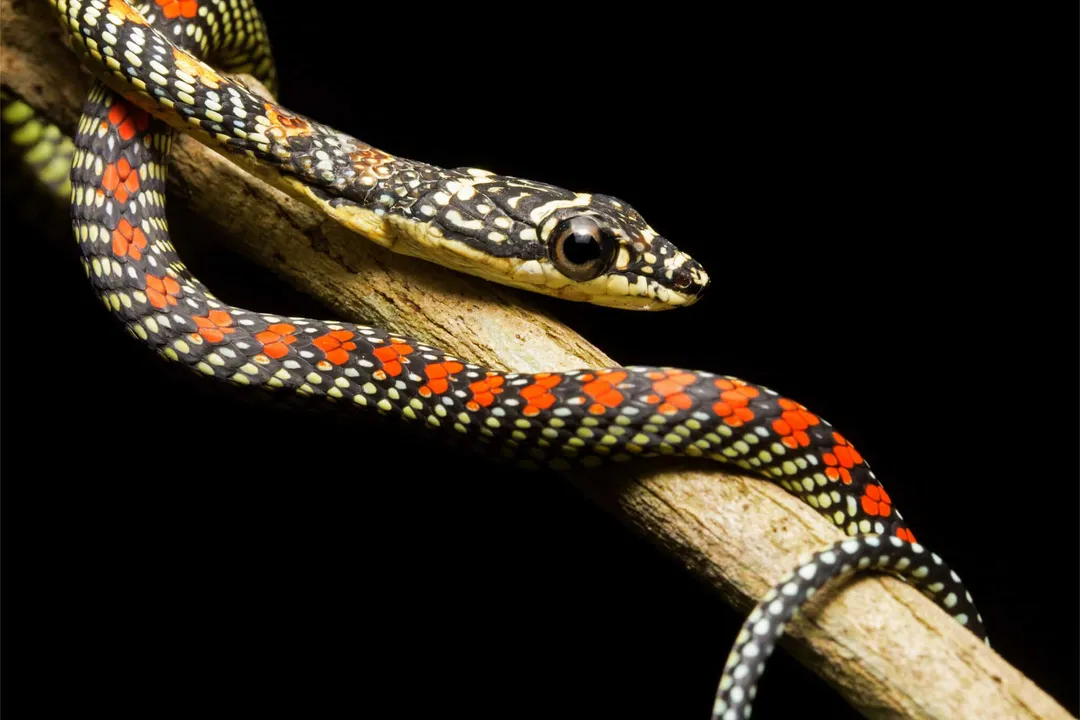
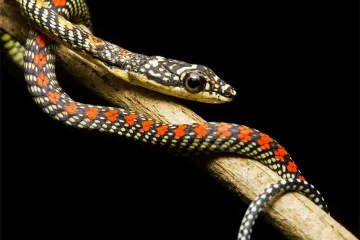
The Paradise Flying Snake, or Chrysopelea paradisi, fits squarely into the category of an animal that consumes other animals; yes, it is a carnivore. This designation is central to understanding its life in the forest canopies of Southeast Asia, where its acrobatic gliding abilities are not just a spectacle but a method of securing its next meal. Classified within the family Colubridae, this snake relies on a diet composed entirely of living creatures, which it captures using a combination of speed, agility, and mild toxicity.
# Carnivorous Nature
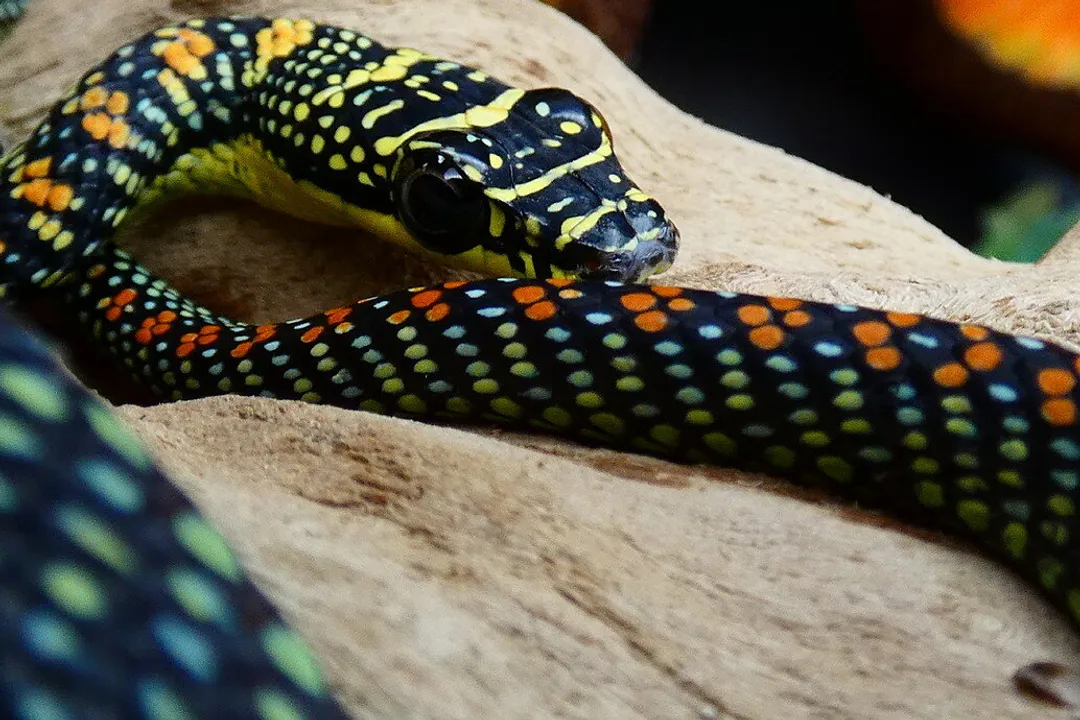
The fact that C. paradisi is a carnivore is an established aspect of its natural history. Unlike omnivores or herbivores, this species depends on obtaining animal protein for survival. Its classification as a carnivore is supported by the documented components of its diet, which primarily consist of small vertebrates found in its environment. This feeding strategy is intrinsically linked to its arboreal existence, as it must find its next meal in the trees where it spends most of its time.
# Prey Spectrum

The specific menu for the Paradise Flying Snake reflects the smaller, agile animals inhabiting the moist forests and even nearby parks and gardens where these snakes are found. Their preferred food items appear to heavily favor other small climbing or flying creatures.
Key dietary components mentioned across various observations include:
- Lizards: These form the bulk of the diet for wild specimens. Given that the snake is tree-dwelling, it naturally targets tree-dwelling lizards.
- Frogs: Amphibians, particularly tree frogs (hylids), are noted as important food sources, especially in captive settings where variety is encouraged.
- Bats: These flying mammals are an identified part of their wild diet, highlighting the snake’s ability to hunt aerial prey.
- Rodents and Small Mammals: These are also included in the known diet of the species.
It is worth noting that while captive care guides often list small rodents and button quail as occasional offerings, the consensus leans heavily toward reptiles and amphibians as staples in their natural ecosystem.
| Prey Category | Common Examples/Notes | Source Confirmation |
|---|---|---|
| Reptiles | Lizards (especially tree-dwelling) | |
| Amphibians | Frogs (hylids encouraged in captivity) | |
| Mammals | Bats, small rodents |
# Venom Role
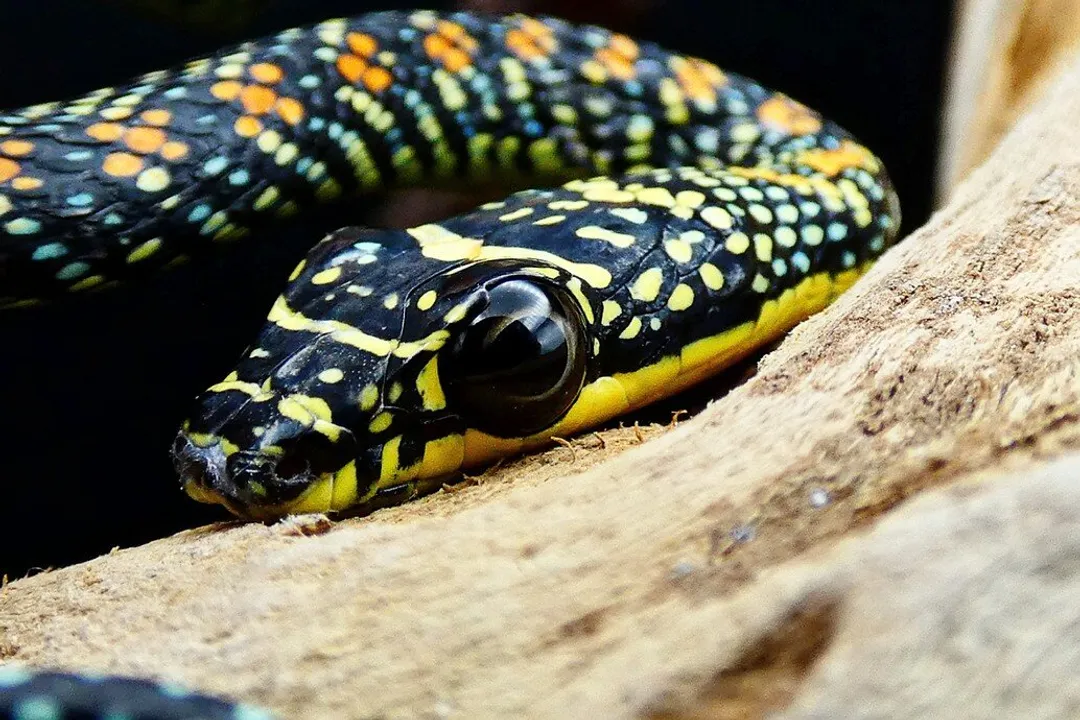
To efficiently dispatch this small, mobile prey, C. paradisi employs two primary methods: constriction and venom delivery. While they can constrict their prey, they also possess a specialized, though mild, venom apparatus. This venom is delivered via fixed rear fangs rather than the typical front fangs seen in many other venomous snakes. The venom is generally only potent enough to subdue their small prey, making them only mildly venomous to larger animals like humans, where its injection is rare and usually ineffective. This chemical aid speeds up the feeding process, which is essential for a predator that must rapidly subdue prey it has caught, perhaps after a long, energy-intensive glide.
# Arboreal Hunting
The very structure of the Paradise Flying Snake is adapted for an arboreal, carnivorous lifestyle. Their capacity to glide allows them to cover distances of 10 meters or more, sometimes reaching up to 100 meters under favorable conditions. This is not merely escape behavior; it is a hunting tool that allows the snake to efficiently traverse the canopy, moving from one tree to a distant perch to locate or ambush prey.
When considering the snake's primary prey—lizards, frogs, and bats—it becomes clear that its aerial maneuvering is a direct adaptation for reaching food sources that might otherwise be inaccessible from a single trunk or branch. The fact that they are found in habitats where these prey animals are abundant strongly suggests that their gliding capability is evolutionarily advantageous for predation, giving them a vertical and horizontal hunting range few other snakes can match. For instance, a snake might spot a lizard on a neighboring branch and launch itself across the gap rather than attempting a dangerous climb or drop and re-climb sequence. This is an excellent example of how ecological pressures shape physical specialization, where the ability to "fly" is fundamentally tied to the need to eat.
# Captive Diet Needs
For those keeping C. paradisi in captivity, understanding their strict carnivorous requirements is paramount, as feeding is often cited as the most challenging aspect of their husbandry. Because captive breeding is currently rare, most snakes are wild-caught imports, which brings specific feeding considerations. Keepers must ensure a steady supply of appropriate feeders, such as house geckos and anoles, which serve as staples.
A practical consideration for any keeper sourcing live feeders is the potential parasite load that wild-caught prey can carry. Experienced keepers often recommend prophylactic parasite treatment for all feeder animals for at least a week before introduction to the snake, a step that demands specialized knowledge regarding dosage and administration of medications like Metronidazole, often through means like nebulization or dusting food. This highlights a crucial aspect of responsible carnivorous pet ownership: the keeper’s responsibility extends not just to the snake but to the health maintenance of its entire food chain within the enclosure environment. Furthermore, because they are known to be mildly venomous constrictors that rely on seizing prey, providing live food ensures the snake practices its natural hunting and subduing behaviors, which is more stimulating than offering pre-killed meals.
#Videos
MASTERCLASS | PARADISE FLYING SNAKES - YouTube
Related Questions
#Citations
Paradise flying snake facts, distribution & population - BioDB
Chrysopelea paradisi - Wikipedia
Comprehensive Care Guide for Paradise Flying Snakes (C. paradisi)
Malaysia. outside my window. Paradise flying snake? - Reddit
MASTERCLASS | PARADISE FLYING SNAKES - YouTube
Paradise tree snakes on Singapore shores - wildsingapore homepage
Paradise Flying Snake Animal Facts - Chrysopelea paradisi