Yellow Cobra Scientific Classification

The vibrant reptile often sighted across Southern Africa, commonly known as the Yellow Cobra, has a more formal identity established through its scientific classification: Naja nivea. [4] While its striking yellow phase draws immediate attention, understanding its taxonomic placement is what truly reveals its biological relationships and evolutionary history, placing it far beyond just its coloration. [1][3] This scientific naming system, derived from the Linnaean binomial nomenclature, provides an essential structure for understanding its placement within the broader kingdom of life. [4]
# Naming Roots

The very name assigned to this cobra carries echoes of ancient languages. The genus name, Naja, is a Latin adaptation of the Sanskrit term nāgá, which simply translates to "cobra". [4] This establishes its immediate recognition as a member of this iconic group of snakes.
The specific epithet, nivea, however, presents an interesting puzzle. Derived from the Latin words nix or nivis, meaning "snow" or "snowy," the specific epithet nivea means "snow-white". [4] This designation seems counterintuitive for a snake frequently seen in bright yellow, brown, or even black phases across its range. [3][4] Taxonomists suggest this seemingly mismatched name might be an artifact from the first preserved specimens that reached Europe, perhaps showing signs of post-mortem discoloration, leading to the "snowy" label even though the snake is anything but pale in life. [4]
# Hierarchical Structure
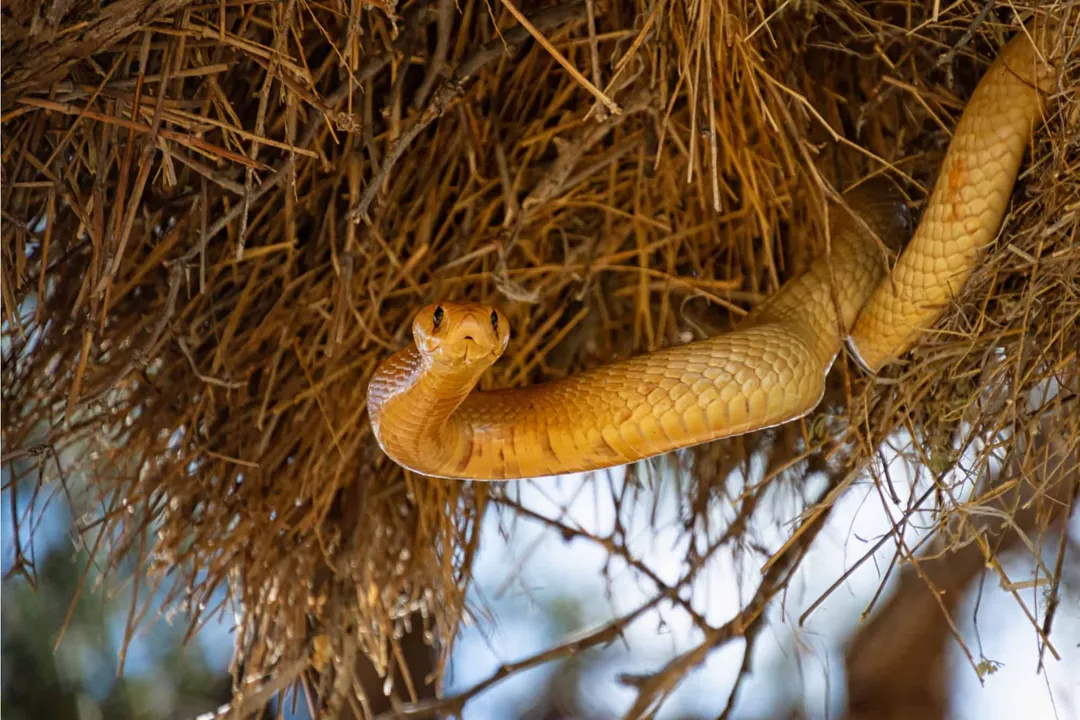
The scientific classification drills down systematically, starting from the broadest category and narrowing to the species level, establishing exactly where Naja nivea sits in the tree of life. [3][4]
The full recognized taxonomy for the Cape Cobra, or Yellow Cobra, is as follows:
- Kingdom: Animalia [3][4]
- Phylum: Chordata [3][4]
- Class: Reptilia [3][4]
- Order: Squamata (comprising lizards and snakes) [3][4]
- Suborder: Serpentes [4]
- Family: Elapidae [1][3][4]
- Genus: Naja [3][4]
- Subgenus: Uraeus [4]
- Species: N. nivea [4]
The placement within Family Elapidae is significant; this group contains some of the world’s most venomous snakes. [1][3] This family affiliation signals a shared characteristic of having fixed, short fangs located at the front of the mouth, delivering potent venom. [5]
# Genus and Subgenus Delimitation
Within the genus Naja, there are numerous species of cobras, often distinguished by geography, morphology, and venom delivery method. [2][4] Modern taxonomic revision, such as the work done by Wüster et al. in 2007, partitioned the genus into distinct subgenera to better reflect evolutionary divergence. [4]
The Cape Cobra (N. nivea) is specifically placed within the subgenus Uraeus. [4] This subgenus is notable because it groups the African non-spitting cobras. [4] Other members of Uraeus include the Egyptian Cobra (N. haje), the Snouted Cobra (N. annulifera), and the Senegalese Cobra (N. senegalensis). [4] This grouping implies a shared evolutionary trajectory, particularly regarding the absence of venom-spitting capability, which contrasts sharply with other Naja subgenera that house spitting species. [4][5]
For instance, the Asiatic cobras, such as the Indian Cobra (Naja naja), are often classified under the subgenus Naja. [2] This distinction is more than academic; the mode of venom delivery—whether specialized for spitting or purely for biting—is a fundamental evolutionary difference that classification systems aim to reflect. [4][5]
The sheer variety of colors displayed by the Cape Cobra—ranging from yellow to golden brown, dark brown, or black—highlights a situation where common, visual identification can easily mislead an observer unfamiliar with formal taxonomy. [4] Although color morphs are often geographically linked (e.g., Kalahari specimens are typically more consistently yellow), [4] they do not equate to separate species or even subspecies, as N. nivea currently has no recognized subspecies. [4] The consistent classification as Naja nivea across all these visual forms underscores a core tenet of taxonomy: the formal name is based on underlying genetic and morphological structures, not superficial pigmentation. [4]
It is fascinating to consider that while the species is known as the Geelslang (yellow snake) by many locals in South Africa, its Latin name translates to "snowy". [4] This naming discrepancy serves as a gentle reminder that scientific nomenclature prioritizes a consistent, universal identifier over temporary or local descriptive terms, which are often based on the most commonly encountered phenotype at the time of initial description. [4] For instance, the juvenile dark throat banding fades within the first couple of years, often leading to confusion with the Rinkhals spitting cobra before the snake fully establishes its adult coloration. [4][5]
# Family Context and Potency
The placement of Naja nivea within the Elapidae family is critical when assessing the snake’s biological significance, particularly concerning its venom. [1][3] The venom of the Cape Cobra is characterized by potent postsynaptic neurotoxins, which can affect the nervous system, heart, and respiratory function, potentially leading to paralysis and death if untreated. [4][5] In fact, the Cape Cobra is frequently cited as one of the most dangerous snakes in Africa due to this venom potency combined with its proximity to human habitation. [3][5]
Comparing the toxicity data reveals the severity inherent in its classification: the mouse subcutaneous LD50 for N. nivea venom falls in the range of to . [4] While other cobras, like the Indian Cobra (N. naja), also possess potent neurotoxins and cardiotoxins, [2] the specific composition and yield define the clinical picture associated with N. nivea bites. [4] This venom profile, tied to its specific genetic makeup, is the biological reality underpinning its formal classification within the genus Naja. [2][4]
The structure provided by taxonomy, therefore, does more than just name the snake; it groups it with species sharing lethal venom characteristics and separates it from species whose primary defense or attack strategy involves spitting venom, clearly defining N. nivea as a formidable biter within the African non-spitting cobra lineage. [4] This systematic arrangement ensures that conservation efforts, medical response protocols, and biological research can be accurately directed toward the specific venom profile and ecological needs of Naja nivea without confusion from its highly venomous, yet taxonomically distinct, cousins. [2][5]
Related Questions
#Citations
Cape cobra - Wikipedia
Yellow Cobra Animal Facts - Naja nivea
Cape cobra - SANBI
Naja naja (Indian Cobra) | INFORMATION - Animal Diversity Web
Cape cobra - Students | Britannica Kids | Homework Help
Yellow Cobra Facts & Photos | Wowzerful
Cape Cobra - Facts, Diet, Habitat & Pictures on Animalia.bio