Xiaosaurus Physical Characteristics
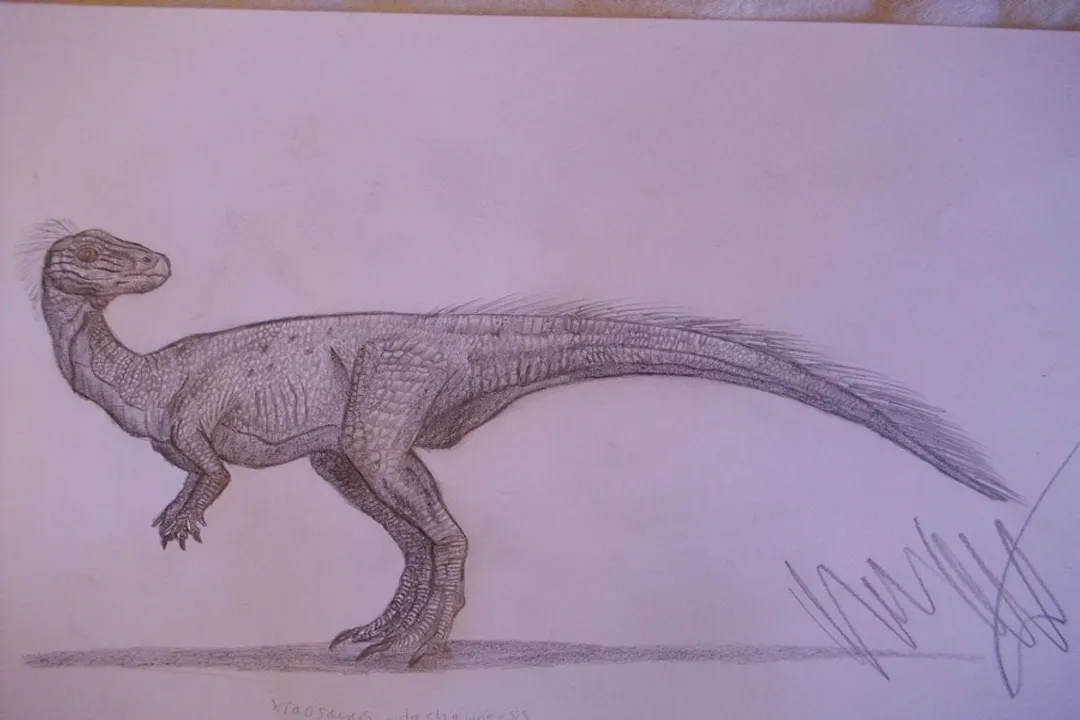
The small dinosaur Xiaosaurus, whose name translates roughly to "Lizard of Xia," represents a significant, if somewhat enigmatic, piece of the early dinosaur puzzle. [3] As one of the earliest recognized members of the Ornithischia—the group known as the bird-hipped dinosaurs—understanding its basic physical makeup provides crucial anchors for tracing the lineage of later, more famous herbivores like Triceratops or Stegosaurus. [3][8][9] However, defining the exact physical characteristics of Xiaosaurus is a challenging task because the knowledge base rests upon relatively limited fossil evidence. [3]
# Discovery Locale
The specimens that allow us to reconstruct this ancient creature were recovered from the famed Lufeng Formation in Yunnan Province, China. [3][6][8][9] This location is renowned for yielding exceptionally well-preserved fossils dating back to the Lower Jurassic period. [3][6] The geological age of Xiaosaurus places it near the very beginning of the Mesozoic Era when dinosaurs were solidifying their ecological dominance. [3] Being situated in the Lufeng fauna means Xiaosaurus shared its world with other contemporary giants and smaller reptiles of that time. [3] The fact that its remains come from this specific, ancient rock layer highlights its role as a primitive example of its later, more diverse clade. [3]
# Size Estimate
One of the most immediate physical attributes readers seek is size, and Xiaosaurus was decidedly small by dinosaurian standards. [3][8] Scientific estimates place the typical length of an adult Xiaosaurus at approximately one meter (about three feet). [3][8][9] While exact mass estimates are rarely provided for such lightly built, early dinosaurs based on fragmentary evidence, its length suggests a relatively slight build, more comparable to a large modern housecat or a small dog than the massive herbivores that would appear later in the Jurassic and Cretaceous periods. [3] Considering that it was an early ornithischian, this modest stature likely reflects an ancestral body plan before specialized defensive structures or immense bulk evolved in its descendants. [3]
# Ornithischian Status
The most scientifically important characteristic of Xiaosaurus is its placement within the dinosaur family tree. [3] It is classified firmly as an Ornithischian, distinguishing it from the Saurischia (lizard-hipped dinosaurs like Brontosaurus or Tyrannosaurus). [3][8][9] Specifically, it is often grouped as an early ornithopod, though its exact position remains somewhat fluid due to the nature of its fossils. [3]
The genus was first formally named and described by the paleontologist Dong Zhiming in 1973. [3][6] Its classification has seen it tentatively assigned to the group Hypsilophodontidae, although this classification sometimes causes taxonomic debate among researchers examining the nuances of its skeletal structure compared to later forms. [3] The critical defining feature that firmly plants it in Ornithischia involves the structure of its pelvis, specifically the orientation of the pubis bone, which points backward, mirroring the configuration seen in modern birds (though this feature evolved independently in birds). [3][8] Examining this foundational hip structure is key to understanding Xiaosaurus as the root of an entire evolutionary branch. [3]
# Known Anatomy
The primary limitation in sketching a precise physical portrait of Xiaosaurus lies in the fossil record itself. [3] The description is based on only two incomplete skeletons recovered from the Lufeng Formation. [3] This means that large portions of the creature's anatomy—such as the exact shape of its head, the length of its tail relative to its body, or the fine details of its teeth—are inferred rather than directly observed from complete structures. [3]
What we do know is that its known elements suggest a creature that was bipedal or facultatively bipedal, capable of walking on two legs, a common trait among early ornithopods. [3] Its limbs were likely slender, supporting its small frame. [3] While specific dental wear patterns or jaw mechanics are difficult to ascertain definitively from the incomplete material, its assignment to the herbivorous Ornithischia strongly implies a diet composed of plants. [3][6] The incompleteness means that any detailed drawing or reconstruction must bridge the gaps using knowledge gleaned from slightly younger, better-preserved relatives. [3]
For comparison, if we consider the known remains of other early ornithischians from the same period, Xiaosaurus might have displayed a relatively long neck and a body shape streamlined for speed rather than defense. [3] The lack of heavy armor or elaborate cranial ornamentation suggests that its primary defense mechanism against contemporaneous carnivores was likely speed and agility, much like its later, smaller relatives. [3]
# Primitive Features
The physical characteristics of Xiaosaurus, as derived from its few bones, speak volumes about the nascent stages of ornithischian evolution. [3] Being a Lower Jurassic inhabitant, its anatomy represents a relatively primitive version of the bird-hipped body plan before many of the defining specializations took hold. [3]
Unlike the armored ankylosaurs with their bony scutes or the later ceratopsians with their massive frills and horns, Xiaosaurus appears physically unassuming. [3] This simplicity is an evolutionary insight in itself: the lineage leading to the great herbivorous tanks began as slight, fast-moving bipeds. [3] The physical structures present, even if incomplete, show the initial blueprint for chewing mechanisms and hindlimb structure that would later be massively exaggerated or modified in its descendants. [3] For instance, the spacing and structure of the pelvic bones lay the foundation for the unique method of gut processing that allowed later ornithischians to digest tough vegetation efficiently. [3] Observing the structure of Xiaosaurus allows scientists to place markers on the timeline: this is what the ancestor looked like just before the major evolutionary arms race between herbivores and carnivores began driving the development of extreme physical traits. [3] The very absence of exaggerated features is its most telling physical characteristic in an evolutionary context.
# Conclusion
While Xiaosaurus will never be as instantly recognizable as Tyrannosaurus or Triceratops, its physical characteristics—defined by its small, one-meter stature and its foundational bird-hipped pelvic structure—make it invaluable. [3][8][9] It serves as a tangible link to the earliest branching points of the Ornithischia, preserved within the ancient sediments of the Lufeng Formation. [3][6] The physical data, even in its fragmentary state, confirms that the earliest members of this major group were generally slight and lightly built, relying perhaps more on quick movement than on heavy bone or horn for survival in the challenging world of the Early Jurassic. [3]
Related Questions
#Citations
Xiaosaurus dashanpensis - A-Z Animals
Xiaosaurus | Dino Wiki - Fandom
Xiaosaurus - Wikipedia
Xiaosaurus - Mindat
Xiaosaurus Pictures & Facts - The Dinosaur Database
Xiaosaurus: Facts, Habitat, Diet & Dinosaur Insights
xiaosaurus - Developmental Commentary - Flickr
Xiaosaurus Facts for Kids
Xiaosaurus - Simple English Wikipedia, the free encyclopedia