Xiaosaurus Locations
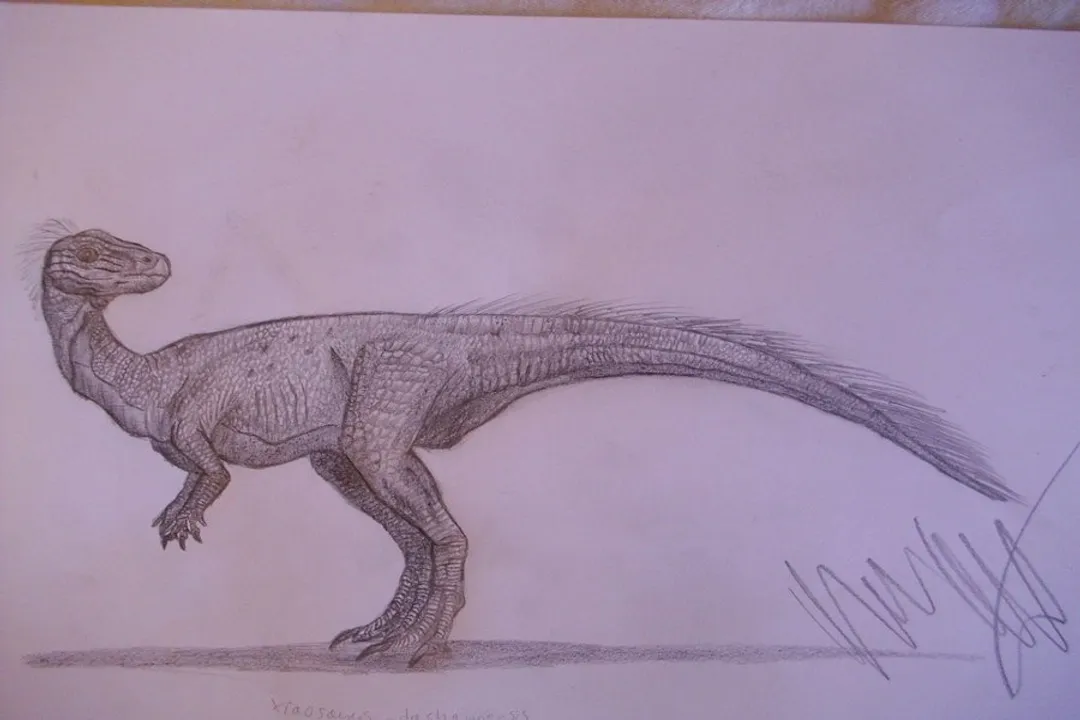
The very ground where Xiaosaurus fossils rest tells a deeper story than just a geological coordinate; it speaks of a dynamic, ancient world within Asia millions of years ago. [2] The primary, most authoritative locations associated with this small, bipedal herbivore point consistently to a specific region in what is now southwestern China. [2][3] This dinosaur, whose name translates to the evocative "Dawn lizard," is firmly anchored in the paleontology of the Sichuan Basin. [1][2]
# China Context
When scientists Dong Zhiming and Tang Zilu formally named Xiaosaurus dashanpensis in 1983, they were naming a creature that roamed this region during the Middle Jurassic period. [1][3] This places its existence roughly between 169 and 163 million years ago, an era when large plant-eaters and various predators shared the landscape across the continent of Asia. [2] The identification of Xiaosaurus helps paint a picture of the smaller fauna existing alongside giants in that ancient Asian setting. [2] While it is categorized as an ornithischian—a member of the "bird-hipped" group of dinosaurs—its importance lies heavily in the stratum from which it was extracted. [1][2]
# Fossil Site
The precise geographical "location" for Xiaosaurus is far more specific than just the province; it is tied directly to the sedimentary layer that preserved the remains. [2][3] The key site belongs to the Xiashaximiao Formation. [1][3] This formation is renowned in paleontology, particularly for yielding a collection of mid-Jurassic vertebrates. [4] The specific areas where the initial excavations occurred were near a place called Dashanpu within the Sichuan region. [2] It was during digs here, in 1979 and 1980, that the two partial specimens—the holotype (IVPP V6730A) and the paratype (IVPP V6730B)—were brought to light. [1][2] The specific epithet of the type species, dashanpensis, directly honors this discovery location, Dashanpu. [1]
This reliance on a single formation for the type species means that any future understanding of Xiaosaurus morphology or ecology is entirely dependent on the conditions preserved within the Xiashaximiao rock record. [3] The geological makeup of this formation is significant; it is characterized by fluvial-lacustrine deposits, meaning the sediment originated from ancient river systems and lakes. [2] This environment implies that Xiaosaurus lived near waterways, suggesting access to lush, riparian vegetation necessary to sustain a small herbivore. [2]
# Dating the Dawn
The very name Xiaosaurus—"Dawn lizard"—was assigned because the fossil represented an early or ancient find within the context of Chinese dinosaur discoveries at the time. [2] However, a closer look at the geological dating presents a slight irony regarding this nomenclature. The Middle Jurassic, when Xiaosaurus lived (around 169–163 mya), is quite far removed from the true "dawn" of the dinosaurs, which began in the Late Triassic. [2] If one were to be pedantic about the term "dawn" in the timeline of dinosaurian dominance, the name feels perhaps more appropriate for a creature existing during that earlier period. [2] The time of its existence, the Middle Jurassic, was already a well-established, flourishing age for dinosaurs. [2] Furthermore, the dating of the specific layer, the lower Xiashaximiao Formation, remains a point of minor scientific discussion, with proposals sometimes spanning from the Bajocian age up to the Bathonian-Callovian boundary, though the Middle Jurassic is the generally accepted bracket. [1]
# The Assemblage Site
One of the most crucial aspects of the Xiaosaurus location is not just where the fossil was, but who it was found with. [4] The Dashanpu digs in Sichuan were exceptionally productive, yielding a community of dinosaurs whose co-occurrence allows paleontologists to reconstruct the local ecosystem with a higher degree of confidence. [4]
When a fossil site preserves multiple species simultaneously, it provides an irreplaceable snapshot of that ancient community structure. For Xiaosaurus, a small, roughly one-meter-long herbivore weighing around 15 pounds, its life was likely spent foraging on low-lying plants. [1][2] Being small made it potential prey for contemporary carnivores. [2] The advantage of the Dashanpu location is that it offers context on the available threats and resources. [4]
Consider the companions found alongside Xiaosaurus in the same geological horizon:
| Associated Genus | Primary Diet Type | Contextual Significance |
|---|---|---|
| Shunosaurus | Herbivore | A larger sauropodomorph sharing the herbivorous niche. [4] |
| Omeisaurus | Herbivore | Another large sauropodomorph, suggesting high primary productivity in the area. [4] |
| Huayangosaurus | Herbivore | A stegosaurian, indicating a diverse array of plant-eaters. [4] |
| Gasosaurus | Carnivore | A potential predator or competitor, defining the trophic level structure. [4] |
| Hexinlusaurus | Herbivore | Another small ornithischian, providing a potential contemporary comparison, although the specific classification linkage (X. multidens) was historically rejected. [1][4] |
This grouping reveals that the Xiashaximiao Formation in Sichuan was not just a random graveyard, but a thriving Middle Jurassic biome populated by both gigantic sauropods and smaller, more agile ornithischians like Xiaosaurus. [4] A paleontological insight emerges here: the recovery of the complete right hindlimb and other well-preserved post-cranial elements (like the humerus) from Xiaosaurus at this specific site suggests that the depositional environment was relatively low-energy once the remains settled, perhaps in a slower-moving part of a river or lake bottom, which aided in the preservation of these lighter, more fragile bones against crushing forces. [1]
# Provincial Differences
While the Sichuan Basin is the undisputed primary location, scientific literature can sometimes mention different, though related, geological areas or even feature discrepancies in reporting, demanding careful comparison. For instance, some sources dealing with dinosaur finds in China might list other provinces, but for Xiaosaurus specifically, the evidence consistently anchors it to Sichuan. [2] This geographical specificity is important because dinosaur populations in the Jurassic were often separated by significant geographical barriers, meaning a fossil found in, say, western Liaoning province (home to later Cretaceous dinosaurs like Dilong) does not necessarily indicate the range of a Middle Jurassic animal found in Sichuan. [2]
If a researcher were attempting to map the distribution of early ornithischians, the Xiaosaurus location serves as a crucial data point for central-western Asia during that time frame. [2] The fact that the remains are considered fragmentary—including only a jaw fragment with one tooth, some vertebrae, and limb bones—highlights the importance of keeping these specific fossils associated with their single, rich locality. [1] A fragmented specimen gains immense value when its precise geological and faunal context, like that provided by Dashanpu, is known. [1][4]
# Paleoecological Mapping
To truly grasp the "location" of Xiaosaurus, one must overlay the known geological facts onto a map of the Middle Jurassic Earth. The environment was warm, without the polar ice caps familiar today, and characterized by dense vegetation such as giant ferns and cycads. [3] The Sichuan Basin, being an intracratonic basin (a large depression within a continent's interior), would have experienced a relatively stable, perhaps humid, climate compared to more arid inland regions. [2]
For a 1-meter-long animal with a beak and leaf-shaped cheek teeth—traits suggesting it cropped vegetation rather than aggressively chewing tough material—this warm, well-watered habitat in the Sichuan Basin was ideal. [2] The location dictates the lifestyle. It was a terrestrial habitat, suggesting Xiaosaurus never ventured into the ancient seas that bordered the landmasses. [2] The fact that it was an ornithopod, a group that would go on to dominate many Late Cretaceous niches, places Xiaosaurus at a significant evolutionary crossroads within its ancient location. [1] It represents an earlier, more basal form thriving in an environment that would later host more specialized relatives. [1]
In thinking about the modern-day implications of this specific ancient location, one can draw a parallel to current ecological preservation. The sheer richness of the Xiashaximiao Formation, responsible for preserving Xiaosaurus and its neighbors, underscores the value of protecting geological sites that hold deep environmental records. [3] Just as understanding the Middle Jurassic flora is crucial to understanding Xiaosaurus's diet, studying modern ecosystems helps us appreciate the delicate balance that allowed this small dinosaur to survive in its specific location millions of years ago. [3]
The documented remains, though incomplete, provide enough detail to place Xiaosaurus not just in China, but in a specific, vibrant, and well-documented Middle Jurassic community of the Sichuan Basin, defined by the geology of the Xiashaximiao Formation near Dashanpu. [1][2][4] This geological tether is the most meaningful information regarding its physical location in prehistory. [3]
Related Questions
#Citations
Xiaosaurus Pictures & Facts - The Dinosaur Database
Xiaosaurus dashanpensis - A-Z Animals
Xiaosaurus - Prehistoric Wildlife
Xiaosaurus Facts For Kids | AstroSafe Search - DIY.ORG
Xiaosaurus - PaleoCodex
Xiaosaurus and other dinosaurs of the Dashanpu digs in China