What are the characteristics of the ivory-billed woodpecker?

The Ivory-billed Woodpecker, Campephilus principalis, presents one of the most compelling and tragic figures in North American ornithology, largely due to its massive size and its current status as possibly extinct. [2][6] This bird was the largest woodpecker in North America, often surpassing even the Pileated Woodpecker in overall bulk and wing span. [1][5][7] Descriptions place its length generally between 16 and 20 inches, with a wingspan that could stretch nearly three feet. [1][2][7] Its sheer scale alone set it apart from nearly all other contemporary cavity-nesting birds in the continent’s forests. [5]
# Giant Proportions

The most striking feature, aside from its size, was its remarkable bill. [1][7] This beak was long—sometimes measuring over two inches—and conspicuously pale, appearing ivory or yellowish in color, which lent the species its common name. [1][2][5][9] Unlike the dark bills of many other large woodpeckers, this feature made the bird instantly identifiable, even from a distance, assuming one could get close enough to see the head details. [7] The body plumage was primarily glossy black, but this dark coloration was dramatically contrasted by large, conspicuous white patches on the wings. [1][2][5][7] These white areas were often described as looking like a white mantle or saddle when the bird was perched, creating a sharp visual contrast against the deep woods habitat it occupied. [1][7]
The sheer mass of the Ivory-bill required a corresponding physical adaptation in its feeding strategy. While smaller woodpeckers chip away at bark to find beetle larvae, the Ivory-bill had the strength to undertake significant structural damage to trees. [2][6] It was known to peel back large sheets or slabs of bark, sometimes removing areas several feet long to expose the tunnels of wood-boring insects beneath. [1][6] This behavior required an extraordinary amount of physical power, suggesting a level of excavation far exceeding that of even the large Pileated Woodpecker, which tends to probe more than strip massive sections of wood. [2] This specialized, powerful feeding habit indicates a unique role in the forest ecosystem, one that likely influenced the decay and structure of old-growth timber stands. [6]
# Crest Marks

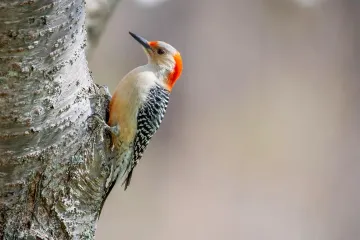
Sexual dimorphism in the Ivory-billed Woodpecker was clearly marked by the coloration of the male's crest. [1][5] Males boasted a spectacular, fan-shaped crest of bright red or crimson that covered the top of their head. [1][5][7] This vibrant feature contrasted sharply with the rest of the mostly black and white body plumage. [7] Females, on the other hand, possessed a crest that was entirely black. [1][5][7] In both sexes, the white wing patches were prominent, often described as being visible on the rump and the lower back as well, adding complexity to their visual signature. [1][7] Furthermore, the eyes were pale, often described as whitish or yellowish, providing another distinguishing characteristic against the dark feathers of the head. [5]

# Specialized Diet

The survival of Campephilus principalis was intrinsically linked to the availability of large, dead or dying trees that harbored its preferred food source. [1][6] Its diet was highly specific, focusing almost entirely on the larvae of large, wood-boring beetles. [2][5][7] This specialization meant that the woodpecker could not easily substitute its diet with smaller insects or nuts, unlike some other species when primary food sources dwindled. [1] The necessity of finding trees in a specific stage of decay—rotten enough to house large grubs but solid enough to support the bird's weight—placed severe constraints on its preferred environment. [6] This reliance on high-quality, old-growth timber for food, rather than just nesting, explains why logging was so devastating to their populations. [1][7] If a region lost its mature bottomland hardwoods, the food supply for a viable Ivory-bill population vanished, regardless of secondary factors.
# Wood Sounds

Beyond its visual characteristics, the vocalizations and drumming habits of the Ivory-billed Woodpecker were notable, though often less frequently recorded or remembered than its appearance. [6][7] Its call was distinctive and unlike many other North American birds. [1] It was frequently characterized as a series of loud, somewhat nasal calls, often transcribed as a "kent-kent-kent" sound, given in groups of two to six notes. [1][6][7] This call served as a territorial marker or contact call across the dense forest canopy. [6] Additionally, the woodpecker produced a deep, resonant drumming sound made by striking wood with its large bill. [6] This drumming, while perhaps not as rapid as some smaller woodpeckers, possessed a distinctive, heavy tone that observers noted carried a long distance through the swampy terrain. [6] These auditory signatures are often cited by those who claim recent sightings as crucial evidence, as visual confirmation remains challenging in deep forest settings. [1][7]
# Lost Territory
The historical range of the Ivory-billed Woodpecker spanned the vast, humid, old-growth bottomland hardwood forests stretching from southern Florida and the Gulf Coast north along the Mississippi River valley and into the Carolinas. [1][2][6][8] This immense territory was characterized by cypress swamps and mature deciduous forests. [1][7] The bird was once relatively common across this expanse in the early 19th century, but its fortunes turned rapidly with the expansion of logging. [2][7] Extensive deforestation, particularly the removal of large, old trees necessary for both food and nesting cavities, fragmented and eliminated their habitat. [1][6] Because they require significant tracts of undisturbed, mature forest, they were particularly vulnerable to clear-cutting practices that swept the South in the late 1800s and early 1900s. [7]
| State/Region | Historical Density | Primary Habitat Type |
|---|---|---|
| Southeastern US | Relatively common pre-1900 | Virgin bottomland hardwoods, swamps [1][2][7] |
| Mississippi River Valley | Significant populations | Mature deciduous forests [6][8] |
| Carolinas/Florida | Fragmented populations | Deep, undisturbed swamps [1][7] |
# Modern Searches
The primary characteristic now associated with the Ivory-billed Woodpecker is its contested status. The species has not been definitively documented by the scientific community for many decades, leading to its listing by the U.S. Fish and Wildlife Service as Critically Endangered and presumed extinct. [3][6] Despite numerous expeditions since the 1940s into potential remaining strongholds, conclusive photographic or physical evidence of its continued existence has remained elusive. [3] The U.S. Fish and Wildlife Service officially proposed removing the bird from the Endangered Species List in 2021 due to a lack of evidence confirming its survival, though this decision is subject to review and public comment. [3] The difficulty in finding this bird highlights a conservation paradox: the habitat it needs—vast, mature, structurally complex swamp forest—is itself one of the most threatened ecosystems in the United States. [6][8] Any modern sighting, therefore, must occur within the few remaining patches of truly primeval forest that escaped industrial logging, often requiring researchers to employ methods like acoustic monitoring alongside traditional field surveys to cover the large, remote areas where they might persist. [1][7] The enduring mystery ensures that the search for the "Lord God Bird," as it was sometimes called, remains a powerful symbol of wilderness loss and the enduring hope for discovery. [6]
Related Questions
#Citations
Ivory-billed Woodpecker - All About Birds
Ivory-billed woodpecker - Wikipedia
Ivory-billed Woodpecker (Campephilus principalis)
Ivory-billed Woodpecker Characteristics and Rediscovery - Facebook
Campephilus principalis (ivory-billed woodpecker) | INFORMATION
Ivory-Billed Woodpecker | National Geographic
Ivory-billed Woodpeckers in the Florida Panhandle - Auburn University
Campephilus principalis - Georgia Biodiversity Portal
Ivory-billed woodpecker - Campephilus principalis - A-Z Animals