Why is it called a bamboo shark?

The slender profile of certain bottom-dwelling sharks often sparks curiosity, leading many to wonder exactly how they acquired the descriptive moniker of the "bamboo shark." These creatures, which bear little resemblance to the stereotypical, large, fast-swimming pelagic sharks, are named not for their diet or habitat in a bamboo forest, but for their physical characteristics, particularly their elongated, relatively thin bodies reminiscent of bamboo stalks or culms. [1][2]
This group of sharks belongs to the family Hemiscylliidae, [3] a classification shared by several species often found in the warmer waters of the Indo-Pacific region. [6][7] While the term "bamboo shark" can sometimes be used broadly, it most often refers to species like the White-spotted Bamboo Shark (Chiloscyllium plagiosum), a popular resident in public aquariums due to its manageable size and docile nature. [4][8] Understanding why they are named this way requires looking closely at their morphology, which sets them apart from many other members of the shark world. [5]
# Slender Form

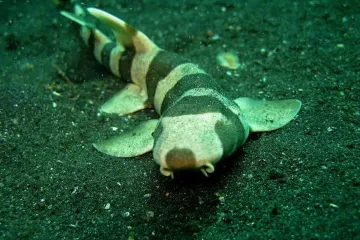
The most direct reason for the naming convention lies in their body shape. Unlike the robust, torpedo-like build of a Great White or a Mako, bamboo sharks are notably long and thin. [7] When viewed from above or the side, their bodies possess a distinct elongation. Think of the thick, segmented stalks of bamboo—these sharks share that extended length relative to their girth. [1]
This physical trait is an adaptation perfectly suited to their lifestyle. Bamboo sharks are primarily benthic, meaning they spend the vast majority of their lives on or near the ocean floor, often navigating complex reef structures, sandy bottoms, or rocky crevices. [4][7] A slender body allows them to slip into tighter spaces that larger, bulkier sharks cannot access, which is essential for hunting small invertebrates or resting safely during the day. [8]
To put this comparative size into perspective, one can observe the difference in scale. A mature White-spotted Bamboo Shark typically reaches lengths around 90 centimeters (about 3 feet), [4][8] though some related species can reach up to 1.2 meters. [7] Contrast this with an average adult Tiger Shark, which can easily exceed 4 meters. The difference in body proportions—length versus depth—is what solidifies the "bamboo" connection in observers' minds.
| Feature | Bamboo Shark (Approx. Adult) | Large Reef Shark (e.g., Nurse Shark) |
|---|---|---|
| Typical Length | 0.75 to 1.2 meters [7] | 2.5 to 4.3 meters [5] |
| Body Profile | Elongated, cylindrical, slender [1][7] | Robust, broad, powerful |
| Primary Habitat | Benthic (Seafloor) [4][7] | Benthic/Demersal to Midwater |
| Locomotion Specialty | "Walking" on fins [6] | Swimming via caudal fin |
The relatively small size combined with this elongated profile creates an immediate visual association with thin, stick-like objects found in tropical environments, such as bamboo. [1]
# Specialized Movement
While the name refers to their shape, the family they belong to, Hemiscylliidae, is often associated with another remarkable behavior that further separates them from typical sharks: their method of locomotion. [3] Certain species are frequently dubbed "walking sharks" because of how they utilize their pectoral and pelvic fins. [6]
When exploring very shallow water, tide pools, or when attempting to cross small patches of dry sand or rock between pools, bamboo sharks can support their body weight on these modified, muscular fins. [6] They move forward in a clumsy but effective sort of push-up motion. [6] This ability to literally haul themselves across the substrate is unique among many shark groups and showcases an incredible evolutionary divergence toward a life spent primarily on the bottom rather than continuously swimming in the water column. [8] This adaptation for terrestrial or near-terrestrial movement in an intertidal zone requires a body structure that can be easily maneuvered in tight spaces, which the slender, bamboo-like form facilitates. [1]
# Family Identity
The Hemiscylliidae family groups together these small, bottom-dwelling sharks, including the bamboo sharks and the closely related epaulette sharks. [3] Recognizing that "bamboo shark" is a common name grouping several species within this specific taxonomic family helps explain the consistency in their defining features, such as the slender build and often distinct, spotty, or banded patterns. [4][7]
Within the family, coloration plays a significant role in species identification, even if it doesn't explain the primary group name. For example, the common White-spotted Bamboo Shark is covered in dark spots over a lighter background, which can sometimes look like markings on a piece of aged wood, though the primary naming convention remains the overall body silhouette. [4][8] It is important to note that the name itself is an informal descriptor used by fishkeepers, divers, and researchers for ease of reference, rather than a formal Latin designation. [5]
When browsing different resources describing these sharks, one finds consistent notes about their gentle temperament. [8] Their small size and lack of aggression toward humans make them highly visible in environments where people observe them closely, such as shallow reefs or aquarium displays, thus increasing public familiarity with the name "bamboo shark". [2] Unlike many open-ocean sharks whose primary survival strategy revolves around speed and power, the bamboo shark relies on stealth, camouflage, and specialized ground mobility. [6] This behavioral difference stems directly from their morphology—a shape that is excellent for crawling but inefficient for sustained, high-speed swimming. [5]
# Habitat Naming Influence
Although the name is not derived from where they live, their preferred environment strongly supports the suitability of the name. Bamboo sharks inhabit tropical and subtropical waters, generally found in the Western Pacific and Indian Oceans. [7] They thrive on shallow coastal reefs, rocky areas, and seagrass beds. [4] In these complex, shadowed environments, being long and narrow is advantageous. A thick shark would constantly get snagged or struggle to access food sequestered beneath overhangs or within small coral heads. [3]
Considering the environmental context further, one can appreciate the functional advantage of their build. Reef ecosystems are inherently three-dimensional and often crowded. If you were to try and navigate a dense thicket of branching coral using a wide, flat body versus a narrow, elongated one, the latter would prove far more efficient at avoiding entanglement and maximizing foraging opportunities. The "bamboo" shape is, therefore, an effective evolutionary solution for a life lived in the structure of the reef, rather than just over it. [1][7]
# Final Thoughts on Identification
To solidify the concept, remember that while many small sharks exist, the combination of being benthic, relatively small, and possessing that characteristic long, thin body structure—often coupled with the unique ability to move short distances via fin-walking—points directly to the bamboo shark grouping. [6][8] The name is a simple, accessible label based on the most immediate visual cue available to human observers, much like calling a specific type of crab a "spider crab" because of its long legs, even if it isn't an arachnid. [1] Recognizing these visual cues ensures accurate identification when encountering them in the wild or in dedicated marine exhibits. [2][4]
Related Questions
#Citations
Bamboo Shark - "OCEAN TREASURES" Memorial Library
Facts About Bamboo Sharks | SEA LIFE Orlando Aquarium
Hemiscylliidae - Wikipedia
Whitespotted Bambooshark - Florida Museum of Natural History
What species of shark is in the photo? - Facebook
And that is why they are called “Walking Sharks”. An Epaulette shark ...
Bamboo Shark: Habitat, Diet, and Fascinating Facts
Bamboo Sharks | Saint Louis Zoo