Whooping Crane Physical Characteristics
The Whooping Crane, scientifically known as Grus americana, cuts an unmistakable figure against any landscape, embodying grace and immense fragility as one of North America's rarest avian inhabitants. [4][9] To truly appreciate the efforts dedicated to its survival, one must first look closely at its physical structure—a study in stark white contrast and imposing height. [3][4] This bird is not merely large; it is a giant among its North American peers. [3][8]
# Stature Height
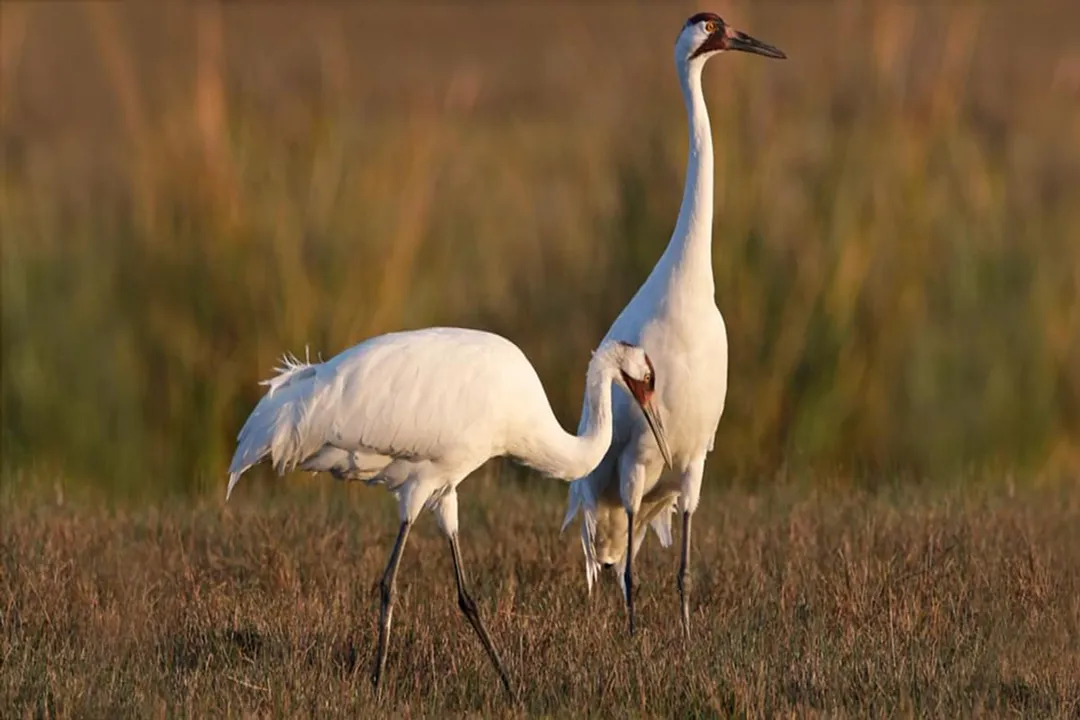
The defining feature that immediately sets the Whooping Crane apart is its sheer vertical presence. It holds the undisputed title of the tallest bird in North America. [2][3][5][7][8] An adult bird, standing erect, measures approximately five feet in height. [1][2][3][5][7] Depending on the measurement source and the individual bird's posture, figures range from $1.24$ to $1.6$ meters, or up to $5$ feet $3$ inches. [8] The body structure contributes to this stature; they are tall, white birds characterized by long necks and equally long legs. [4] When considering this imposing height, it is remarkable that despite towering near the height of many humans, their weight is relatively modest, averaging around $15$ pounds. [3][4] Some averages suggest males tip the scale around $16$ pounds, while females are slightly lighter at about $14$ pounds. [4][8] The overall range documented for adult weight is between $13.2$ and $17.2$ pounds. [4] This combination of great height and moderate weight allows for the elegant flight they are known for. [3][9]
# Plumage Color
Adult Whooping Cranes are predominantly covered in snowy white plumage. [4][5][7] This brilliant whiteness is the source of its common name, although the bird possesses several crucial, non-white markings that aid in identification, especially when viewed from a distance or among similar species. [9]
The exceptions to the clean white canvas are concentrated on the extremities and head:
- Wing Tips: The primary flight feathers—the largest feathers on the outer wing—are black. [2][4][5][8] Crucially, when the crane's wings are folded, these black tips are often hidden, which can sometimes make identification tricky if the bird is only seen stationary on the ground. [4]
- Alula: The specialized feathers attached to the upper leading edge of the wing, known as the alula, can also be black or grayish. [4]
- Nape: A distinctive dark gray-black, wedge-shaped patch is sometimes present on the nape, or the back of the neck. [4][7]
A fascinating structural feature relating to their plumage is the trachea; the bird's windpipe measures about $5$ feet in length, coiling into the sternum, which is what enables its loud, bugling call to carry great distances across the marsh. [9]
# Distinctive Head
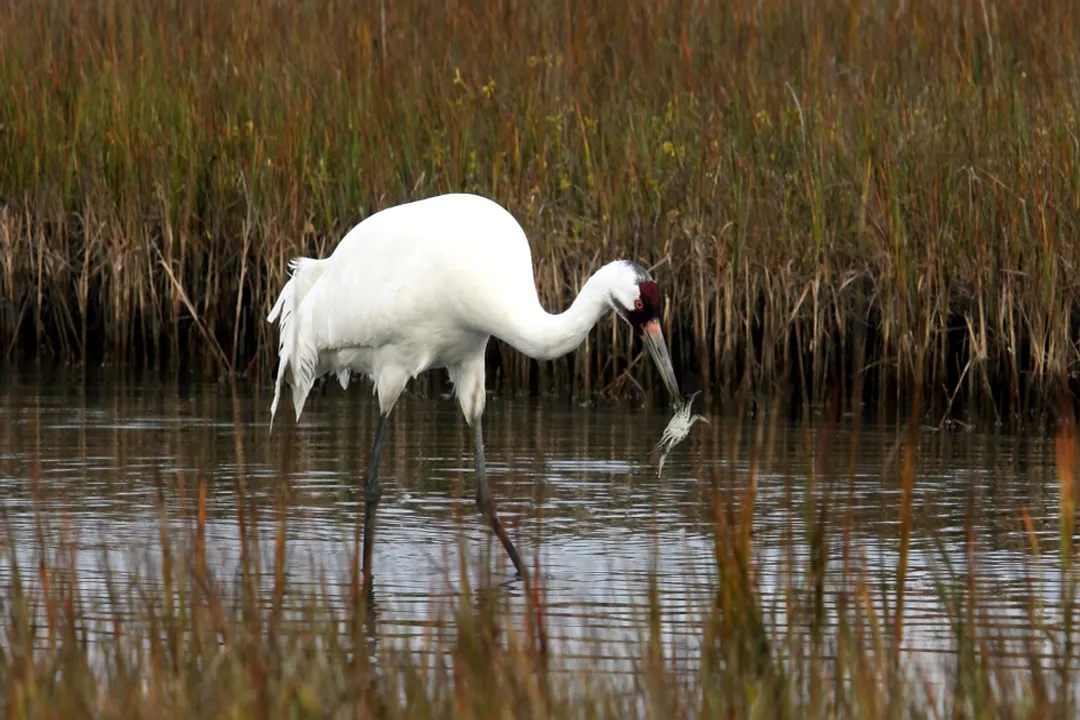
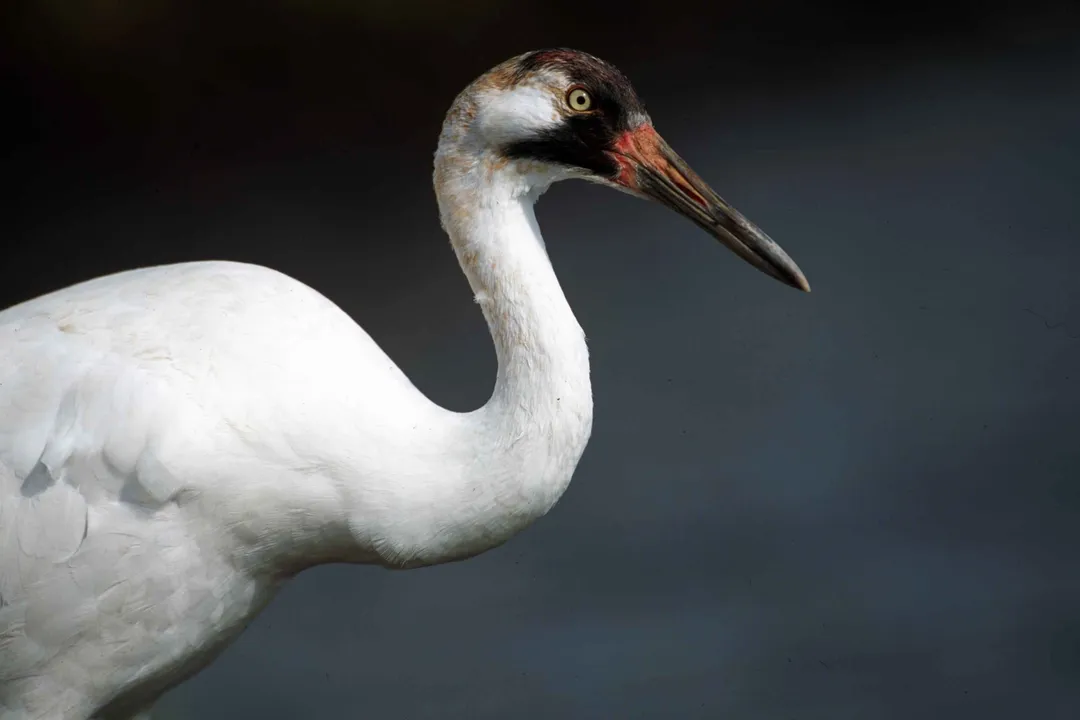
The head of the adult crane features some of the most essential field identification markers. The most striking feature is a large, featherless patch of skin on the crown, described as a vivid crimson color. [1][2][3][4] This red cap is bare or sparsely covered with black, bristly feathers. [3][4] Furthermore, the side of the head, extending from the bill to the angle of the jaw (the malar region), also features sparse black bristly feathers, often described as a black mustache-like face mask. [1][3]
The eye coloration also shifts with age. Newly hatched chicks have a blue iris, which gradually transitions to gray before finally becoming yellow by the end of their first year. [4][7]
It is useful for observers to note that the bill color can change slightly depending on the season. During the breeding season, the bill is a lighter olive-gray, but outside of the breeding season, it is a darker olive-gray. [4] The base of the bill often shows a touch of pink or rosaceous color. [4] The bill itself is characterized as stout and straight. [4]
If one were trying to differentiate a Whooping Crane from a Great Egret, which is also white, the stark difference in size—the Egret being over a foot shorter and possessing only about one-seventh of the crane's weight—is significant. [8] Even larger Sandhill Cranes are clearly distinguished by their gray coloration, contrasting sharply with the Whooping Crane's predominantly white body. [8][9] The way an adult Whooping Crane holds its long neck straight out while in flight offers another structural clue, distinguishing it from species like herons and storks which have different body structures. [4][8]
# Bill Legs
The crane's lower appendages are long, matching its overall vertical structure. [3][4] The legs and feet are generally described as gray-black [4] or simply black. [3][7] The bill is dark olive-gray, stout, and straight. [2][4] While the bill averages about $11.7$ to $16$ cm in length, it serves a probing function as the bird forages in shallow water and fields. [8][4]
If you find yourself observing a flock in the Central Texas wintering grounds, remember that their primary diet there consists of blue crabs and clams. [5][6] It is noteworthy that while the bird is tall and its leg length is substantial, their primary winter feeding strategy involves probing the soft mud and salt flats for these crustaceans, meaning the long legs are just as essential for wading as they are for terrestrial movement. [5][6] This adaptation to both shallow aquatic foraging and field-walking underscores the physical capability afforded by their long limbs.
# Juvenile Look
The appearance of a young Whooping Crane offers a stark contrast to the brilliant white adult. Upon hatching, the chick is often described as cinnamon brown or rusty-colored. [2][5][8] Their plumage is mottled as the bases of their future white feathers begin to extend beneath the initial brown coat. [2]
The transformation is gradual:
- White feathers start appearing on the neck and back around $120$ days of age. [4]
- By the end of their first migration, the bird is a mixture of brown and white. [5]
- As they approach their first spring, the plumage becomes predominantly white, though rusty juvenile feathers may still remain on the head, upper neck, secondary wing coverts, and scapulars. [4]
- Yearlings typically achieve their full adult plumage late in their second summer. [4]
The iris starts blue in the hatchling, changes to gray in chicks, and finally settles into the adult yellow by the conclusion of the first year. [4] These young birds are generally raised by their parents throughout the first year, including the journey back to the wintering grounds. [3][5]
# Flight Form
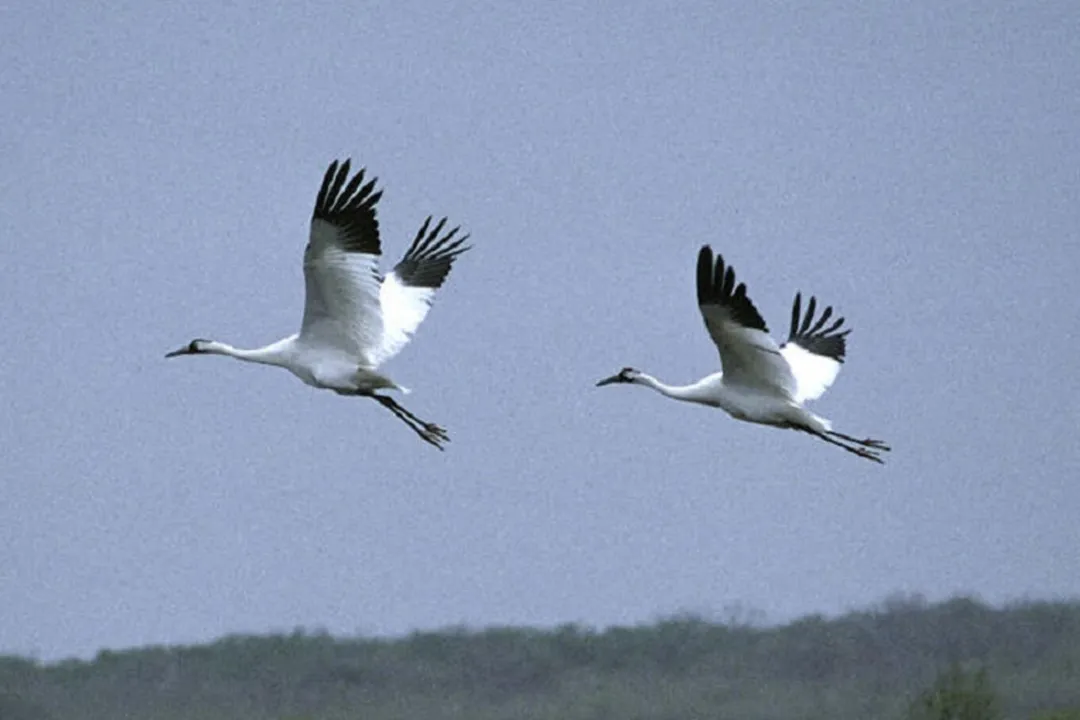
When airborne, the Whooping Crane presents a streamlined silhouette. Their wings are broad, [4] and the neck is held fully extended forward. [4][8] It is during flight that the black primary feathers on the wing tips become highly visible, providing a key identification marker against a white body. [4][5] Their wingspan is expansive, often exceeding $7$ feet, with measurements reported up to $7$ feet $7$ inches. [3][4][8] This large wingspan, combined with their height, makes them truly majestic flyers. [9] Interestingly, these elegant flyers are skilled at using thermal gusts, allowing them to ride the wind for significant distances without needing to flap, a behavior that conserves energy during their long migrations. [3] The species is also noted to be monomorphic, meaning the sexes look alike in terms of plumage and size, though males tend to be slightly heavier on average. [4][8]
Related Questions
#Citations
Whooping Crane Overview, All About Birds, Cornell Lab of Ornithology
Whooping Crane | National Wildlife Federation
Whooping Crane (Grus americana) | U.S. Fish & Wildlife Service
Whooping Crane | Louisiana Department of Wildlife and Fisheries
Whooping Crane (Grus americana) - Texas Parks and Wildlife
Whooping Crane - Guadalupe-Blanco River Authority
Whooping Crane - Colorado Parks and Wildlife
Whooping crane - Wikipedia
Whooping Crane - Southern Wisconsin Bird Alliance