White-Crowned Sparrow Facts
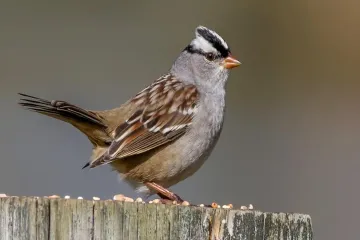
The White-crowned Sparrow is a familiar sight across much of North America, instantly recognizable by the bold, high-contrast black and white stripes running down its head, a pattern that gives the bird its common name. [1][4] While it shares the Zonotrichia genus with the equally common White-throated Sparrow, the White-crowned bird lacks the white throat patch, instead presenting a more generally gray or buff-colored breast depending on the subspecies and age. [2][5] These are medium-sized sparrows, somewhat larger than a House Sparrow, usually measuring around 7 to 7.5 inches in length. [1][9] They possess a relatively thick, conical bill, perfect for cracking seeds, and their overall plumage is a mix of gray, brown, and white, with streaks on the back and wings. [4][5]
# Crown Stripes
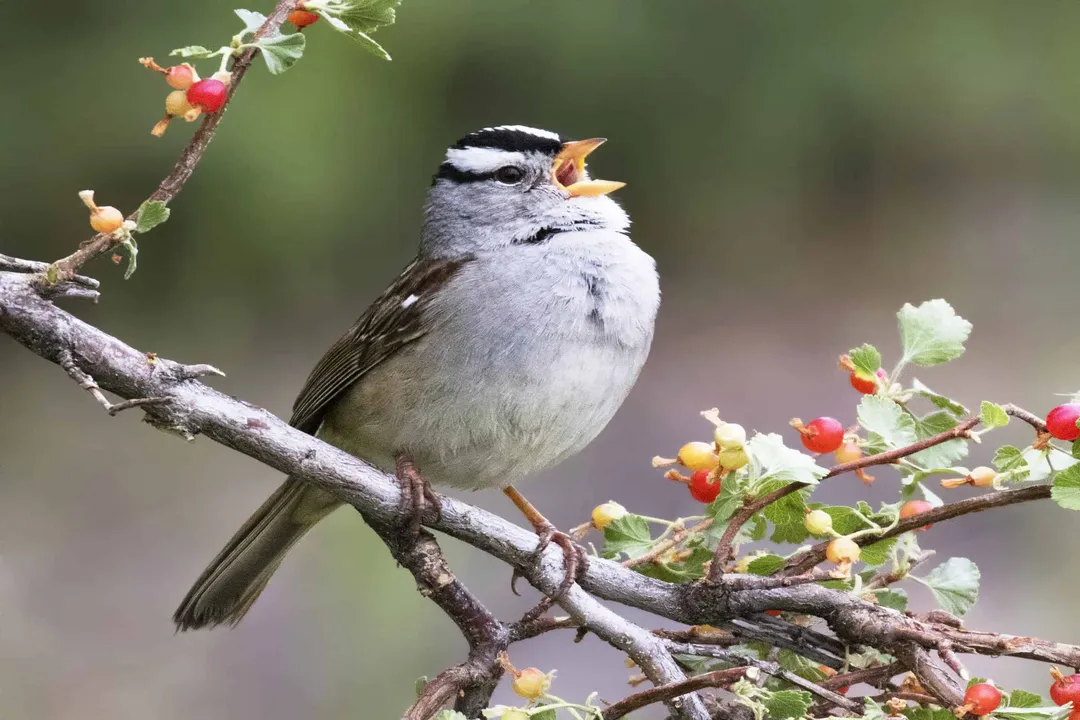
The definitive field mark, the crown, shows variation that can be key to identification and understanding its biology. Adult birds are marked with five black stripes separated by four white stripes running from the bill to the back of the head. [1][5] The central white stripe is often the widest, flanked by narrower white stripes. [2] However, this striking pattern is not static across the species’ entire range. The appearance of the crown changes significantly depending on which of the five recognized subspecies one observes. [2][10]
# Subspecies Markings
The variation in crown striping across subspecies offers a fascinating look at regional differentiation within a single species. For example, birds found in the West, often designated as the Z. l. oriantha or Nuttall’s subspecies, frequently exhibit a much duller or buffier crown, where the white stripes appear tinged with yellowish or grayish color, contrasting less sharply with the black stripes than those seen farther east. [2] In contrast, the nominate subspecies, Z. l. leucophrys, common in the northern interior and eastern parts of the breeding range, typically displays the starkest black-and-white contrast. [2] This visual difference is important because it means relying solely on the "white-crowned" description might mislead a novice observer looking at a Western bird in winter plumage, highlighting the value of noting the bill color and overall gray wash as well. [4]
# Identification Details
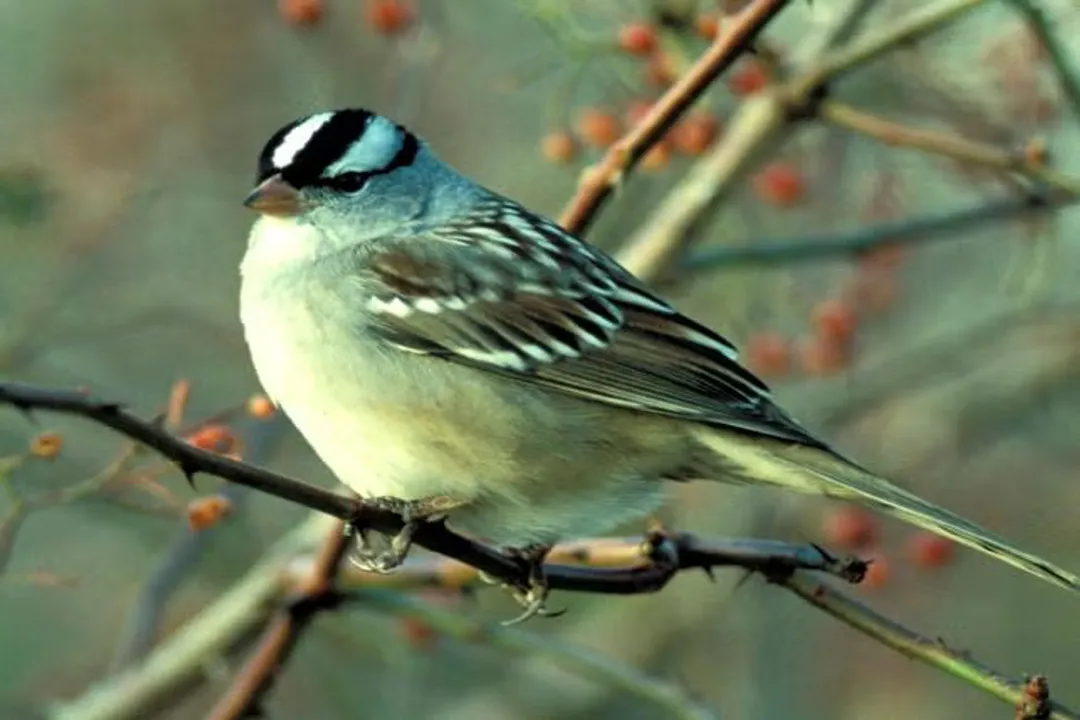
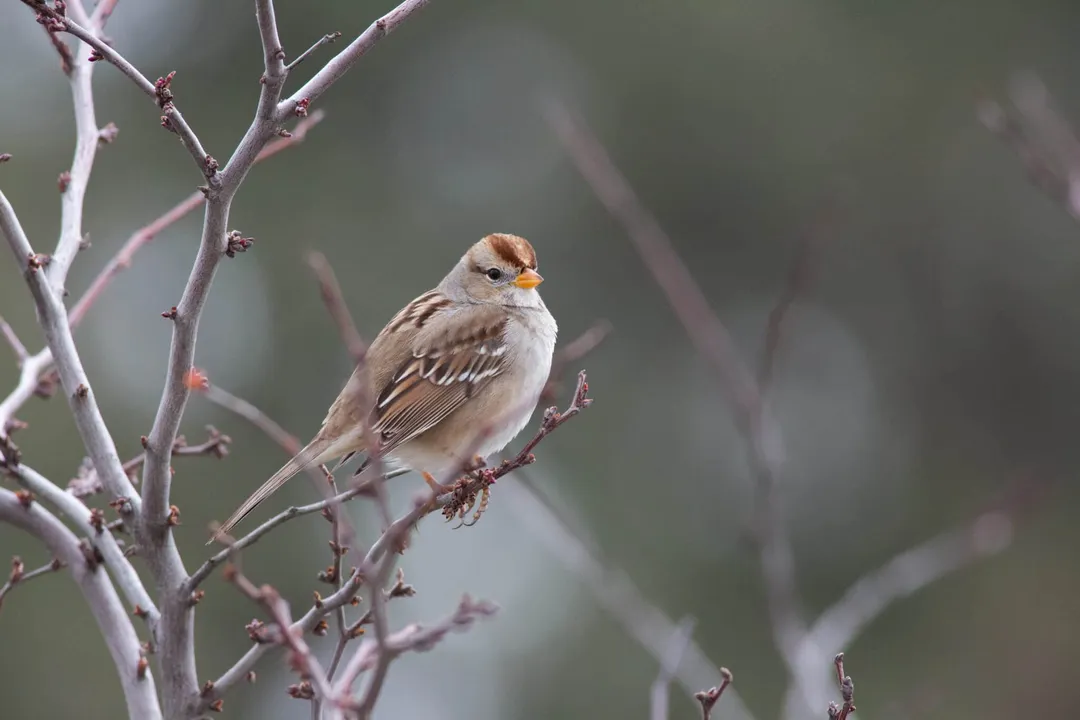
Beyond the crown, other features help separate the White-crowned Sparrow from its relatives, particularly when viewing birds in mixed winter flocks. [4] Adults typically have gray underparts that wash into a paler white on the belly. [9] Their backs and wings are streaked brown and black. [4] The legs and feet are usually pale, often pinkish or flesh-colored, which can contrast with the darker legs of some other sparrows. [5][7] Immature birds are easily distinguished; their crowns are brownish or buffy, featuring dark brown stripes separated by buff or pale grayish-white stripes, lacking the sharp definition of the adults. [1][5] A helpful, non-plumage field mark for experienced observers, particularly when comparing it to the White-throated Sparrow, is the bill color: White-crowned Sparrows usually have a relatively pale bill, often pinkish or yellowish, whereas White-throated Sparrows tend to have a darker, grayish bill. [4]

# Where They Live
The White-crowned Sparrow is an extensive North American resident, though its location shifts dramatically between seasons. [1] They are considered migrants in many areas, though some populations are year-round residents where conditions permit. [10]
# Breeding Grounds
During the breeding season, these sparrows prefer open, shrubby habitats. [1] This includes thickets, brushy streamsides, and the edges of forests. [9] They are common in the brushy understory of coniferous or mixed forests, often near clearings. [4] In the north, their breeding range extends across the boreal forests of Canada and Alaska. [1] In the western United States, they can breed in higher elevation shrub zones, such as sagebrush country or chaparral, especially in mountainous areas. [2]
# Wintering Areas
When the cold hits, they move south, becoming numerous across the southern United States, Mexico, and even into parts of Central America. [1][9] In the non-breeding season, their habitat preferences shift slightly; they become closely associated with human habitation and disturbed areas. [4] You will frequently find them foraging in suburban backyards, parks, weedy fields, and along roadsides where vegetation offers cover. [1][3] An actionable observation for birders: While breeding birds prefer the density of natural shrubbery, wintering birds often frequent the cover offered by dense ornamental bushes near buildings, making them reliable visitors to feeders surrounded by protective cover during cold snaps. [3]
# Soundscape
The songs of the White-crowned Sparrow are quite variable, leading to numerous regional dialects across the species' vast range. [2] The song is often described as a series of clear, loud, sweet, whistled notes, usually delivered in two or three parts. [7] A common rendering is often transcribed as something like “oh sweet sweet study study to be” or “o-wee-o-weep-o-weep-o-wee”. [1][2] The quality can sometimes be described as somewhat slurred or mournful, but the clarity of the whistles is its defining characteristic. [7]
The most common calls are a sharp, metallic “tsink” or a softer “chip” note. [1][5] The “tsink” call is particularly useful for identifying their presence when the bird is hidden in dense brush, as it carries well, even when the bird is not singing its full song. [7] Older individuals often have more complex songs than first-year birds. [2]

# Feeding Habits
White-crowned Sparrows are ground-foraging birds, spending significant time scratching and hopping through leaf litter and low vegetation to find food. [8] Their diet is heavily influenced by the season and location. [9]
# Seasonal Diet Shifts
In the warmer months, particularly during the breeding season, their diet includes a substantial amount of protein derived from insects and arthropods. [9] They consume grasshoppers, caterpillars, beetles, and spiders. [4][8] This insect-rich diet is crucial for feeding developing nestlings. [8]
As fall approaches and they move into wintering territories, their diet pivots heavily toward seeds and grains. [9][4] They consume the seeds of weeds, grasses, and leftover agricultural grains. [1][8] This dietary switch is vital for building up fat reserves needed for migration or surviving colder winter temperatures. [9] They are known visitors to backyard feeders, especially in winter, readily taking cracked corn, millet, and sunflower chips, often preferring the lower trays or the ground beneath the feeders. [3] An interesting point of comparison: While the White-throated Sparrow often forages slightly higher in the brush, the White-crowned Sparrow is more inclined to stay on the ground or very low vegetation, making a visual sweep of the ground beneath shrubs a better strategy for locating them in winter. [4]
# Reproduction and Lifespan
The reproductive schedule varies based on latitude; birds farther north generally begin nesting later in the summer. [2] The nest is typically built low to the ground in dense shrubs, thick grass clumps, or in low branches, constructed by the female using grasses, weeds, and sometimes lined with finer materials like hair or feathers. [1][9] They usually lay clutches of three to five eggs, which are pale white or bluish-white, marked with brown or reddish-brown speckles. [9][4] Incubation is performed primarily by the female and lasts about 11 to 13 days. [2] Both parents share the duties of feeding the young once they hatch. [8] Young birds fledge around 9 to 11 days after hatching. [2] These sparrows can live for several years; longevity records indicate they can survive for over 15 years in the wild, though the average lifespan is significantly shorter due to predation and other mortality factors. [2]
# Migration Patterns
Migration is a significant feature of the life cycle for many White-crowned Sparrow populations. [1] They are diurnal migrants, meaning they fly during the day, which sets them apart from many other sparrow species that prefer nocturnal migration. [2][10] This daytime movement means that birders might observe flocks moving through during daylight hours, especially during peak migration periods in spring and fall. [2] The timing is flexible; in the northernmost breeding areas, migration north might begin as late as May, while southern wintering birds start heading back toward the northern US/Canada in February or March. [1] The difference in migration strategy—daytime versus nighttime flight—is a notable behavioral distinction within North American sparrows, potentially influenced by the species’ more open habitat preferences during flight compared to denser woodland migrants. [2]
# Longevity and Survival
While the potential lifespan of over fifteen years is remarkable for a small songbird, the survival challenge is constant. [2] Mortality rates are highest in the first year of life, as is typical for most passerines. [8] Predation pressure comes from various sources, including domestic cats, snakes, and raptors like Sharp-shinned Hawks. [8] The fact that they frequently winter in dense cover, often close to human development, may offer some protection from certain aerial predators, though it increases exposure to mammalian threats. [4] Studying these birds, particularly through banding efforts, reveals that while juvenile survival is low, adults that survive their first year have a decent chance of living several subsequent years. [2]
# Foraging Styles
Observing how they forage can reveal a lot about their adaptation to different environments. They are categorized as ground foragers, constantly shuffling through leaf litter. [8] They use a characteristic two-footed hop to scratch backward, kicking debris away to expose seeds or insects underneath. [4] This backward kick is a highly efficient, characteristic motion shared by other ground-feeding sparrows in the Passerellidae family. [8] When seeds are scarce, they will occasionally glean insects from low foliage or perch on low branches to look for food, but the ground remains their primary feeding location. [4] This dedication to ground feeding dictates where they prefer to winter; areas with easily accessible ground cover and available seeds are key attractants in colder months. [9]
Related Questions
#Citations
White-crowned Sparrow - All About Birds
White-crowned sparrow - Wikipedia
Fun Facts About White-crowned Sparrows - Wild Birds Unlimited
White-crowned Sparrow | Audubon Field Guide
Fun Facts about the White-Crowned Sparrow! - iNaturalist
White-crowned Sparrow - Zonotrichia leucophrys - NatureWorks
Zonotrichia leucophrys (white-crowned sparrow) | INFORMATION
White-Crowned Sparrow - Missouri Department of Conservation
White-Crowned Sparrow - Zonotrichia leucophrys - A-Z Animals