Where does the spotted snake live?

The term "spotted snake" rarely points to a single species; rather, it serves as a common, descriptive shorthand for several visually similar reptiles found across the globe, each occupying vastly different ecological niches. To truly understand where a spotted snake lives, one must first identify which one is being discussed, as they hail from North America, Africa, and Australia. The habitat these snakes seek out is intrinsically linked to their climate, diet, and need for security, whether that security is found under desert gravel or within the eaves of a human dwelling.
# Speckled Home

The Speckled Kingsnake (Lampropeltis holbrooki), a species endemic to the United States, is one of the most frequently encountered snakes bearing this pattern. Its range is extensive, covering areas from southern Iowa down to the Gulf of Mexico. Within this wide distribution, which includes Oklahoma and Missouri, the snake shows remarkable adaptability regarding its immediate surroundings.
# Varied Terrain
The Speckled Kingsnake does not restrict itself to one type of environment; instead, it thrives across a wide variety of habitats. These snakes can be found in open prairies and near the streams that traverse them, suggesting a tolerance for both dry, open ground and proximity to water sources. Brushy areas and the edges where forests transition into old farm fields are also common settings. Further supporting its diverse preferences, it inhabits rocky, wooded hillsides, but will also venture to the borders of swamps and marshes. In Missouri, for instance, a common local setting is the rocky, wooded hillside that also features some clearings. This snake’s ground color is dark brown or black, overlaid with small yellow or white specks, one centered on nearly every dorsal scale, giving it the "salt-and-pepper" look.
# Seeking Cover
Regardless of the specific biome—be it prairie or woodland—the need for cover is universal for this nonvenomous reptile. Speckled Kingsnakes are characteristically secretive. During their active seasons, which span from April through October, they rely heavily on finding secure hiding spots. Surface activity is often diurnal (daytime) in the cooler spring and autumn months, but they switch to nocturnal activity during the heat of the summer to avoid high temperatures.
Underneath the surface, their retreats include under flat rocks, beneath logs, inside rotten stumps, and, importantly, within small mammal burrows, moles’ burrows in particular. A fascinating adaptation noted in northern Missouri is their use of crayfish burrows as retreats during both summer activity and winter dormancy. This reliance on underground shelter highlights a key ecological connection: the health of the local crayfish population directly supports the availability of safe retreats for the kingsnake in those dry upland prairies. When winter arrives, these snakes enter dormancy underground, utilizing rock crevices, hollow logs and stumps, sawdust piles, and even the foundations of abandoned buildings, with caves being a rare but recorded option for overwintering.
If you are monitoring local wildlife in the central and southern US, observing this species requires adapting to its schedule. In the spring and fall, look for them moving during the day, often hiding under surface objects like boards or pieces of tin to absorb residual heat. If you are driving roads early in the evening or after dark during the summer months, you might spot them out hunting or warming up on the asphalt, as they frequently use roads for thermal regulation.
# African Vantage Point

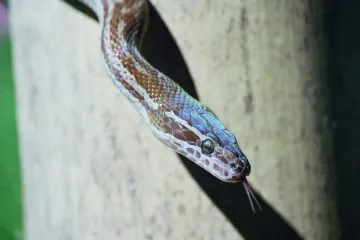
Moving across the globe to Southern Africa, the term "spotted snake" often refers to the Spotted Bush Snake (Philothamnus semivariegatus), which is entirely harmless. Its habitat choices differ significantly from its North American counterpart, favoring vertical structures and proximity to easy prey like geckos.
# Building Dwellers
Unlike the subterranean tendencies of the kingsnake, the Spotted Bush Snake is an alert, day-active serpent that demonstrates excellent climbing ability. This arboreal skill is aided by keeled belly scales, which allow it to grip surfaces like tree bark or even face-brick walls. This climbing proficiency dictates where they are often found: frequently positioned between the walls and ceilings of outbuildings, where they actively hunt their preferred food source, geckos. This species is also commonly present in suburban gardens, a location where its juveniles are often preyed upon by domestic cats.
# Desert Seclusion
In the arid landscapes of the southwestern United States—specifically areas like Arizona (AZ), California (CA), Nevada (NV), and Utah (UT)—a different reptile fits the description: the Spotted Leaf-nosed Snake (Phyllorhynchus decurtatus). This small, nonvenomous snake has adapted a life dictated by sand, rock, and darkness.
# Subterranean Nights
The defining feature of this snake's habitat is the substrate: it burrows in coarse sand, gravel, and rocky desert or brushland soils. As a strictly nocturnal creature, it spends the daylight hours hidden beneath the surface, emerging only when conditions are right for hunting or movement. Its surface activity peaks on warm, humid nights, or when rain falls, as these conditions might encourage its specialized prey—lizard eggs, and potentially just the eggs of banded geckos—to become more accessible. The specialized, enlarged rostral scale (the scale on the tip of the nose) is crucial, likely assisting in its burrowing endeavors within these loose, dry soils.
# Australian Extents
The search results also bring us to Australia, featuring the Mulga Snake (Pseudechis australis), sometimes mentioned alongside a related "Spotted Mulga Snake". Although the Mulga Snake is generally known as the King Brown Snake, its habitat range is vast and its coloration, described as two-toned scales creating a reticulated effect, contrasts with the typical "speckled" look of the kingsnake.
# Continent Wide
The Mulga Snake possesses the widest distribution of any snake species across the Australian continent. They are found everywhere except the far southern and general southeastern regions. This broad reach necessitates inhabiting an equally broad array of environments. Their habitat spectrum includes dense, closed tropical monsoon forest, Triodia hummock grassland, chenopod shrubland, and even nearly bare gibber or sandy desert. They are also known to occupy significantly altered landscapes, such as wheat fields, indicating a tolerance for human-managed areas.
The shelter strategy here mirrors the need for deep cover, but adapted for drier conditions: they utilize disused animal burrows, deep fissures in the soil, and rock cavities found in outcrops, alongside seeking refuge under large rocks and fallen timber. Their activity cycle is also flexible, described as crepuscular, diurnal, and nocturnal, adjusting to the temperature swings common across the continent.
# Synthesis of Shelter
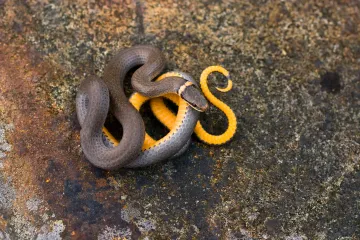
When comparing the dwellings of these globally separated snakes, an interesting pattern emerges, irrespective of latitude or primary prey: the critical factor is the reliability and security of their daytime or winter retreat. Whether it is the Speckled Kingsnake utilizing a mole burrow or crayfish hole in the American prairie, the Spotted Leaf-nosed Snake burrowing into desert sand, the Spotted Bush Snake finding the narrow gap between a wall and a ceiling in an African outbuilding, or the Mulga Snake sheltering in a deep soil crack in the Australian outback, all demonstrate an acute reliance on structure for thermal regulation and predator evasion.
The Speckled Kingsnake's need for burrows during dormancy and the Mulga Snake's use of deep soil cracks suggest that geological stability and soil type are major determinants of population density in open country. However, the presence of the Spotted Bush Snake thriving in suburban gardens and outbuildings, alongside the Kingsnake's documented use of structures like abandoned building foundations for wintering, illustrates a convergence in adaptation. Human habitation, with its discarded lumber, foundations, and stacked materials, offers stable, relatively predator-free thermal sinks that mimic natural log piles or rock crevices. For a species like the Spotted Leaf-nosed Snake, which is nocturnal and burrows, the soft, disturbed soil around agricultural or residential edges might provide easier access to substrate than untouched wild areas.
To summarize the broad geographic spread of these four snakes called "spotted":
| Snake Species | Primary Geographic Area | Key Habitat Features | Activity Pattern |
|---|---|---|---|
| Speckled Kingsnake | Central/Southern United States | Prairies, wooded hillsides, swamps/marshes, rocky areas, small mammal/crayfish burrows | Diurnal (Spring/Fall), Nocturnal (Summer) |
| Spotted Bush Snake | Southern Africa | Areas with climbing structures, often near human habitation (outbuildings, suburban gardens) | Diurnal |
| Spotted Leaf-nosed Snake | Southwestern US (AZ, CA, NV, UT) | Coarse sand, gravel, rocky desert/brushland soils | Nocturnal, surfaces on warm/rainy nights |
| Mulga Snake | Widespread Australia (Excluding far southeast) | Monsoon forest, grassland, shrubland, bare desert, disturbed areas (wheat fields) | Crepuscular, Diurnal, Nocturnal |
It is worth noting that while the Speckled Kingsnake can live in wetter areas like swamps, it is also immune to the venom of native pit vipers and consumes snakes, including venomous ones. This unique dietary ability means its habitat must also support populations of creatures that other predators might avoid, creating a dynamic where its location is tied to the prevalence of rodents, birds, lizards, and, crucially, venomous snakes. The presence of a Speckled Kingsnake in an area where rattlesnakes exist is a strong indicator that the environment provides enough cover for both species to coexist, even if one is specialized to hunt the other.
Ultimately, determining where "the" spotted snake lives demands looking beyond its pattern. It requires examining whether the environment offers the necessary thermal buffering, safe nesting sites for egg-laying, and a reliable food supply, whether that food is a gecko in a suburban shed or a prairie mouse under a rotting log. The diversity in their required habitats—from the arid, sandy deserts of Utah to the humid borders of Missouri swamps—shows that pattern is a poor substitute for precise species identification when mapping distribution.
Related Questions
#Citations
Speckled Kingsnake - Oklahoma Department of Wildlife Conservation
Speckled Kingsnake - Missouri Department of Conservation
Speckled kingsnake - Wikipedia
Spotted Bush Snake - African Snakebite Institute
Mulga Snake - The Australian Museum
Spotted Leaf-nosed Snake - Snake Snap