Where do mockingbirds live in the US?

The Northern Mockingbird, the famous feathered mimic of the American soundscape, possesses a remarkably widespread distribution across the United States, yet its presence isn't uniform throughout the year in every location. [1][7] While one might assume this ubiquitous singer stays put year-round, the reality involves a fascinating split between permanent residents and seasonal travelers, painting a complex picture of its geography. [2] Understanding where they live requires looking beyond simple state lines and considering the latitude and the type of environment they choose within those zones. [3][4]
# Continental Scope

The overall range of the Northern Mockingbird is extensive, stretching from southern Canada all the way south through the United States, into Mexico, and continuing down into parts of Central America and the Caribbean islands. [1][6] Within the United States, this bird is a true fixture across large portions of the country. [3] Unlike some species that stick strictly to the coasts or the interior, the Mockingbird claims territory across the southern half of the nation and pushes significantly northward during the warmer months. [1]
# Seasonal Residency

The key to mapping the Mockingbird’s U.S. home is understanding its migratory behavior, which varies dramatically depending on the latitude. [1] In the southern parts of its range, the bird is generally considered a year-round resident. [7] This means that states firmly in the Deep South, for example, are likely to host Mockingbirds in their yards and parks regardless of whether it is July or January. [1]
However, as you travel north, the story shifts. Birds breeding in the northernmost parts of their U.S. range, and those that venture into southern Canada, are typically migratory. [1][2] These northern populations move south when the weather turns cold and resources become scarce, often settling for the winter in the southern U.S. or points further south. [1] This distinction means that observing a Mockingbird in, say, Maine in January is a much rarer event than seeing one in central Florida during the same month. [2] The areas where this transition occurs—where birds become more likely to migrate than to stay—represent the dynamic edge of their wintering grounds. [1]
# Breeding Maps
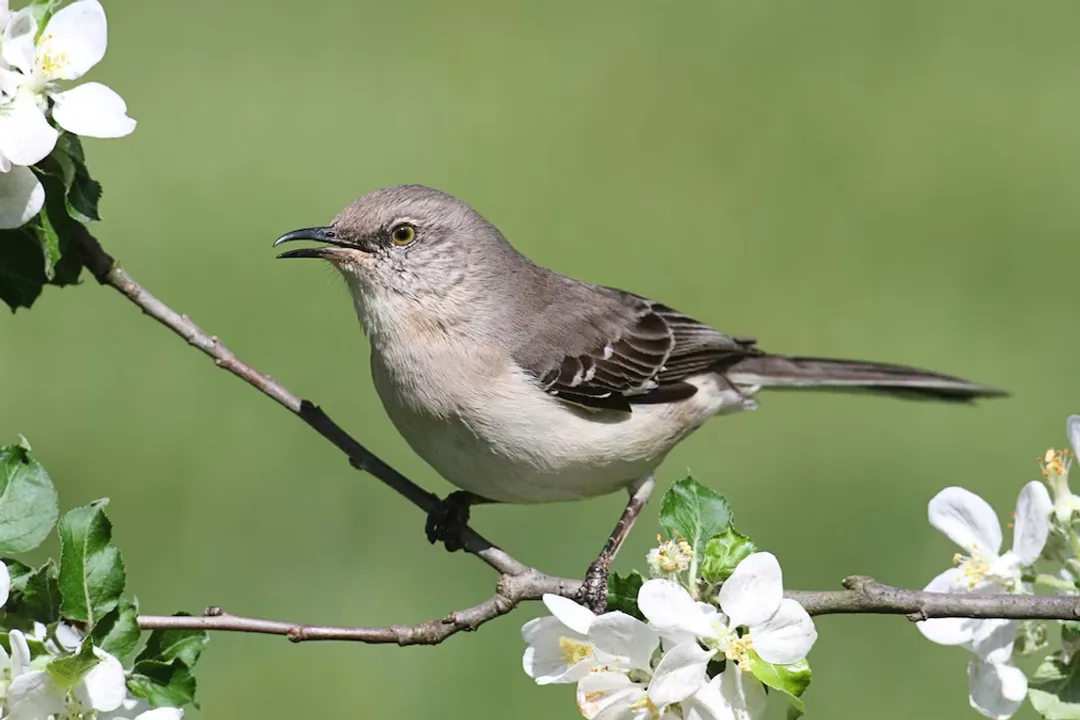
When spring arrives, the Northern Mockingbird expands its territory significantly for nesting and raising young. [2] The breeding range is considerably broader and stretches farther north than the year-round residency zone. [1][2] For instance, the breeding range encompasses much of the contiguous United States, often reaching the border regions of southern Canada, such as southern Ontario or Quebec, depending on the specific year and local conditions. [1][2] During this period, they are utilizing the peak availability of insects and materials across a vast swath of North America. [7]
The Audubon guide confirms that the general range covers the southern half of Canada, the entire lower 48 states, and down into Mexico. [7] The National Wildlife Federation places their range across the US in shrubby areas and open country. [3] Comparing the breeding range map with the winter range map reveals a distinct northward push in summer, illustrating that these birds take full advantage of the seasonal bounty available across the continent's temperate zone. [2]
# Preferred Settings
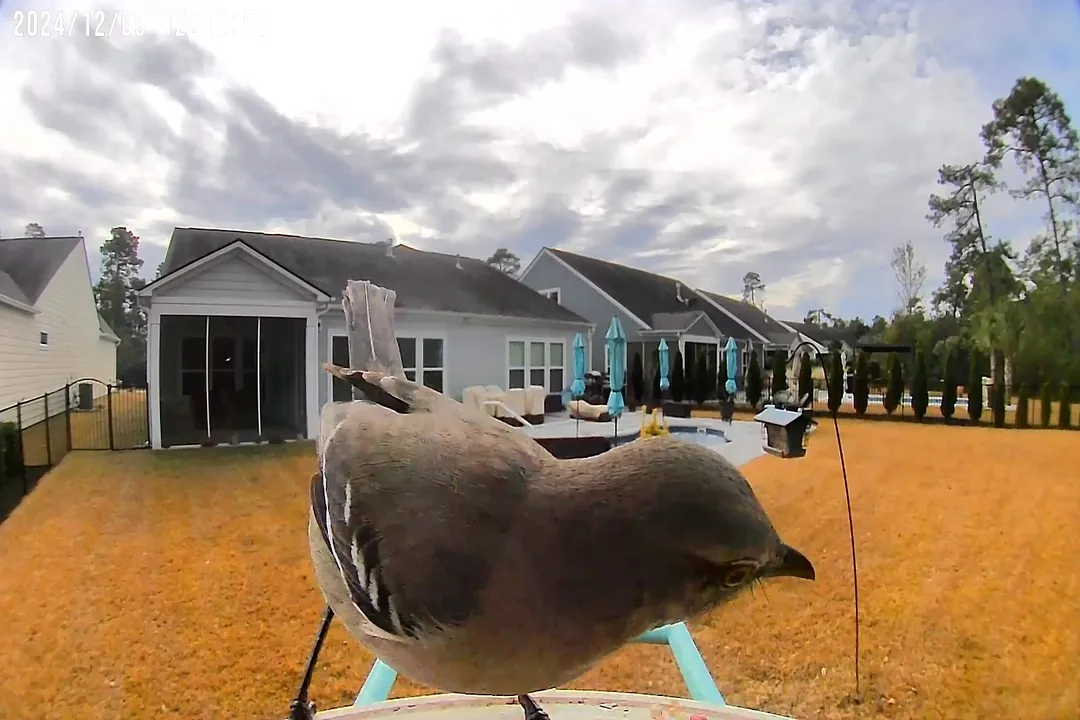
Beyond where on the map they are located, it is important to consider what kind of environment they prefer within those areas. [3] Mockingbirds are highly adaptable, which contributes to their success across such varied geographies, but they show clear preferences for certain structures. [4] They generally favor open areas with scattered shrubs or low trees, providing both open ground for foraging and dense cover for nesting and safety. [3]
This adaptability means they thrive in a wide variety of settings. You are likely to find them in suburban neighborhoods, parks, orchards, and even moderately dense urban green spaces, provided there is adequate low cover available. [4][8] In settings like the Anacostia area near Washington D.C., for example, they are common residents, frequenting parks and well-landscaped areas. [8] They avoid dense, unbroken forests where the canopy blocks too much sunlight or prevents the growth of necessary understory vegetation. [3] A practical observation for bird watchers is that Mockingbirds often choose landscaping features that mimic their natural habitat: a dense lilac bush next to an open expanse of lawn offers the perfect combination of cover and foraging space. [4]
# State Example
To ground the continental description, examining a specific region like Maryland offers insight into how these general rules apply locally. [4] In Maryland, the Northern Mockingbird is a year-round resident. [4] This aligns perfectly with the pattern that areas situated further south in the Eastern Seaboard retain their bird populations throughout the winter. [1] Here, they are found throughout the state in urban, suburban, and rural habitats, often utilizing ornamental plantings in yards or dense thickets along the edges of fields. [4] For birders in the Mid-Atlantic, the Mockingbird’s consistent presence makes it one of the most reliable species to observe across all four seasons. [4]
# Range Dynamics
One interesting aspect of the Mockingbird's habitation is how stable its southern residency appears to be versus the fluidity of its northern boundary. [2] While the maps clearly show the breeding range extending into Canada, the year-round resident area seems tightly anchored to the southern tier of the U.S. and southward. [1] This suggests that the limiting factor for permanent residency is not necessarily summer heat, but rather winter cold and the subsequent availability of food or the birds' physiological limits to survive freezing temperatures, even with supplemental feeding opportunities. [2] Considering the sheer volume of human development across the South, it’s clear that the Mockingbird has found a way not just to coexist with us, but to utilize the altered landscape—lawns, hedges, and scattered trees—as a reliable, if artificial, habitat substitute for more natural shrublands. [3][4] If one were attempting to estimate the total population size across the U.S. based purely on habitat suitability, factoring in the high prevalence of suburban environments (which these birds favor) might lead to an overestimation unless one accounts for the fact that they are absent entirely from the northern tier for several months of the year. [1][2] This adaptability in utilizing human-created structures is perhaps the biggest success story in their distribution across the nation.
Related Questions
#Citations
Northern mockingbird - Wikipedia
Northern Mockingbird Range Map - All About Birds
Northern Mockingbird | National Wildlife Federation
Northern Mockingbird - Maryland DNR
Northern mockingbird in the correct state? Do they migrate to SC in ...
Northern Mockingbird | National Geographic Kids
Northern Mockingbird | Audubon Field Guide
Northern Mockingbird at the Anacostia - Kenilworth Park & Aquatic ...