What kind of bird has an orange head yellow body and black wings?
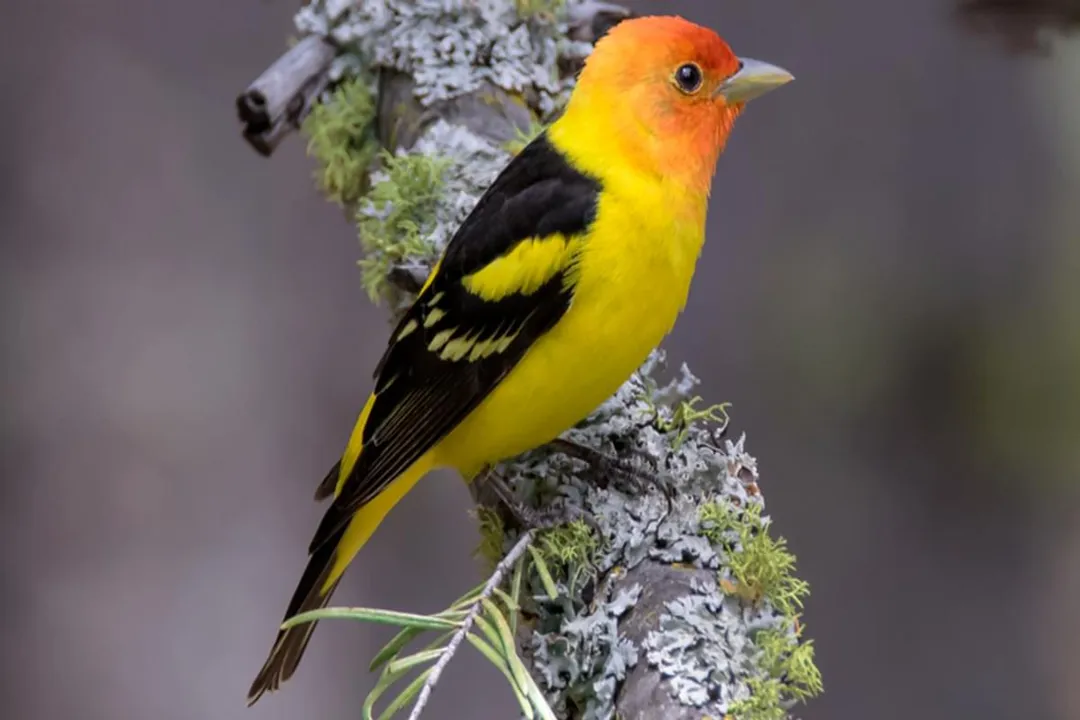
The striking combination of a brightly colored head, a vivid yellow body, and contrasting black wings immediately brings to mind one of North America's most dazzling summer visitors: the Western Tanager (Piranga ludoviciana). When an observer spots a bird matching this description, they are almost certainly looking at an adult male in breeding plumage. This species offers a brilliant splash of color against the greens of the forest canopy, making it a highly sought-after sighting for birdwatchers across its range.
# Plumage Description
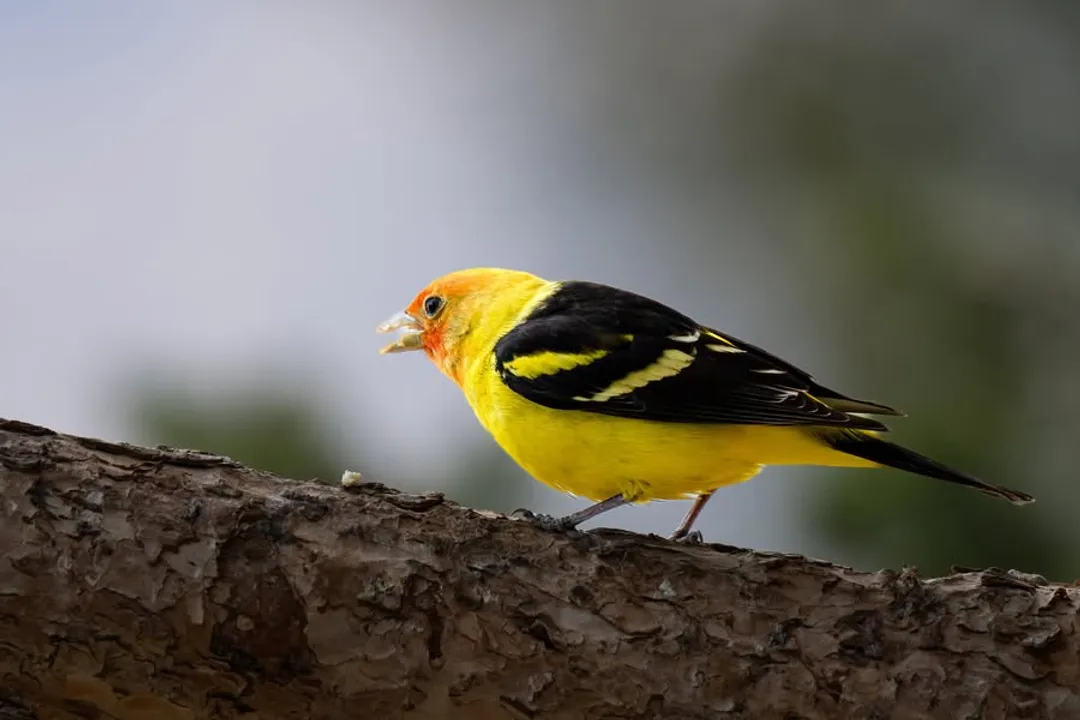
The male Western Tanager’s appearance is unmistakable during the breeding season. The head color is often described as flame-red or orange-red, which contrasts sharply with the canary yellow of its breast, belly, and rump. The back, wings, and tail are distinctly black. A key feature often mentioned alongside the body colors is the presence of two prominent white or yellowish wing bars against those black wings, which are essential for definitive identification. These bars are what separate it from the Scarlet Tanager, which has solid black wings. The bird’s bill is grayish-horn colored, and its legs are dark.
While the male is a vision of tropical brightness, the female and immature birds are far more subdued, which often causes confusion when trying to identify the species outside of the mature male. A female Western Tanager typically shows a grayish-olive overall appearance, sometimes appearing dusky yellow, with pale yellowish wing bars. The young males gradually acquire their brilliant coloration as they mature, passing through stages that might still feature some yellow and black but lack the deep, saturated red head of the adult.
| Feature | Adult Male | Adult Female |
|---|---|---|
| Head Color | Bright Red to Orange-Red | Dull Yellowish-Gray |
| Body Color | Bright Yellow | Olive-Yellow/Gray |
| Wings/Tail | Black with Two White Wing Bars | Dark with Pale Wing Bars |
| Overall Impression | Strikingly bright | Drab, often hard to spot |
| Citation |
# Range and Movement
The Western Tanager is a migratory bird whose breeding grounds span a significant portion of western North America, generally west of the Continental Divide. You can find them breeding in coniferous forests, especially those containing pines, firs, and spruces, from the mountain West up through the Canadian provinces of British Columbia and Alberta, and extending into Alaska. Observers in areas like the Rocky Mountains, where the bird is common in summer, frequently report seeing them once the warmer months arrive.
Their migratory patterns are fascinatingly broad. After breeding, they move south, often traveling far south of the United States border into Mexico and sometimes even as far as Central America for the winter. This means that a bird seen in the mountains of Montana or Wyoming during June might be enjoying the warmer climes of, say, Oaxaca, Mexico, come January. Their presence in a specific area is often dictated by the season, making them a temporary, though brilliant, feature of many northern ecosystems. This broad sweep across the continent means that during migration, they can occasionally show up far outside their typical breeding or wintering ranges, surprising birders in unexpected locations.
It is worth noting that while the description points directly to the Western Tanager, which has a strong preference for western North America, the Summer Tanager (Piranga rubra) is another red-headed tanager found in the eastern US, though the male Summer Tanager is entirely red, lacking the yellow body and black wings of the Western species. This difference in geography and specific coloration is a crucial distinction for birders charting their sightings along the continent’s longitudinal lines.
# Feeding Habits
These insectivorous birds primarily sustain themselves on insects gleaned from foliage or caught in mid-air. They have a particular fondness for flying insects, often catching them with quick, acrobatic sallying flights from an exposed perch—much like a flycatcher does. During the breeding season, their diet keeps local insect populations in check, a beneficial service to the forest ecosystem. When they are not feasting on bugs, they will supplement their diet with fruits and berries when available.
For those hoping to attract these summer visitors to their yards, understanding their preferences can be helpful. While they are generally not frequent visitors to typical seed feeders, offering certain items can sometimes pique their interest, particularly during migration when insects are scarcer. Certain fruits, such as chopped oranges or other soft, sweet fruits, might appeal to them, as might jellies, though they are far less consistent visitors than orioles or mockingbirds. Placing a water source, like a bird bath, can also be an excellent way to draw them in, as they enjoy bathing, often by dipping down to the water's surface rather than fully submerging.
# Song and Vocalization
The song of the Western Tanager is quite distinctive, though it can sometimes be mistaken for that of an American Robin, as both species share a similar quality in their vocalizations. The song is described as a series of rather slow, rambling, and somewhat rambling or whistled notes, often described as "cheerily-cheerily-cheerily" or "a-way-a-way-a-way". The pitch is often somewhat high, and the pace can vary, making it sound less structured than the songs of many other woodland birds. Their calls, used for contact between individuals, are often a sharp, high kip or birk sound. Learning this simple, distinct call can sometimes be easier than learning the song itself, proving useful when the bird is hidden high in the canopy.
One helpful observation many experienced birders make is that the Western Tanager, despite its bright plumage, often sings from the top of the tallest trees in the area. This habit means that even if you cannot see the bird, listening for its voice coming from an unusually high perch in a large coniferous tree is a great clue to its location, especially in patchy, fragmented woodland areas where the tallest remaining trees become prime real estate for territorial males. This tendency to sing from the highest point is a behavior worth remembering when trying to locate one of these elusive singers early in the morning when they are most active.
# Distinguishing the Head Coloration
The description of an "orange head" is certainly accurate for many individuals, but it is important to acknowledge the slight color variation present in this species that can sometimes lead to misidentification or confusion in field guides. The male’s head is a stunning gradient, often starting as a deep red on the forehead and face, which blends back into a rich orange or yellow-orange on the nape and crown. Depending on the light—whether direct morning sun or deep shade—the intensity of the color shifts dramatically.
In dimmer light, a head that appears intensely red in full sun might look distinctly more orange, or even a strong yellow with a reddish mask. This variability is actually a point of discussion among field observers; some find their bird appears closer to a bright yellow with a distinct red wash, while others observe the classic "flame-red" head. Recognizing this spectrum—from red to orange to deep yellow—is part of the expertise in identifying the Western Tanager correctly, as guides often use slightly different terms for the same basic feature. It’s less about a single, fixed color and more about that intense, warm coloration contrasting with the yellow body and black wings. If you see the yellow body and black wings, but the head is only mildly reddish or orangey, it might be a non-breeding male or a first-year male transitioning into its adult colors.
# Conservation Status and Activity
The Western Tanager is generally classified as a species of Least Concern on a global scale by conservation bodies, which reflects its large range and relatively stable population numbers across much of that area. However, this broad assessment masks local concerns. Like many migratory forest birds, their success is intrinsically linked to the health of their breeding habitats. Large-scale logging or significant changes in coniferous forest composition in the mountains of the West can certainly impact local breeding densities, even if the overall continental population remains strong.
During the breeding season, these birds are most active around dawn and dusk, engaging in foraging and singing to establish territory and attract mates. They are often found high in the canopy, making them somewhat secretive despite their bright colors. To spot them, look for the flashes of yellow among the dark needles of mature conifers, or listen for their distinctive, somewhat rambling song emanating from the treetops during late spring and summer. Patience and a good pair of binoculars are your best allies when seeking out this magnificent visitor to the western forests.
Related Questions
#Citations
Western tanager bird description and habitat - Facebook
Western Tanager Identification - All About Birds
Western tanager - Wikipedia
Western Tanager - Rocky Mountain National Park (U.S. National ...
Saw this gorgeous bright yellow body, orange-red head and ... - Reddit
5 Types of Tanagers Birders Should Know - Birds and Blooms
Western Tanager - Wild Birds Unlimited
Western Tanager - Piranga ludoviciana - New Hampshire PBS
Western Tanager - Montana Field Guide