What is the difference between a Snouted Cobra and a Mozambique cobra?
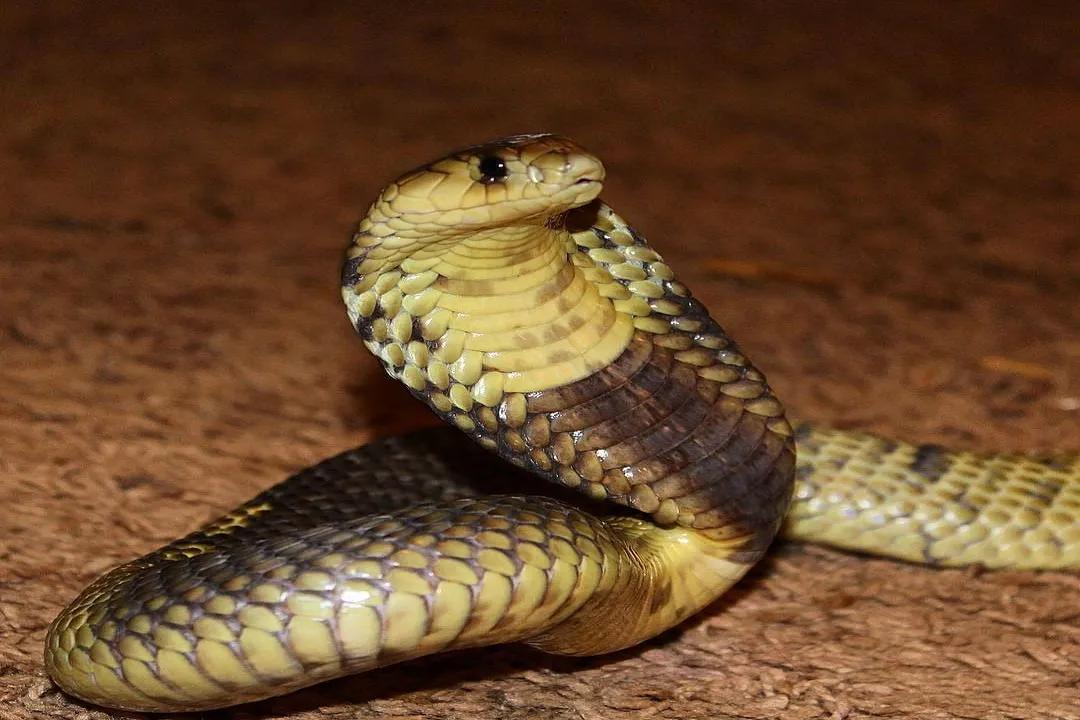
The comparison between the Snouted Cobra (Naja annulifera) and the Mozambique Spitting Cobra (Naja mossambica) is a study in how two large, medically significant elapids occupying overlapping ranges in Southern Africa have evolved distinct survival strategies and physical markers. While both belong to the Naja genus, often associated with the spread of the iconic hood, they present differences in appearance, venom effect, and defensive behaviour that are vital for accurate identification and awareness in the field. They are both large snakes, though the Snouted Cobra generally achieves greater absolute size. Adult Snouted Cobras typically measure between 1.2 and 1.8 metres, with specimens occasionally reaching 2.5 metres or even exceeding 3 metres in captivity. [3] In contrast, the Mozambique Spitting Cobra is considered medium-sized, usually reaching about 1.2 metres, with a maximum recorded length nearer 1.8 metres. [3]
# Physical Markers
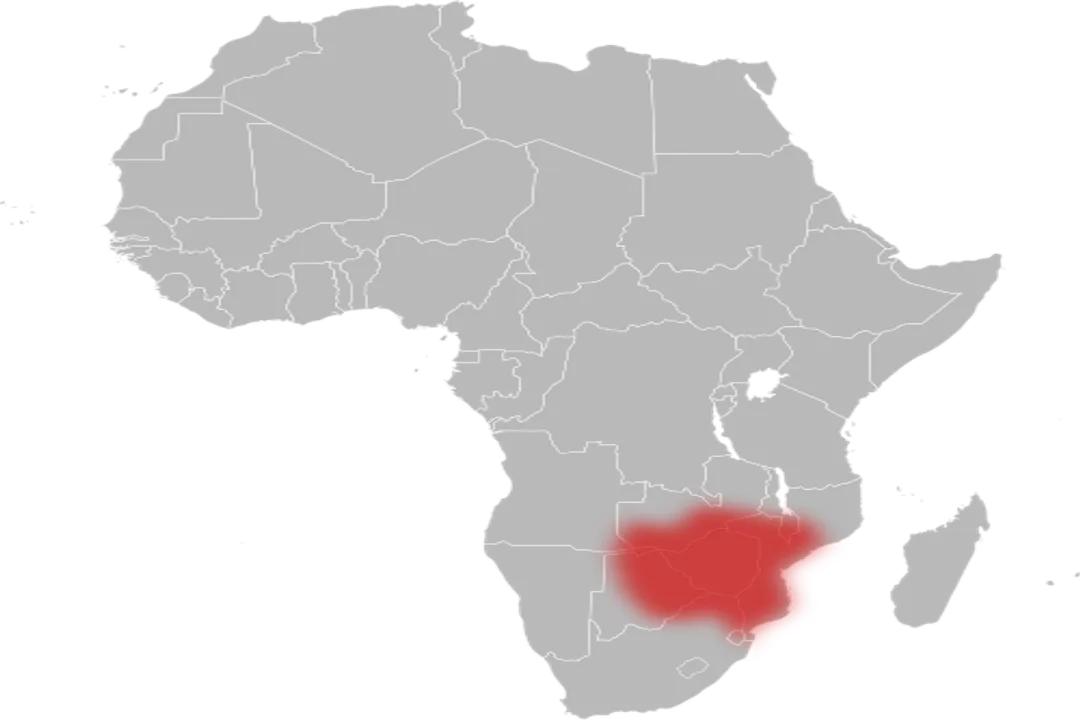
Distinguishing these two cobras often begins with a careful look at their general colouration and specific markings, especially around the throat region, as their distribution patterns can sometimes overlap in areas like the bushveld. [3]
The Naja annulifera exhibits significant colour variation across its range. It can be found in shades ranging from yellowish to greyish-brown, dark brown, or even a deep blue-black. A particularly striking phase, sometimes more prevalent in males, is the banded morph. This snake displays distinct cross bars of yellow to yellow-brown set against a blue-black body; these lighter bands are typically half the width of the darker bars. Regardless of the primary dorsal colour, the ventral (belly) scales are typically yellow mottled with black. A notable feature, often more prominent in juveniles, is a darker throat band or a darker "tear" mark visible under the eye. [3]
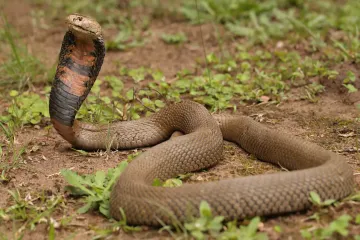
The Mozambique Spitting Cobra (N. mossambica) has a more consistent, albeit striking, look that aids in field identification. It is generally described as brown to grey. [3] A key feature that gives it a textured appearance is the presence of black edging on the dorsal scales, creating a net-like or "fish-net" pattern. [3] The belly colouration is perhaps the most visually arresting difference: it is often described as light salmon pink to almost orange. [3] Furthermore, when displaying, the Mozambique Spitting Cobra reveals a throat marked by a series of well-defined bars. [3] This contrasts with the Snouted Cobra's throat pattern, which is noted more as a darker band or mottled area. [3]
# Defensive Displays
The name Mozambique Spitting Cobra immediately signals one of its most famous—and dangerous—defensive behaviours: the ability to eject venom as a projectile. [3] N. mossambica is certainly equipped for this, capable of aiming accurately up to 3 metres away. Importantly, observations suggest that this spitting capability can be deployed even when the snake is not fully hooded, or when it rears low to the ground. [1] If spitting fails to deter an attacker, or if the threat persists, the Mozambique Spitting Cobra is equally prepared to bite, and individuals showing this behaviour often deliver a full envenomation. [3]
The Snouted Cobra, N. annulifera, presents a different defensive profile. While it shares the classic cobra threat display—raising the front third of its body off the ground and spreading a wide, impressive hood while hissing loudly—it is not generally listed as a spitting species, unlike its cousin. [3] If a threat does not retreat, the Snouted Cobra will strike to defend itself. Evidence from field observations also notes that they may briefly charge towards a perceived aggressor. Like many cobras, they possess the option to escape to a nearby crevice, and in rare instances, may even feign death, though this is uncommon. Despite this less projectile-focused defence, a bite from a large N. annulifera can deliver a substantial dose of venom. [3]
It is interesting to note that despite the dramatic difference in defensive arsenal—projectile venom versus bulk strike—both species are capable of biting without a full threat display. A Snouted Cobra does not require its hood to be spread in order to bite, and N. mossambica can bite or spit without first fully hooding. This subtle mechanism highlights a fundamental truth: any cobra displaying aggression, regardless of whether it is spitting or not, must be treated as a biting hazard.
# Venom Profile Risk
The chemical composition of the venom dictates the resulting medical emergency following a bite, and here the two species diverge significantly in their primary threat mechanism.
The Mozambique Spitting Cobra possesses a venom that is predominantly cytotoxic. [3] This means its primary effect is localized damage to tissues, leading to immediate pain, swelling, blistering, and potentially necrosis. [3] While bites from these snakes account for the most snakebites in Southern Africa, leading to numerous cases requiring skin grafts or, in severe instances, amputations, fatalities are less common compared to bites from purely neurotoxic species. [3] Their tendency to inhabit urban areas and bite sleeping individuals exacerbates their bite statistics. [3]
Conversely, the Snouted Cobra’s venom is described as having a mixture of both neurotoxic and cytotoxic components. [3] The neurotoxic element targets the nervous system, which can lead to respiratory distress, and if left untreated, may result in respiratory failure and death. [3] While N. annulifera bites are described as not common, perhaps due to their slightly more retiring nature, the medical intervention required for a neurotoxic component is typically more urgent than for a purely cytotoxic injury. [3] The intravenous LD50 for the Snouted Cobra is recorded at 1.98 mg/kg, confirming its classification as a highly venomous snake.
Considering this venom disparity, one can draw an analytical conclusion regarding risk perception versus actual outcome. The Mozambique Spitting Cobra causes more frequent medical incidents due to its proximity to humans and feeding habits that lead to accidental bites on sleeping persons, yet its predominantly cytotoxic venom generally results in less swift fatality than a severe bite from a strongly neurotoxic species like the Cape Cobra. [3] The Snouted Cobra, carrying a potent neurotoxic mix, poses a swift systemic threat, although its bite frequency is lower, suggesting its behaviour or habitat preference leads to fewer unwanted encounters. [3] This contrast forces a careful recalibration of risk: one snake is a frequent nuisance with high morbidity (tissue damage), while the other is less common but carries a higher potential for rapid systemic collapse. [3]
# Habitat and Ecology
Both cobras are generally associated with savanna and bushveld environments within their respective ranges, though the nuances of their preferred microhabitats offer further differentiation. [3]
The Snouted Cobra is characteristic of bushveld and lowveld areas, tending to avoid true forests. A particularly interesting ecological detail is that N. annulifera often establishes a permanent home base or lair within an abandoned termite mound, sometimes residing there undisturbed for years. They are primarily nocturnal foragers but frequently engage in basking behaviour near their retreat during the day. Their diet is varied, including toads, rodents, birds and their eggs, lizards, and notably, other snakes, including the venomous Puff Adder (Bitis arietans).
The Mozambique Spitting Cobra also favours rocky regions within bushveld habitats but demonstrates a greater tolerance for human habitation, being "equally at home in urban areas". [3] Its primary dietary preference leans heavily toward amphibians, particularly toads, although it readily consumes rodents, lizards, and other snakes as well. [3]
The documented interaction between these two species provides an exceptional insight into their respective ecological roles. A recorded instance shows a Snouted Cobra preying upon a Mozambique Spitting Cobra. [4] This event suggests that, despite both being formidable venomous snakes, the larger N. annulifera can dominate and consume its smaller cousin. This implies that in areas where their ranges perfectly align, the Snouted Cobra may occupy a higher trophic level, viewing the Mozambique Spitting Cobra as a potential food source rather than solely a competitor. [4] Such predation events underscore the complex, dynamic interactions that occur even among venomous snakes in the ecosystem. [4]
# Distinguishing Similar Species
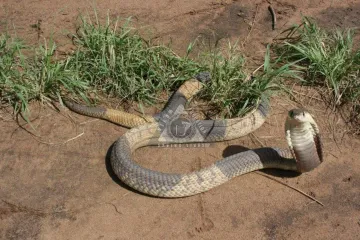
When identifying snakes in the field, especially in areas where ranges may converge or where colouration is ambiguous, it is important to keep other look-alikes in mind. The Snouted Cobra is superficially similar to Anchieta’s Cobra (Naja anchietae) in its distribution across parts of northern Botswana and Zimbabwe, but the N. annulifera has a higher midbody scale count (fewer rows, meaning larger individual scales) compared to Anchieta's. [3]
Furthermore, the Mozambique Spitting Cobra is often confused with the Rinkhals (Hemachatus haemachatus), although the Rinkhals is not a true cobra, lacking smooth scales and being viviparous (giving birth to live young instead of laying eggs). [3] Distinct visual cues separate them: the Rinkhals is often matte grey or black with a jet-black belly and broad white throat bands, whereas the Mozambique Spitting Cobra is glossy brown with a salmon pink/yellowish belly and irregular black bars on the throat. [1]
Ultimately, while detailed examination of scales and subtle markings can confirm an identification, the most critical takeaway for public safety revolves around behaviour and location. If a snake displays a hood and is found in the appropriate distribution area, one must immediately assume it is highly dangerous, irrespective of whether spitting is observed or not. [3] Avoiding interaction—by leaving it alone, retreating slowly, or using a hose to encourage movement—is the universal best practice when encountering either of these powerful Southern African cobras.
#Videos
Rinkhals vs. Mozambique Spitting Cobra - YouTube
Snake Identification video series no 4 Snouted Cobra - YouTube
Related Questions
#Citations
Rinkhals vs. Mozambique Spitting Cobra - YouTube
The cobras of southern Africa - African Snakebite Institute
Snouted Cobra preying on a Mozambique Spitting Cobra! - Newsflare
Snouted cobra - Wikipedia
Is an ID possible? [South Africa] : r/whatsthissnake - Reddit