What is the classification of the spotted salamander?
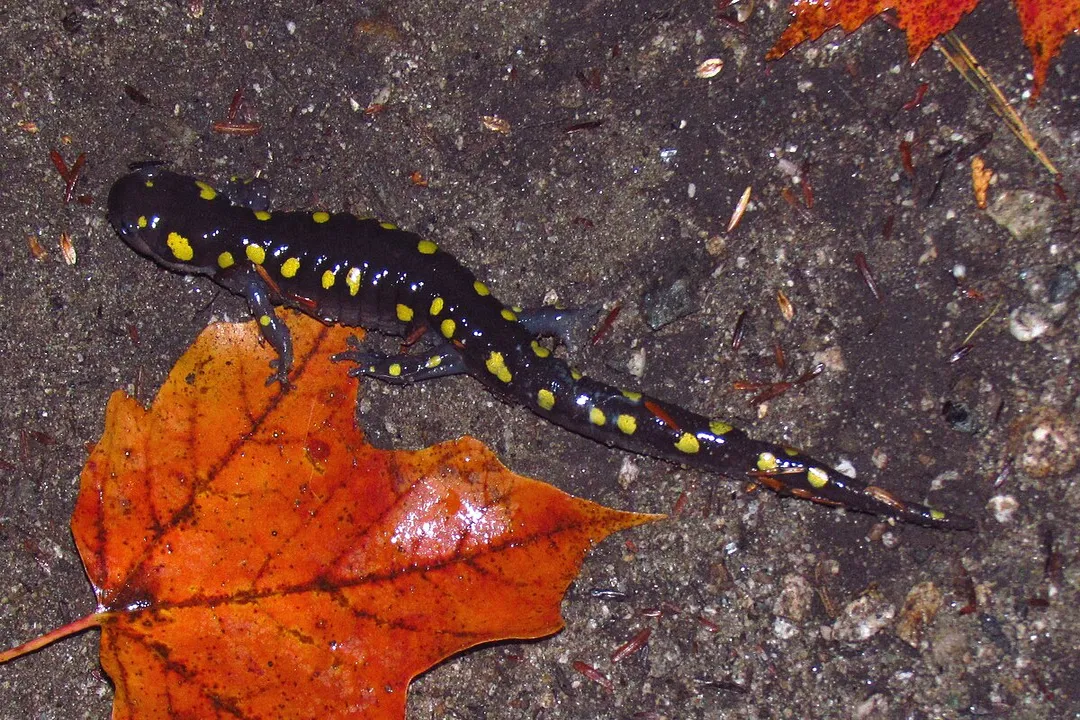
The Spotted Salamander, a familiar sight in the moist woodlands of eastern North America, occupies a specific and well-defined spot in the organization of life. Understanding its classification—the hierarchical system used by biologists to name and group organisms—reveals a great deal about its ancestry, anatomy, and life strategies. This creature is formally identified by the binomial name Ambystoma maculatum. The genus name, Ambystoma, is derived from Greek, translating roughly to "blunt mouth," a characteristic shared across this group of salamanders. The specific species name, maculatum, is Latin for "spotted," an obvious nod to the bright markings that characterize the adult amphibian.
# Linnaean Ranks
The classification of Ambystoma maculatum begins at the broadest level and progressively narrows down to its unique identity. It resides within the Kingdom Animalia. As a complex, multicellular organism that consumes other organisms, this placement is standard for most visible wildlife. Moving to the Phylum level, the Spotted Salamander is a member of Chordata, meaning it possesses a notochord at some point in its life cycle.
The Class designation is particularly defining: Amphibia. This group immediately tells us that the species is characterized by a dual existence, typically involving an aquatic larval stage and a terrestrial or semi-terrestrial adult stage, relying on moist environments for survival and respiration. Within Amphibia, its Order is Caudata, which includes all salamanders and newts—amphibians that retain a tail as adults, distinguishing them from frogs and toads (Order Anura).
# Family Grouping
The family level further refines its identity, placing it within Ambystomatidae, commonly known as the mole salamanders. This family shares several key characteristics. Members of Ambystomatidae are generally robust and stocky amphibians. A significant trait shared by many in this family is their fossorial, or burrowing, nature, spending substantial time underground, which earns them the "mole" association. While the Spotted Salamander does emerge for breeding and surface activity, it often seeks refuge in burrows, under logs, or beneath leaf litter during drier weather.
This family placement contrasts with other North American salamander families, such as Plethodontidae (lungless salamanders), which breathe solely through their skin and mucous membranes and lack lungs entirely. A. maculatum, being in Ambystomatidae, possesses lungs, though cutaneous respiration (breathing through the skin) remains a vital supplementary function.
# Morphological Traits
The classification system is constantly supported by observable physical traits. Adult Spotted Salamanders are quite large for their kind, often measuring between 5 and 6 inches in length, though some specimens can approach 7.5 inches or more. The adult integument (skin) is typically dark, ranging from deep black to dark gray. Superimposed on this dark background are the characteristic yellow spots, usually arranged in two rows along the back. While most commonly yellow, these markings can sometimes appear greenish-yellow, a variation that can sometimes cause confusion with other species if seen only briefly or in poor light. These distinctive spots are one of the primary ways to confirm the species ID within the genus Ambystoma.
# Life Cycle Specifics
The class Amphibia dictates a complex life history for A. maculatum, which heavily influences its habitat requirements. Breeding occurs primarily in the spring, often triggered by rain events, where adults migrate to temporary, fishless wetlands known as vernal pools. Here, mating takes place, and the female deposits large egg masses, often adhering them to submerged sticks or vegetation. These egg masses are distinctive, appearing as clear, gelatinous spheres that can sometimes take on a slight green hue due to symbiotic algae that live within the jelly layer.
The resulting larvae are fully aquatic, possessing external gills for respiration in the water. After metamorphosis, they lose these external gills, develop functional lungs, and transition to life on land as terrestrial juveniles and adults. This transition is a major biological checkpoint dictated by their amphibian classification.
While Ambystoma maculatum is geographically widespread across its range, understanding its family placement helps us appreciate subtle ecological differences. For example, where this species overlaps with the Barred Salamander (Ambystoma tigrinum), both are mole salamanders, but A. maculatum generally favors more consistently damp, mature deciduous forests, whereas the Tiger Salamander can tolerate slightly drier or more disturbed conditions, a difference that matters when mapping their precise local territories.
# Geographic Distribution
The native range of the Spotted Salamander is extensive, covering much of the eastern United States and southern Canada. This breadth of distribution means that while the basic classification remains constant, subtle regional genetic variations exist, though they do not warrant separate species status based on current consensus. They are typically associated with mature forests that provide a deep layer of leaf litter and rich, moist soil—conditions that support both their terrestrial existence and the integrity of their essential vernal breeding pools.
The reliance on these specific forest floor conditions offers a valuable perspective on local habitat management. If you are monitoring populations in a wooded area, remember that the health of the terrestrial habitat (leaf litter, moisture retention) directly impacts the success of the aquatic phase, because the adults must travel from their underground homes to the pools to reproduce. Disturbing the soil structure or drastically altering the forest canopy can change the hydrology enough to dry out the critical vernal pools before the larvae complete their development, wiping out that year's reproductive output instantly. This sensitivity highlights how deeply interwoven their classification (Amphibia) is with microclimate and local hydrology.
# Taxonomic Stability and Confirmation
Across various state surveys and biological records, the morphological and genetic data consistently support Ambystoma maculatum as a distinct, valid species within Ambystomatidae. While some closely related Ambystoma species can hybridize, the visual markers of the Spotted Salamander—the robust body and the paired rows of bright spots on a dark background—are usually sufficient for identification in the field, confirming its stable placement within the established taxonomic structure. For naturalists tracking biodiversity, this clear designation helps in accurately assessing the health and presence of local amphibian communities.
Related Questions
#Citations
Spotted salamander
Spotted Salamander - Ambystoma maculatum - NatureWorks
Spotted Salamander (Ambystoma maculatum)
Spotted Salamander - INHS Herpetology Collection
Spotted Salamanders and the Department of Defense
Spotted Salamander (Ambystoma maculatum)
Spotted salamander - Conserve Wildlife Foundation of NJ
Spotted Salamander | Virginia DWR
Spotted Salamander | State of New Hampshire Fish and Game
Spotted Salamander | Rare Species Guide