How to spot an American Redstart?
Catching sight of an American Redstart often feels like witnessing a tiny piece of fire flicker through the dense understory, and for good reason—this small warbler possesses some of the most startling and distinctive plumage in its family. While they are widespread across eastern North America during the breeding season and are common migrants, their small size and hyperactive nature can make them frustratingly difficult targets for the casual observer. Knowing where to look and how to look is the trick to turning that fleeting glimpse into a satisfying identification.
# Male Plumage
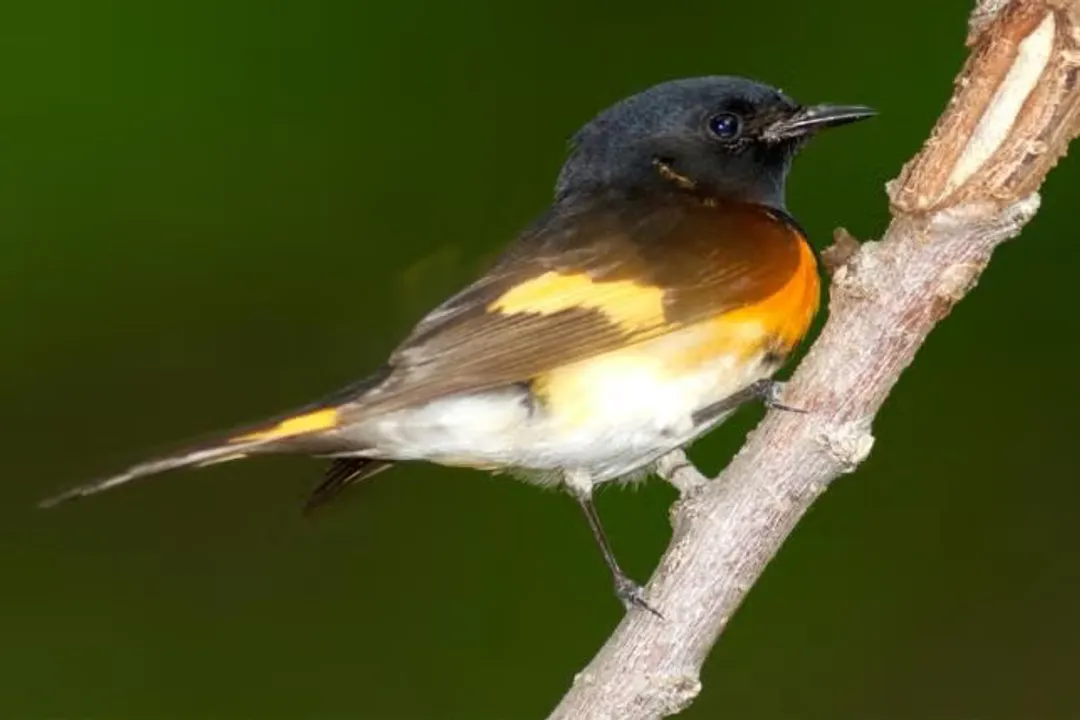
The male American Redstart is arguably one of the most strikingly patterned birds you'll encounter in a North American forest. The breeding male is predominantly glossy black across its back, head, and chest. The true signature, however, comes from the patches of brilliant color set against that dark background. Look for large, vivid orange-red patches on the sides, often referred to as the flanks, just below the wings. Similar bright patches flare out from the base of the wings and at the corners of the tail feathers. When they move, these flashes of color can appear almost electric against the shade of the woods.
It is important to note that the intensity and exact shape of these patches can vary slightly between individuals and due to light conditions, but the overall pattern of black punctuated by these warm colors remains consistent for the adult male. Some descriptions note that the area around the throat might also appear reddish or orange, contributing to the overall impression of a bird decorated in fire.
# Females Yellow
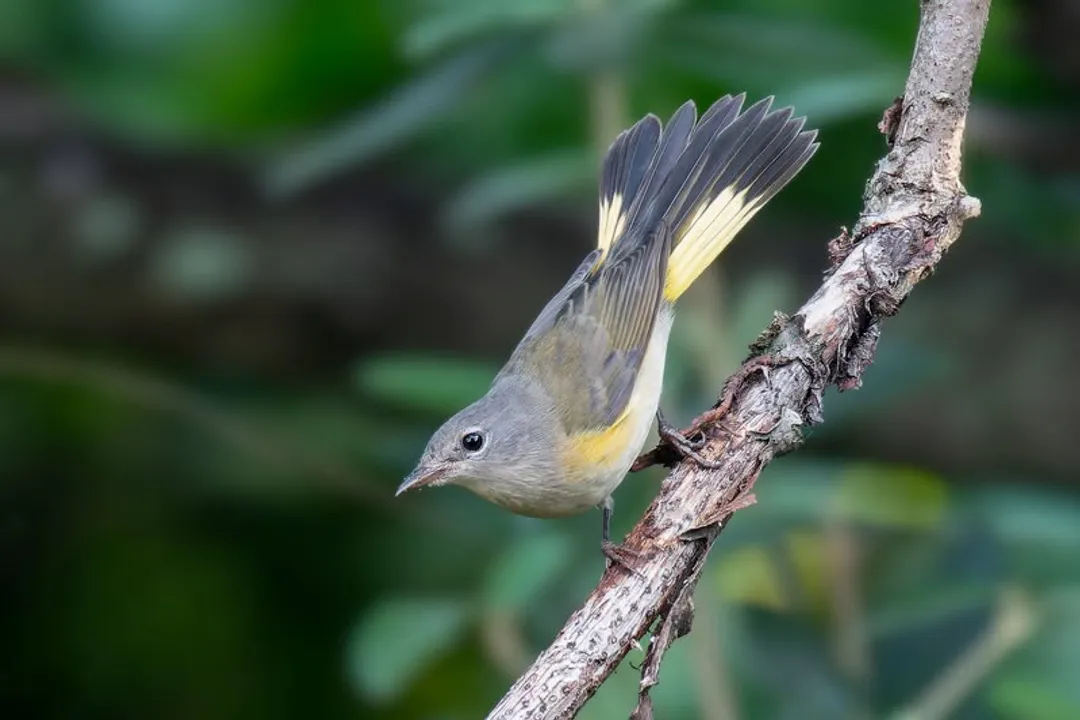
If you see a small warbler with a similar pattern but the bright orange-red is replaced by a vivid yellow, you are likely looking at a female or a young male. The female American Redstart swaps the male’s dramatic black for a more subdued olive-gray or grayish-black overall coloration. The bright patches on the sides, wings, and tail corners are instead lemon yellow. While the overall bird is less contrasty than the male, the yellow patches still serve as critical identification markers against other warblers. Immature males will look very similar to females, often showing yellow, though they may have darker feathers starting to emerge on their body as they mature.
# Spotting Moves
Pinpointing the American Redstart often relies less on standing still and more on following frantic movement. These birds are energetic foragers, constantly fluttering, hopping, and darting among the leaves and branches of the lower to middle strata of the forest canopy. They are rarely still for long.
Their most reliable field mark, which surpasses even their colorful plumage, is their unique feeding strategy. Redstarts employ a technique often called "wing-flashing" or "tail-fanning". As they move through the foliage, they often spread their tail or wings wide, showing off those brilliant patches. This sudden flash of color is thought to startle hidden insects into immediate flight, allowing the redstart to quickly snatch the panicked insect out of the air, a maneuver known as hawking. Watching for this specific, repetitive action—a rapid, jerky movement followed by an immediate aerial snap—is far more effective than simply scanning for a colored shape. You might see them darting down to snatch prey from a leaf surface or even the ground, but the flash of color preceding the catch is the signature move. Considering that they often forage in dimmer, shaded areas where a static color patch might blend, this flashy behavior makes sense; the movement itself draws the eye while simultaneously serving a hunting purpose.
# Forest Types
Understanding where to find them, both in terms of geography and habitat structure, narrows the search considerably. During the breeding season, American Redstarts prefer areas with dense undergrowth and shrubbery within deciduous or mixed forests. They are often found in younger stands or along woodland edges where the vegetation is brushier, rather than deep within mature, closed-canopy woods.
Geographically, their breeding range covers much of the eastern and central United States, extending north into southern Canadian forests. If you are birding during the spring or fall migration, they can show up almost anywhere, but they tend to favor woodlots, large parks, and suburban yards that offer adequate shrub cover during their stopovers. When planning a search trip, aim for forest openings or areas recovering from disturbance, as these environments mimic their preferred dense, mid-level vegetation structure. Focusing your attention on the lower and middle layers—say, between 5 and 30 feet up—will be far more productive than looking only at the very top of the tallest trees.
# Listening In
If you can’t see the flashing colors, your ears can still give away the presence of the American Redstart. Their primary song is distinctive, though perhaps not as melodious as some other warblers. It is generally described as a high, thin, and reedy series of notes. A common way to render the song is as a repetitive tee-a, tee-a, tee-a, see-see-see. The notes start clear and slightly drawn out, concluding with a faster, buzzy trill or series of triplets at the end.
Their call note is much simpler: a sharp, often subtle chip sound. When listening, remember that this bird's song is delivered from the dense cover it prefers, so the sound might seem somewhat muffled. Try tuning your ears specifically for that reedy quality. During migration, you are more likely to hear the sharp chip call than the full song, as birds on the move are less inclined to establish territory.
# Confusion Species
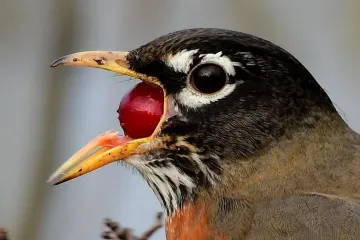
While the male's pattern is quite unique, the gray and yellow females or immatures might occasionally be confused with other small warblers. For example, comparison is sometimes drawn to the American Robin, though the size difference is significant; the Redstart is a small warbler, roughly five inches long, while the Robin is substantially larger. If you are observing a female, contrasting the yellow patches against the gray body against the solid black and orange of the male is a good way to confirm identity if both sexes are present. Always look for the telltale flashes of color in the wings and tail during any movement, as this behavioral trait is harder for other species to mimic exactly.
For the dedicated spotter, focusing your observation during the prime feeding hours offers a practical advantage. While they are active throughout the day, the early morning hours just after sunrise and the late afternoon before sunset often correspond with peak insect availability, meaning the Redstart will be utilizing its flashy foraging technique most frequently then. If you are out on a bright, mid-day trip, you might find them moving more slowly or simply gleaning leaves without the dramatic wing display, making them blend in more easily.
# Field Checklist Summary
To put this knowledge into practice, here is a quick checklist for confirming an American Redstart sighting:
- Size Check: Is the bird small, approximately 5 inches in length?
- Color Check (Male): Does it have a black body with strong orange/red patches on the flanks, wings, and tail?
- Color Check (Female/Immature): Does it have a gray body with strong yellow patches in the same locations?
- Behavior Check: Is the bird fluttering rapidly and constantly flashing its wings or tail open and shut?
- Habitat Check: Is it actively foraging in the dense shrubs or lower to mid-levels of a deciduous woodlot or edge habitat?
By combining the knowledge of their sharp coloration—whether red or yellow—with an awareness of their ceaseless, flashy hunting movements, you significantly increase your chances of spotting and confirming the presence of the American Redstart, one of the most dynamic little birds in the eastern woods.
Related Questions
#Citations
How to Identify an American Redstart - Birds and Blooms
Dan's Feathursday Feature: American Redstart
American Redstart identification tips - Facebook
American Redstart | Audubon Field Guide
How do I tell an American Robin and a Redstart apart? (besides the ...
Meet the American Redstart - Environment for the Americas
American Redstart - Montana Field Guide
American Redstart - Missouri Department of Conservation
American Redstart - BirdWeb