What is the ancestor of the frilled shark?
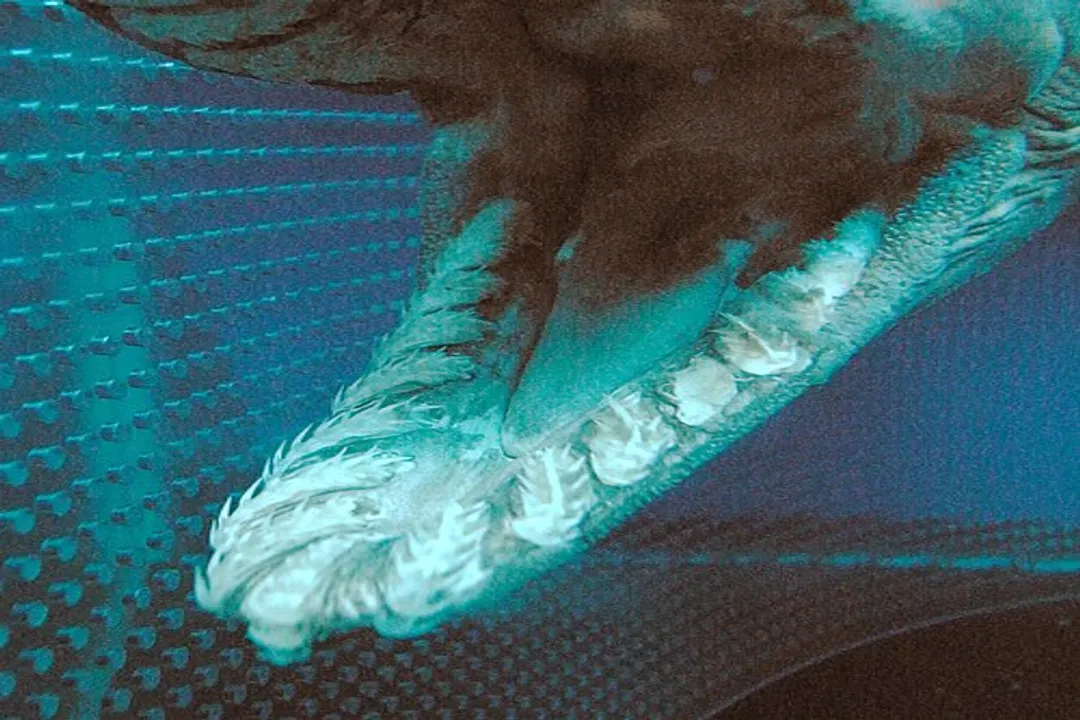
The frilled shark, Chlamydoselachus anguineus, swims through the twilight zones of the world’s oceans looking uncannily like something that should have gone extinct alongside the dinosaurs. When scientists discuss its deep past and what creature came before it, the answer is less a single name and more an acknowledgment of deep, stable time. This animal is famous primarily because it is labeled a "living fossil," an organism whose morphology has remained largely the same across vast stretches of geological history. Rather than pointing to a direct, singular ancestor, its evolutionary story involves tracing the stability of its entire genus, Chlamydoselachus.
# Ancient Lineage

The frilled shark belongs to the family Chlamydoselachidae, and its survival is striking enough that it warrants a special designation in evolutionary biology. The current modern forms consist of just two recognized living species: Chlamydoselachus anguineus, the one most frequently encountered in deep-sea surveys, and Chlamydoselachus africana. This near-monotypic genus, containing only two extant species, immediately signals a lineage that has seen significant pruning or has adapted to an extremely narrow ecological niche.
What we know about its deep past comes from fossils belonging to the same genus. Paleontologists have found fossil evidence for Chlamydoselachus species dating back approximately 80 million years, placing its recognizable form firmly in the Late Cretaceous period. This means that the basic blueprint of the frilled shark was already established when massive extinctions were reshaping life on Earth. Think about that stability: creatures closely related to the one you might accidentally trawl up today were swimming the seas while Tyrannosaurus rex was still roaming the land.
The fact that we have species surviving from that deep past presents an interesting comparison point. If we look at other major shark groups, the evolutionary changes across 80 million years are often significant, showing clear transitional forms leading to modern relatives. In contrast, the frilled shark’s own genus seems to have hit upon a successful formula and held onto it, making the identification of a distinct, clear-cut ancestor much harder than tracing, say, the lineage of a great white shark. The closest relatives are often simply older versions of the same group, rather than a clear precursor species that looked dramatically different.
# Extinct Relatives

While the modern frilled sharks are rare and cryptic, the fossil record shows that the genus Chlamydoselachus was not always so constrained. One fascinating example of a divergent branch within this family is the extinct species Chlamydoselachus goliath. This species, sometimes called the "giant frilled shark," represents a significant departure from the modern C. anguineus in terms of scale.
The primary difference noted between C. goliath and its modern counterpart is sheer size. While the living frilled shark can reach lengths of around 2 meters, C. goliath was reportedly much larger. This tells us that the lineage was once more ecologically diverse. Some members specialized in being large predators in the deep, while others maintained the smaller, perhaps less metabolically demanding, existence of the modern species. The disappearance of the giant form suggests that while the deep-sea environment is stable, it is not entirely static, and specialized gigantism eventually failed to persist, leaving the smaller forms as the successful survivors.
Considering the differences between the extinct C. goliath and the extant C. anguineus, an interesting pattern emerges: the modern shark’s relatively small stature might actually be an adaptation to the extreme pressures of the bathypelagic zone—lower food availability, colder temperatures, and the need for energy conservation. If you were to plot the fossil record of this genus, you wouldn't see a neat progression from a small creature to a large one, but rather a branching pattern where the large form (goliath) was an evolutionary experiment that ended, while the smaller, more generalist form persisted. This lineage, therefore, is defined as much by what it lost (size and diversity) as by what it kept (its unique ancient structure).
# Anatomy of Stasis
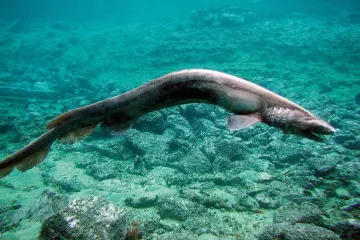
The reason the frilled shark is so often termed an ancient relic lies in its strange, almost reptilian or eel-like features, which contrast sharply with the typical torpedo shape of most modern sharks. Its body is elongated, giving it that serpentine quality. More telling are the features that recall Paleozoic sharks that lived hundreds of millions of years ago.
Consider its jaws and teeth. The frilled shark possesses hundreds of teeth—estimates often place the count around 300—which are arranged in multiple rows. These teeth are slender, three-pronged, and needle-like, designed for gripping rather than shearing. This dental structure is clearly suited for snatching soft-bodied prey, like squid or smaller fish, whole, which is common in the deep sea where meals are infrequent and opportunities must be seized quickly. It lacks the broad, triangular cutting teeth typical of surface predators.
Furthermore, its gill structure is highly unusual. Instead of the typical five to seven separate gill slits found on most sharks, the frilled shark possesses six gill slits, the first of which runs across the throat region, giving it the "frill" for which it is named. This configuration is considered a more primitive characteristic when compared to the more derived forms found in most extant sharks. These primitive traits are the physical proof that its body plan has undergone relatively little modification over the epochs separating it from its earliest relatives.
# Deep Sea Preservation
If we are trying to find the ancestor of the frilled shark, we are really asking why this particular evolutionary line has remained so successful in its form. The answer likely lies in the environment it occupies. Modern frilled sharks are rarely seen, living in the deep sea, often below 500 meters, and sometimes down to 1,500 meters or more. This environment is characterized by cold, constant temperatures, low light, and scarce food resources.
The ecological pressures in the deep sea are far less intense and change far more slowly than those found in coastal or pelagic zones. Surface environments are dynamic; climate shifts, sea level changes, and competition from rapidly evolving competitors (like the bony fishes) force organisms to constantly adapt or perish. In the deep, however, the conditions are incredibly stable. The lack of environmental forcing acts as a powerful evolutionary brake, favoring organisms that are already well-adapted to the status quo. The C. anguineus body plan, perfected perhaps 80 million years ago to thrive in that specific pressure cooker of cold, dark stability, has simply had no strong reason to change. This stasis is not necessarily a sign of evolutionary weakness, but rather a testament to its successful, long-term adaptation to a static habitat. A creature that doesn't need to evolve quickly is a creature that can afford to keep its ancient, successful design.
This stability of environment offers a crucial, albeit non-specific, insight into the ancestor. The ancestor likely thrived in a similar deep-water, resource-limited setting, explaining why the lineage never branched out into numerous, highly specialized shallow-water forms, unlike many other shark groups whose ancestors diversified wildly into various forms across different habitats over time. The frilled shark’s ancestry seems confined to the deep; it did not evolve from a shallow-water ancestor that later moved down, but rather appears to have always been a deep-sea dweller, which is rare among ancient lineages.
# Tracing the Family Tree
When paleontologists dig for the ancestor, they are looking for a creature in the fossil record that possesses some of the frilled shark’s unique traits but perhaps retains others that have since been lost. The challenge here is that the most primitive structures—like the arrangement of the jaw suspension or the structure of the internal skeleton—are often made of cartilage, which rarely fossilizes well compared to bone. Therefore, the fossil record relies heavily on teeth and gill plate impressions, which are often fragmented or difficult to assign definitively to a species.
We can establish a hierarchy of proximity, even without a definitive single ancestor:
- Closest Living Relative: C. africana. This species is morphologically very similar, suggesting a recent split or perhaps a slow divergence following the successful establishment of the genus.
- Known Extinct Relative: C. goliath. This shows the genus once explored larger niches.
- Genus Origin: The earliest fossils assigned to Chlamydoselachus around 80 million years ago.
If an ideal ancestor existed, it would likely be a species from the early Cretaceous or Jurassic periods that showed the development of the six gill slits and the multi-rowed, needle-like teeth, but perhaps possessed a slightly different tail fin or vertebral structure that had not yet reached the modern form. However, the current fossil evidence strongly implies that the transition to the Chlamydoselachus body plan occurred before the Late Cretaceous, making any earlier definitive ancestor incredibly rare or yet to be discovered in a complete state. The evidence points toward the genus itself being the ancient form, rather than a specific ancestor leading into it. The creature that preceded the genus might belong to an even older, more basal group of sharks, one whose defining characteristics have been lost to time or are represented by non-cartilaginous remains that simply disintegrated.
Ultimately, the ancestor of the frilled shark is likely a now-extinct species within the broader Chlamydoselachidae family whose morphology was more generalized, possessing the basic arrangement of gill slits but perhaps lacking the extreme elongation or tooth specialization seen in C. anguineus. The discovery of C. goliath shows that the family was more varied than we assume, suggesting the direct line to our modern shark might have come from a medium-sized, deep-dwelling form that simply never achieved the size of its giant cousin.
#Videos
Why This Shark Hasn't Changed in 80 Million Years - YouTube
Related Questions
#Citations
Frilled shark - Wikipedia
The Mystery of Frilled Shark Evolution
Meet Chlamydoselachus goliath, the extinct relative of the ... - Reddit
The Frilled Shark . . . is Still a Shark
This 80-million-year-old shark species is a biological mystery
Frilled shark's ancient features and deadly trap jaws - Facebook
Why This Shark Hasn't Changed in 80 Million Years - YouTube
frilled shark, Chlamydoselachus anguineus