Is the frilled shark prehistoric?
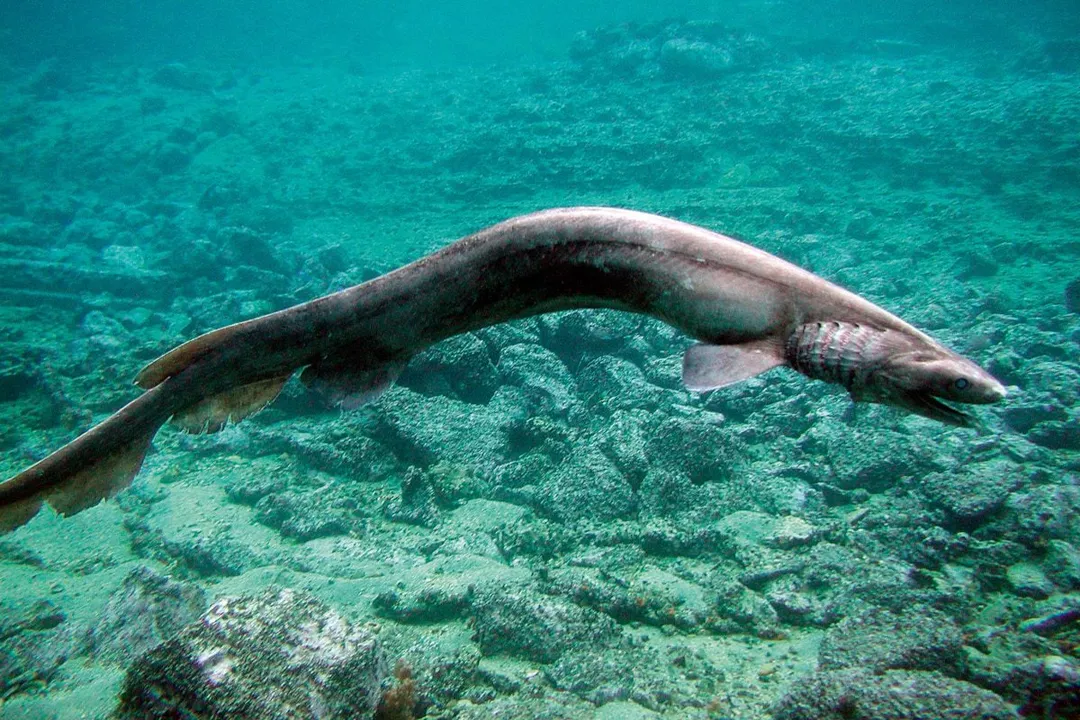
The creature known as the frilled shark immediately provokes thoughts of bygone eras, looking for all the world like something pulled from a prehistoric ocean trench. Its unique, almost eel-like shape, coupled with those unsettling, fringe-like gill slits, has earned it the reputation of a living fossil, prompting many to ask if this animal truly swam alongside dinosaurs. While its appearance certainly suggests an ancient origin, the reality is a fascinating mix of deep time and modern biology. It is less a creature frozen in time and more a highly adapted survivor whose lineage stretches back millions of years, making it a ghost from the Late Cretaceous period.
# Living Fossil Status
The common moniker "living fossil" is frequently attached to the frilled shark, Chlamydoselachus anguineus. This term is applied because the species has changed remarkably little over geological timescales. The lineage itself is ancient; fossil evidence suggests sharks closely related to the modern frilled shark date back at least 80 million years, to the time of the dinosaurs. This immense timescale is what fuels the perception that the shark itself is "prehistoric".
However, it is crucial to draw a sharp distinction between the age of the species and the age of any individual animal caught today. There was a wave of viral media attention around videos claiming to show an 80-million-year-old frilled shark caught off the coast of Japan. Fact-checking efforts clarified that while the species embodies an ancient evolutionary form, any specific specimen hauled up by modern fishermen is, naturally, only as old as the day it was caught. This common confusion stems from the striking evolutionary stasis of the species compared to the rapid changes observed in many other marine lifeforms. Its survival across such vast stretches of time suggests an evolutionary blueprint that perfectly suits its dimly lit, stable environment.
It is worth considering that if this shark’s body plan has remained largely unchanged for 80 million years, its lifestyle must be incredibly specialized and successful within its niche. Unlike species whose fossil records are littered with cousins that adapted to changing surface conditions, the frilled shark has seemingly perfected an existence in the deep, cold waters where major environmental shifts are less pronounced. The lineage represents a successful, albeit slow, evolutionary path.
# Unique Appearance
The shark’s morphology is distinctly different from the sleek, torpedo-shaped predators most people associate with sharks, like the Great White. The frilled shark possesses an elongated, dark, eel-like body. It can reach lengths of up to six feet, though some reports place them longer. Its skin is reportedly dark grey or brownish-black, which offers excellent camouflage in the deep sea.
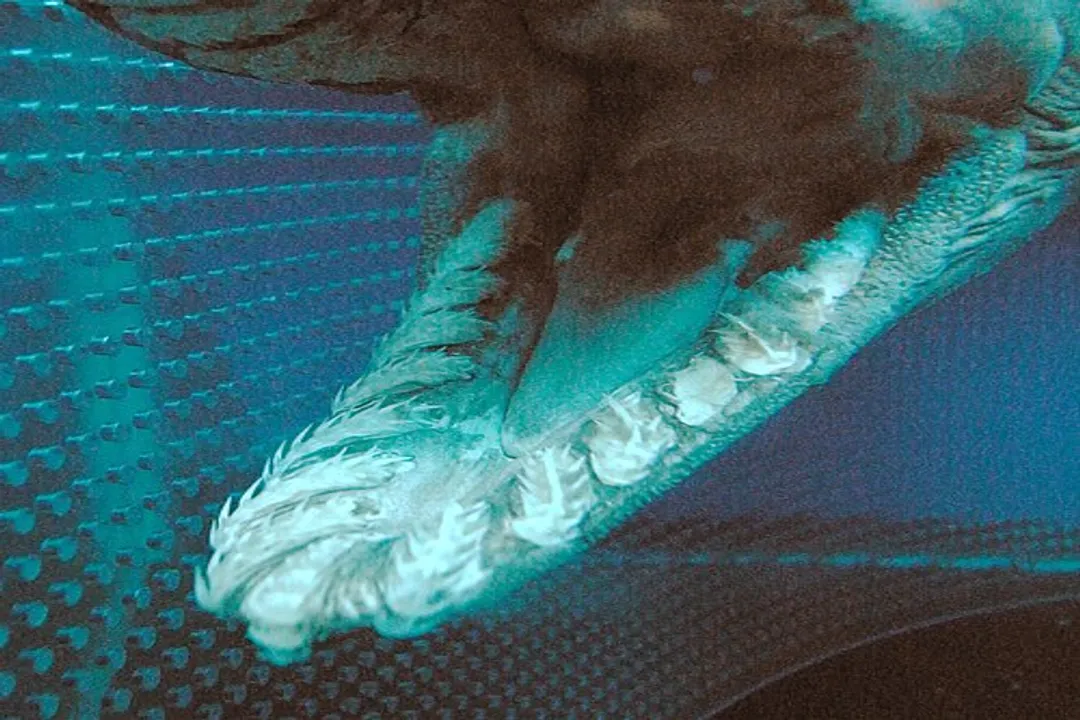
Perhaps the most immediately arresting features are its head and gills. The head is broad and flattened. Its mouth is positioned at the front of the head, rather than underneath like most sharks, and is lined with numerous rows of three-pronged, backward-pointing teeth. This terminal mouth placement is unusual and hints at its specific feeding strategy. Furthermore, it possesses six pairs of gill slits, which are the source of its common name; these slits are red and look like frills bordering its head. It also has a single dorsal fin set far back toward the tail.
This combination of features—the long body, terminal mouth, and external gill frills—is what links it visually to the ancient sharks of deep time. When fishermen in Australia reported catching a specimen in 2015, the rarity and unusual appearance led to immediate public fascination and the application of labels like "horrific".
# Deep Habitat
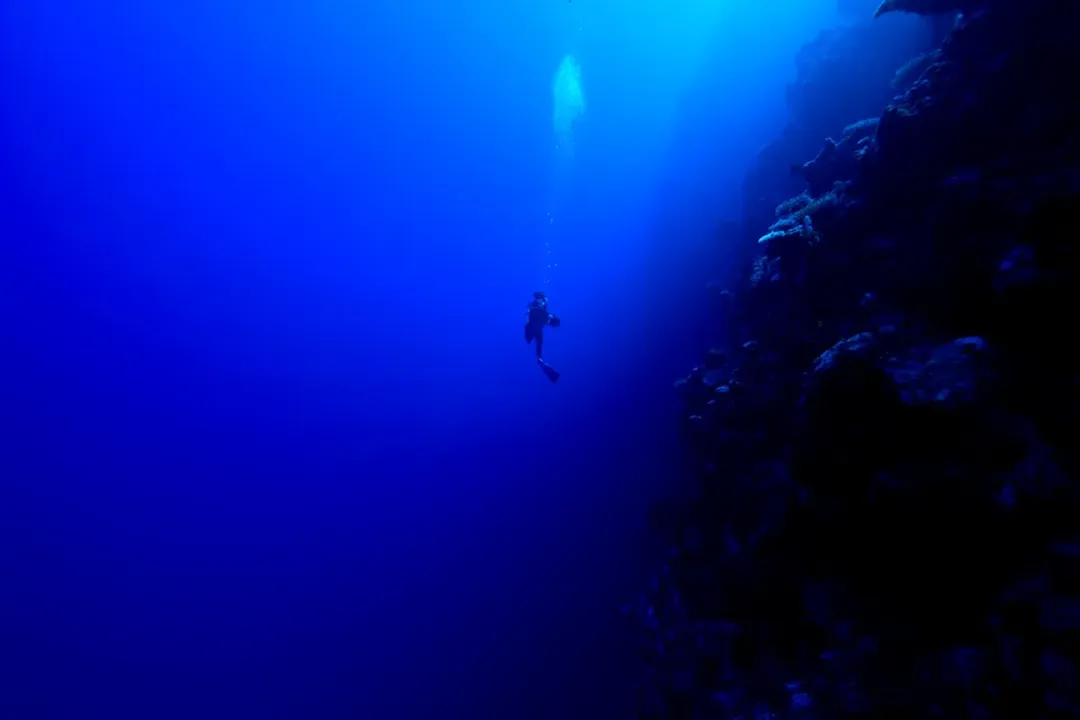
The reason the frilled shark remained largely unknown to science for so long is its strictly deep-sea habitat. It is a creature of the benthic zone, preferring depths ranging from about 120 meters (nearly 400 feet) down to potentially over 1,500 meters (nearly 5,000 feet). They are found globally, inhabiting the continental shelves and slopes in the Atlantic, Pacific, and Indian Oceans.
Its life in the abyss dictates its slow, deliberate existence. Since deep-water prey is often scarce, the frilled shark is not built for high-speed pursuit. Its eel-like body is thought to be used for slow, serpentine movements, perhaps lurking near the seafloor or mid-water waiting for unsuspecting prey. Its backward-pointing teeth suggest a unique feeding mechanism: once it gets its jaws on prey, those teeth act like barbs, preventing escape as the shark swallows its meal whole.
When examining its ancient physiology, one interesting element to consider is the sheer energetic cost of its form. For a modern, fast-swimming shark like a mako, high metabolism and powerful muscles are necessary. For the frilled shark, surviving at depths where temperatures are near freezing and food is sparse suggests a very low metabolic rate. This low energy expenditure is the biological secret that allowed this body plan to persist when surface dwellers faced intense evolutionary pressure to become faster and more aggressive hunters as the world's oceans changed over the eons. Encountering one, even accidentally through trawling or deep-sea fishing, is rare because they occupy waters rarely disturbed by human activity.
# Modern Sightings Context
The relatively infrequent captures of frilled sharks offer snapshots into their distribution and behavior, often causing media excitement precisely because of their "prehistoric" look. In 2007, a capture off the coast of Japan brought this unusual animal back into the scientific spotlight. Similarly, in early 2015, fishermen near Eden, a town on the south coast of New South Wales, Australia, netted a specimen, startling the crew who observed its odd features.
These incidents, while newsworthy, highlight the challenges of studying deep-sea fauna. When a specimen is caught at the surface, it is removed from the high-pressure, cold environment it is adapted for. This sudden change in conditions often leads to immediate stress or death, making live study exceptionally difficult. Analyzing specimens brought up through trawling nets provides important data on size, genetics, and stomach contents, but it doesn't reveal much about its living behavior, which remains largely inferred from its anatomy.
If we were to map out the general areas of capture—Japan, Australia, the Atlantic deeps—it reinforces the understanding that this is a cosmopolitan, albeit widely dispersed, deep-water species, not one confined to a single isolated relic location. The fact that these sightings continue to happen, even if sporadically, confirms that the species is extant and reproducing, not merely a population clinging on from the Mesozoic Era.
# Reconciling Deep Time and Present Day
The true answer to whether the frilled shark is prehistoric lies in appreciating the concept of evolutionary stasis. The shark’s family tree, the Chlamydoselachidae, diverged from the main shark lines a very long time ago. It is a surviving relic from an ancient branch of shark evolution that thrived in deeper waters when other, more modern shark forms were still evolving in shallower seas.
If we organize the key data points regarding its age and biology, the contrast becomes clearer:
| Feature | Description | Implication |
|---|---|---|
| Species Lineage | Fossils date back 80+ million years | Ancient, "Prehistoric" lineage |
| Individual Age | No individual specimen is 80 million years old | Subject to modern lifespans |
| Habitat | Deep continental slopes (120m – 1500m+) | Stable, low-energy environment |
| Morphology | Eel-like body, six gill slits, terminal mouth | Low metabolic requirements, unique feeding style |
Understanding this separation is key to appreciating the frilled shark. It is not a dinosaur that survived intact; it is a modern animal whose successful evolutionary strategy involved not changing drastically while surface environments experienced massive turnovers. The shark’s ability to thrive in the stable, cold, high-pressure deep sea means it never needed the extreme adaptations—like increased speed or drastic changes in body shape—that drove evolution in shallower waters over the past 80 million years.
For those interested in marine biology, the frilled shark serves as a tangible example of how extinction is not always the fate of ancient forms; sometimes, specialization allows them to persist virtually unchanged, hidden from the chaos of the surface world. Its continued, albeit rare, appearance in modern catches reminds us how much of the deep ocean, and its ancient inhabitants, remain fundamentally mysterious to us.
#Videos
Why This Shark Hasn't Changed in 80 Million Years - YouTube
Related Questions
#Citations
Frilled shark - Wikipedia
Prehistoric 80 million year old shark also known as ”the frilled shark ...
Why This Shark Hasn't Changed in 80 Million Years - YouTube
This 80-million-year-old shark species is a biological mystery
The frilled shark (Chlamydoselachus anguineus) is a deep-sea ...
Rare And 'Horrific': Frilled Shark Startles Fishermen In Australia - NPR
Unusual prehistoric shark beast captured in Japan - Mongabay
The Frilled Shark Has a 3-Year Pregnancy Before Giving Birth
Video does not show an 80 million year old frilled shark from Japan