What are the characteristics of the Waimanu?

The study of ancient life often reveals fascinating snapshots of evolutionary paths not taken, and among these, the genus Waimanu stands out as a critical player in the early story of penguins. This group represents some of the very first known examples of true penguins, appearing shortly after the extinction of the non-avian dinosaurs. Fossils recovered from New Zealand offer a window into a world where these birds were establishing their unique niche in the marine environment during the early Paleogene period. [7][10] Waimanu belongs to the order Sphenisciformes, but its specific characteristics show it was caught in a transitional phase between earlier, more generalized aquatic birds and the sleek, powerful swimmers we recognize today. [10]
# Eocene Debut

The geological timing for Waimanu is remarkably precise, placing it firmly in the early Eocene epoch. [2][4] Paleontologists estimate their existence stretched from approximately 62 million years ago to about 56 million years ago, with some sources narrowing the critical fossil record window to between 60 and 56 million years ago. [1][2][10] This placement is significant because it means Waimanu evolved rapidly in the aftermath of the Cretaceous–Paleogene (K-Pg) extinction event. [7] While many groups were radically reshaping their forms and roles in the newly empty ecosystems, the ancestors of penguins were already beginning to specialize toward a flightless, swimming lifestyle. [7] The specimens discovered, which provide the basis for our understanding of this genus, originate from sediments found in New Zealand. [1]
# Giant Stature

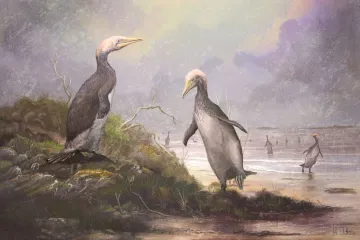
One of the most immediately striking characteristics of Waimanu is its sheer size. These were not diminutive, sea-ice dwelling birds; they were considerably larger than many of the small, recovering bird species populating the globe at the time. [1][3] Estimates place the height of a fully grown Waimanu at around 1.3 meters (or 4.3 feet) tall. [1][3][6] To put that into perspective, this dwarfs the modern Emperor Penguin, the largest species today, which typically reaches heights closer to one meter. [1]
This trend toward gigantism early in penguin evolution is interesting. Given that Waimanu existed when many major predators may have still been recovering or were entirely different from modern marine carnivores, being a large target might have offered protection, or perhaps its size simply allowed it to exploit deep-water foraging niches that smaller birds could not access efficiently. [7] This initial large body plan suggests that the selective pressures favoring massive size were strong even at the very beginning of the penguin lineage before the evolution of the highly specialized flippers seen in later species.
# Wing Peculiarities
Despite their imposing size and established place within the penguin order, Waimanu possessed wings that clearly mark them as primitive compared to their descendants. [1][3] Unlike modern penguins, whose wings have evolved into stiff, powerful flippers perfectly shaped for underwater flight, Waimanu retained small wings. [1][3] The skeletal structure indicates these appendages were not yet fully adapted for the efficient, sustained swimming locomotion characteristic of contemporary penguins. [1]
This specific morphology implies a different method of movement, both in water and potentially on land. [1] If their wings lacked the necessary rigidity and surface area for powerful underwater propulsion, Waimanu might have relied more heavily on their legs for movement in the water, perhaps resulting in slower speeds or shallower dives compared to later forms. [3] Alternatively, their wings may have retained a greater function in terrestrial balancing or even rudimentary surface propulsion, something that became completely obsolete in their highly aquatic relatives. [1] The contrast between their large, powerful body and their relatively small wings highlights a key moment of evolutionary flux.
# Ancestral Link
The classification of Waimanu within the extinct family Waimanuidae solidifies its role as a foundational genus for the Sphenisciformes order. [1][7] While they exhibit definitive penguin characteristics—such as the shape of their beaks and feet—they also retain characteristics seen in earlier, less specialized ancestral forms. [7] This mixture of primitive and derived traits is what makes the genus invaluable to paleontologists attempting to map out the initial divergence of penguins. [7]
The evidence suggests that the transition to a wholly aquatic lifestyle was a multi-step process, not an instantaneous switch following the mass extinction event. [7] Waimanu represents one of the first steps on that ladder. Its existence confirms that penguins successfully diversified early on, occupying niches that supported large body mass before fully committing their limbs to aquatic propulsion. [1][7] Understanding where Waimanu sits chronologically, just a few million years post-dinosaur extinction, helps us appreciate the speed at which specialized bird groups emerged to fill the newly available ecological spaces. [2][7] The fossil evidence from New Zealand effectively anchors the origin of modern penguin characteristics to a very specific time period in the early Eocene, providing a crucial anchor point for evolutionary models. [7]
# Species Variation
While we often discuss Waimanu as a singular entity, the genus encompasses several recognized species, providing a deeper look into the group's short existence. [2] For instance, Waimanu handleyi is a recognized species within the genus. [2] The discovery of multiple, closely related species living concurrently or sequentially within a narrow geological window suggests that the group was already experiencing some degree of adaptive radiation—that is, diversifying rapidly to suit slightly different local environmental conditions in the ancient New Zealand archipelago. [2] This internal variation within the genus shows that even these earliest penguins were not a static evolutionary experiment but an actively branching lineage. [7]
# Evolutionary Implications
The presence of large, early penguins like Waimanu compels us to reconsider assumptions about the pace of evolutionary adaptation. Often, we imagine flightless marine birds evolving slowly from terrestrial ancestors, gradually refining their wings for swimming over vast spans of time. [1] However, Waimanu shows that within a relatively short timeframe after the K-Pg boundary, these birds had already achieved a significant size and were firmly established as flightless marine foragers. [7]
If we map the progression of wing structure, we see that Waimanu represents the stage where the primary adaptation was body size increase for diving efficiency or predator evasion, while the secondary adaptation—the flipper transformation—was still pending. [1][3] This contrasts sharply with genera appearing later in the Eocene, which show fully developed flipper morphology. Thinking about this progression geographically, the fact that these key transitional fossils are clustered in New Zealand suggests that this region may have served as an early "hotspot" or stable refuge where these new avian forms could rapidly evolve away from mainland competition or predation pressures that existed elsewhere. [7] This makes the New Zealand fossil record particularly important, offering data points that might be missing from other continents where the early Eocene marine environments have not preserved fossils as effectively. [7]
Related Questions
#Citations
Waimanu, the first penguin - March of the Fossil Penguins
Waimanu
Waimanu Animal Facts
Waimanu - Dinosaur Park - Primeval Zoo Wiki - Fandom
Waimanu (Waimanu manneringi)
Waimanu Facts for Kids
Waimanu - 60-million year old penguins from New Zealand
Waimanu | Dinopedia - Fandom
Waimanu manneringi
Waimanu - All Birds Wiki