What are some interesting facts about mergansers?
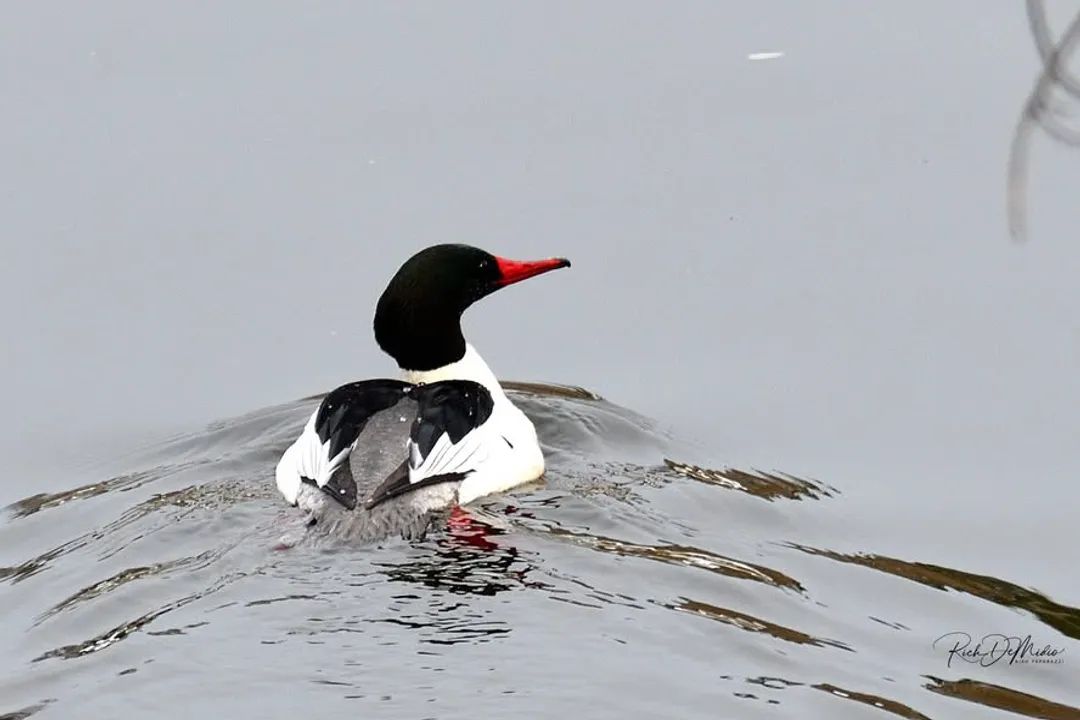
Diving into the world of mergansers immediately brings to mind those striking, long-billed ducks that specialize in aquatic hunting. These birds, often associated with clear, fast-moving water, possess several fascinating adaptations that set them apart from more familiar dabbling ducks. The Common Merganser, for instance, is a large and conspicuous bird that can be found across North America and Eurasia, making it one of the most widespread diving ducks in its family. [1] They are generally not birds content with skimming the surface; rather, they prefer to plunge beneath it in pursuit of their slippery prey. [1][7]
# Serrated Bills
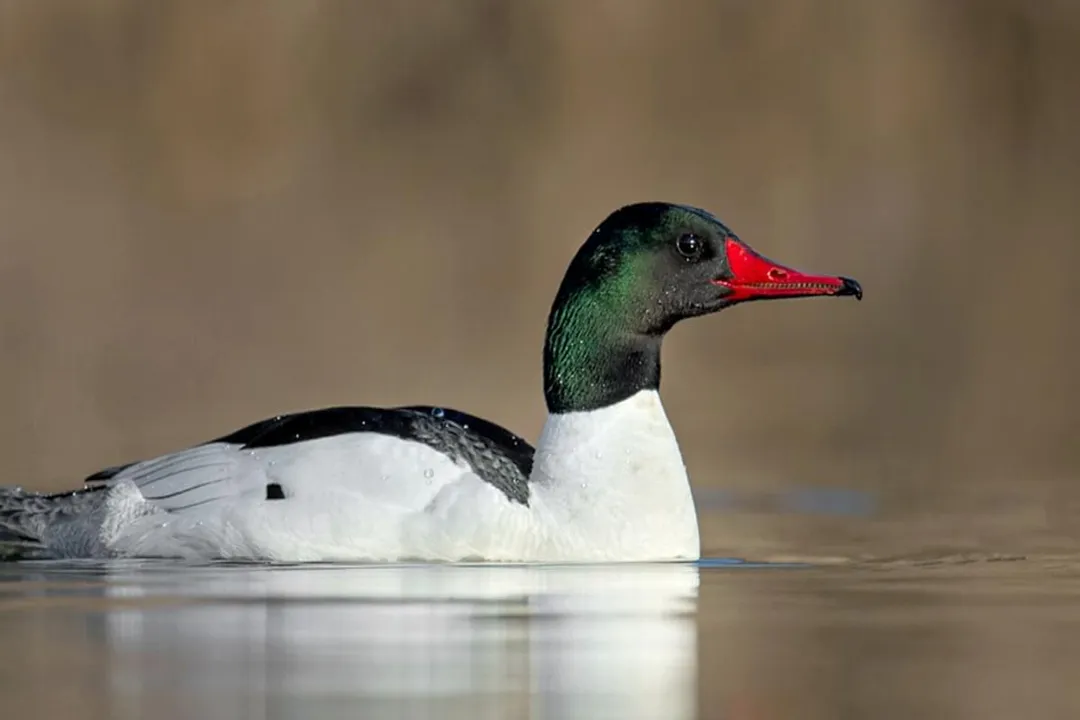
Perhaps the most defining characteristic of the merganser group is its unique dental structure, which has earned them the nickname "sawbills". [1][7] This refers to their long, thin bills which are equipped with sharp, tooth-like serrations along the edges. [1][7] Unlike the broad, flat bills of many other waterfowl designed for straining mud or water, the merganser's bill is perfectly engineered for gripping fish. [1][7] These serrations allow the duck to securely hold onto a fish, even if it's slimy or thrashing, ensuring the prey cannot easily escape before being manipulated for swallowing headfirst. [4][6] This specialized tool dictates their entire foraging strategy. [1][7] It’s worth noting that while they are often grouped together due to this feature, the bill structure and profile can subtly differ between species, offering a key to identification for the keen observer. [4][7]
# Diving Experts
Mergansers are true diving ducks, relying on powerful underwater propulsion rather than surface feeding. [1][7] They are incredibly capable swimmers beneath the surface, capable of remaining submerged for significant periods, sometimes up to a minute. [1] To achieve this level of underwater mobility, they employ their wings in a manner more akin to a seal or penguin, beating them rapidly to move through the water column efficiently. [4] This allows them to pursue active fish deep below the surface, with Common Mergansers documented diving to depths of thirty feet or more in their pursuit. [1][4] Their diet leans heavily on fish, though they will also consume aquatic insects and crustaceans when fish are less accessible. [4][8] The ability to hunt efficiently in deeper or faster currents is often directly related to the clarity of the water available; if a bird cannot visually locate its target, even the best gripping bill is less effective. This observation suggests that mergansers thrive best in environments where visibility is high, making them excellent indicators of water quality in rivers and large lakes. [3]
# Plumage Contrast

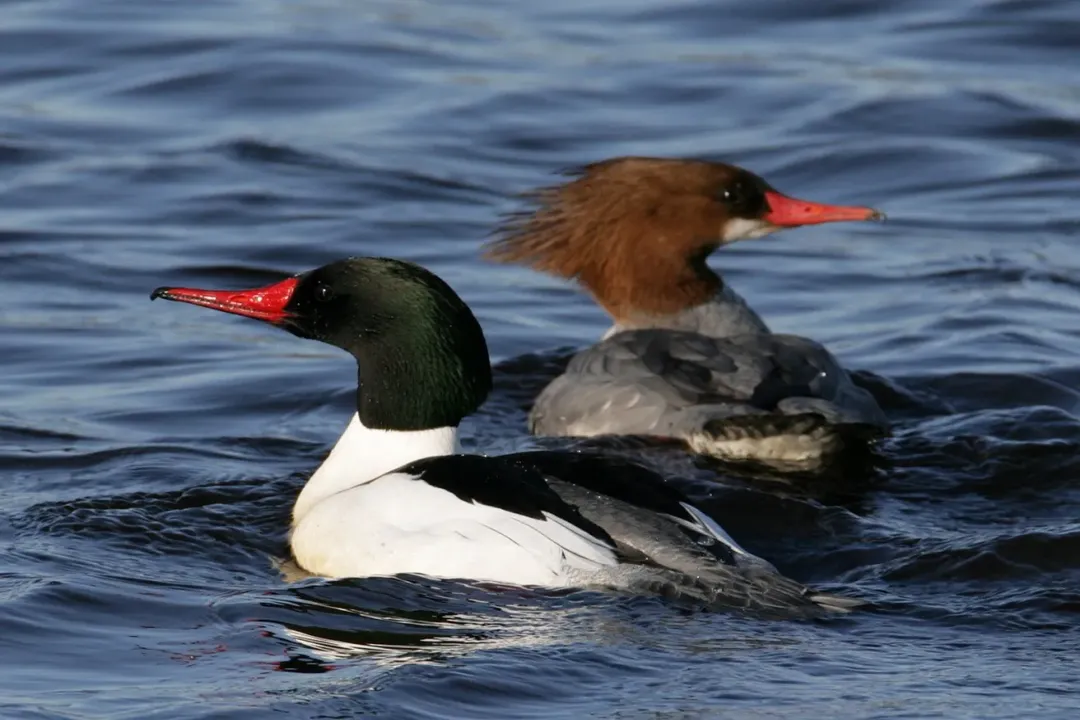
The visual differences between the male and female Common Merganser are striking, particularly during the breeding season, which provides a clear way to distinguish sexes in the field. [1][4] The male, or drake, possesses a brilliant, glossy black head that, depending on how the light catches it, can sometimes appear to have a greenish sheen rather than pure black. [4][7] His body is largely white, contrasting sharply with the dark head and back. [1][4]
The female, or hen, has a much more muted, though still distinct, appearance. [4] Her head is a warm, rusty or rufous color, which clearly contrasts with her grayish body feathers and the white on her neck and chest. [4] This rusty head color meets a distinct boundary with the white neck area, a feature that can help separate her from other species. [4]
When considering other species, like the smaller Hooded Merganser, this pattern of sexual dimorphism holds, though the specific colors vary. [8] Male Hooded Mergansers sport a conspicuous black crest with a central white patch, contrasting with a white body, while females display a crest that is often a duller, buffy-brown color. [8] Observing these plumage details is crucial, especially when they are seen swimming in open water, as the size difference between the Common Merganser and the Hooded Merganser can sometimes be hard to gauge at a distance. [1][8]
# Habitat Preference
Mergansers are adaptable in terms of the type of water body they inhabit, but they generally favor larger, more open areas that support a good fish population. [1][4][7] Common Mergansers are found on large freshwater lakes, major rivers, and even along coastal bays and estuaries, utilizing brackish or salt water as well as fresh. [1][7] This broad geographical spread suggests a high degree of adaptability to various climates and water conditions across their range. [1] Their presence often signals a healthy aquatic ecosystem capable of supporting a decent biomass of fish. [3] While they are strong swimmers, they rely on suitable shorelines or banks for resting and preening, though they are capable of resting on the water for long periods. [4] The fact that the species is found across continents—North America and Eurasia—points to a highly successful evolutionary strategy based on their specialized feeding mechanism. [1]

# Nesting Sites
Despite being expert divers, mergansers demonstrate a surprising preference for nesting in sheltered cavities when building their homes. [1][8] For the Common Merganser, suitable sites include natural tree hollows, old woodpecker holes, or rock crevices found near the water's edge. [1][4] In some less-wooded areas, or where suitable trees are scarce, they may even resort to nesting on the ground among dense vegetation or beneath logs. [1][4] This reliance on cavities means that habitat management can sometimes involve placing artificial nesting boxes near suitable waters to supplement natural availability. [3] Hooded Mergansers share this preference, typically utilizing tree cavities as their primary nesting location. [8] A useful observation for those trying to locate nests or encourage nesting near their property is that the female does the work of lining the cavity with soft materials, often plucked from her own body, to create a warm bed for the eggs. [4]
# Communication Sounds
In the world of ducks, mergansers are generally not known for being the loudest members of the waterfowl community, though this is highly dependent on the sex. [1] The male Common Merganser, or drake, is often described as being relatively silent, especially outside of the breeding season, contributing little to the soundscape. [1][7]
The female, however, is the primary vocalizer. [1][7] She communicates with a low, somewhat rattling series of calls. [1][7] If you are trying to locate a pair in dense riverside vegetation, listening for this distinct female call is often more productive than waiting for a loud quack typical of other duck species. [7] When thinking about identifying a bird by sound, remembering that the male is the quiet one while the female issues the low rattles offers a helpful mnemonic device for field identification. [7] If you see a pair interacting, the hen’s vocalization will likely be the sound you hear, contrasting with the drake's more stoic silence. [1]

# Field Identification Nuances
When observing these ducks in the field, especially the Common Merganser, the details of light and distance become critical. While the male's head is described as black, bright sunlight can reveal its true iridescent quality, shifting the perceived color to a deep green. [4][7] This means that the same bird viewed in shadow one minute and direct sun the next might appear to have a black head or a green head, a factor that can momentarily confuse an observer expecting a uniform color. Furthermore, recognizing the subtle difference in shape between the Common Merganser and the Red-breasted Merganser (though not detailed here, it's a common point of confusion) often comes down to the head shape and profile, especially in flight. [7] A key tip for watchers focusing on the Common Merganser: notice the white flanks of the male, which are usually much more extensive than those found on the Red-breasted species, providing a clear side-view contrast. [4] For the female Common Merganser, ensure you note the distinct demarcation between the rusty-colored head and the white neck; a soft transition or lack of a sharp line might indicate a different species. [4] These nuanced observations move beyond simply noting the bill type to truly understanding individual species characteristics. [1]
# A Comparative View
It is helpful to place the two mentioned species, the Common and the Hooded Merganser, side-by-side to appreciate the diversity within the sawbills.
| Feature | Common Merganser | Hooded Merganser |
|---|---|---|
| Size | Large duck | Smaller duck [1][8] |
| Male Head Color | Glossy black (can appear green) [4][7] | Black with a prominent white patch in the crest [8] |
| Female Head Color | Gray body, rusty-colored head [4] | Gray body, buffy/rusty crest [8] |
| Primary Diet | Mostly fish [4] | Crayfish, small fish, aquatic insects [8] |
| Range/Habitat | Widespread; large lakes, rivers, coasts [1] | More common inland on ponds, small lakes [8] |
This table clearly shows that while both share the serrated bill trait, their coloration and general size place them in different visual categories for birders. [1][8] While the Common Merganser is a powerhouse fisher in large bodies of water, the Hooded Merganser is often a more intimate visitor to smaller, sheltered ponds. [8] Understanding their preferred habitat size can sometimes be the first clue as to which species you are observing, even before the bill or crest comes into sharp focus. [1][8]
# Adaptations for Life on the Water
The merganser’s entire physiology is dedicated to its diving lifestyle. Their feathers are particularly dense, which helps them maintain buoyancy control and insulation while spending so much time submerged in cold water. [6] Furthermore, their leg placement is relatively far back on their body compared to dabbling ducks, which provides excellent propulsion for swimming and diving but makes them somewhat awkward when walking on land—a trade-off common among specialized diving birds. [4] Their movements on land or ice can sometimes appear clumsy or hesitant, reinforcing their dedication to the aquatic realm. [4] To maintain these essential feathers, preening is a significant part of their daily routine, ensuring that the waterproof oils are correctly distributed across the dense plumage. [6] This level of specialization highlights a distinct evolutionary path, prioritizing underwater efficiency over terrestrial mobility. [4]
# Distribution Notes
The breadth of the Common Merganser's range across two continents is remarkable. [1] In North America, they are widespread, often being the most common of the large sawbills seen. [4] Their preference for large bodies of water means that lakeshores and major river systems are prime viewing locations throughout the year in many regions. [3][7] For anyone in areas like Estes Park, Colorado, for example, seeing these handsome birds on the local reservoirs is a regular occurrence, often alongside other diving ducks. [3] This widespread distribution, from Alaskan wilderness to accessible urban park lakes, means that with a little patience and knowledge of their preferred habitat, encountering a merganser is often a high probability when visiting appropriate waterfronts. [1][7] If you are new to birding near water, locating a large, open body of water is a great starting point to look for these specialized divers. [1]
Related Questions
#Citations
Common Merganser - All About Birds
Fun Facts About Common Mergansers - Wild Birds Unlimited
Five Fun Facts About… The Common Merganser - Estes Park News
The Common Merganser - Flathead Audubon Society
Common merganser characteristics and behavior - Facebook
Common Merganser - Facts, Diet, Habitat & Pictures on Animalia.bio
Common Merganser | Audubon Field Guide
Hooded Merganser Fun Facts: The Feathered Fashion Icons of the ...
Common mergansers are easy to identify. No other duck has the ...