Whale Shark Physical Characteristics

The whale shark, Rhincodon typus, is an animal that defies simple description, immediately capturing attention due to its sheer magnitude—it holds the title of the largest fish currently swimming in the world's oceans. [1][5][6][9] Though commonly referred to with the moniker "whale," it is important to remember that this magnificent creature is, in fact, a shark, belonging to the class Chondrichthyes, which means its skeleton is made of cartilage, not bone. [8] Understanding the physical attributes of the whale shark reveals an animal perfectly specialized for a life of large-scale, gentle filter-feeding across tropical and warm temperate seas. [1][6]
# Gigantic Dimensions
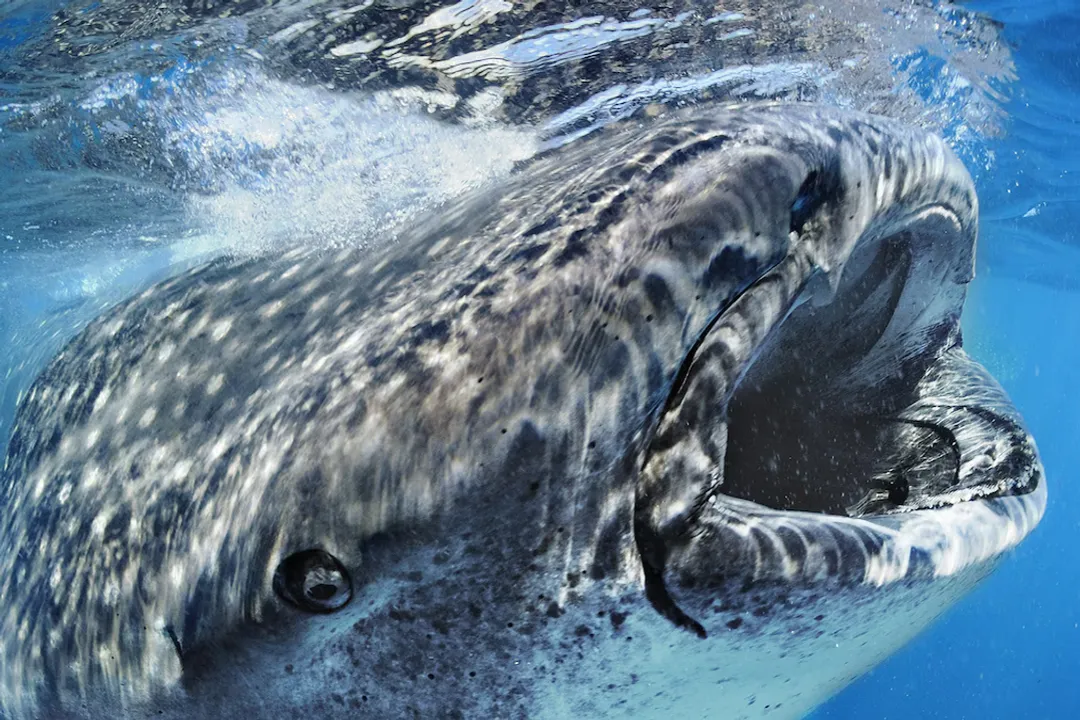
The most striking feature of the whale shark is its massive size. These are truly ocean giants, regularly reported to reach lengths of up to 18 meters (about 60 feet). [1][5][6] While records suggest a maximum size hovering near this mark, the most commonly encountered adults often measure around 9.8 meters (32 feet) for males and slightly larger, up to 14 meters (46 feet), for females. [1] This difference in size between sexes is a subtle but consistent aspect of their physical makeup, with females generally attaining greater bulk. [1]
When considering their mass, the numbers become almost incomprehensible for a fish. A fully grown specimen can weigh in excess of 21.5 metric tons, or nearly 47,000 pounds. [1][6] Given the documented variability in observed sizes, where many sightings remain below the maximum recorded length, one might deduce that the largest, most elusive individuals carry significantly more mass than even the higher end of the commonly reported figures. This suggests a considerable population of massive, mature animals may still live far from direct human observation, contributing to the species' ongoing mystery. [1]
The lifespan estimation is equally grand, with current scientific consensus suggesting these sharks can live for a very long time—possibly up to 130 years, though precise aging data remains scarce and requires further study. [1][6]
# Unique Markings

Stepping closer to the surface, the second most defining physical characteristic emerges: the skin pattern. Whale sharks are adorned with a mesmerizing array of light-colored spots and pale horizontal and vertical lines arranged against a darker background, which typically ranges from a bluish-gray to brownish hue. [1][3][5][6] This pattern is often likened to a checkerboard or a celestial constellation, and it serves a critical purpose: no two whale sharks share the exact same pattern. [1][3][9]
This unique spotting acts as an individual identifier, much like a human fingerprint, allowing researchers to track specific animals across their vast migratory routes. [1][3][9] From an ecological standpoint, this pattern likely provides a form of disruptive camouflage. When viewed from below in the sun-dappled upper layers of the ocean, the contrasting spots and stripes help break up the shark's enormous outline, making it harder for both prey and potential observers to discern its shape against the shifting light and shadow of the water column. [5]

# Head Structure

The overall shape of the head is remarkably broad and flattened, contributing to the shark's "whale-like" profile, distinguishing it from many other, more streamlined shark species. [1][6] The mouth itself is enormous—sometimes spanning up to 1.5 meters (5 feet) wide—and is positioned terminally, meaning it sits right at the very front of the head, rather than being underslung or sub-terminal as seen in predators like the Great White Shark. [1][6]
Despite the massive size of the oral cavity, the teeth housed within are surprisingly small. [1][5][6] These sharks possess around 300 rows of these minute teeth, which are not designed for tearing large chunks of flesh but rather for grasping smaller prey, such as plankton or small fish, before they are directed toward the throat. [1][5] This anatomical setup—a vast mouth paired with tiny teeth—is the perfect physical adaptation for their primary feeding strategy: ram filtration. [3]
# Skin and Gills
The integument, or skin, of the whale shark is exceptionally thick, offering a substantial layer of protection. In certain areas, the skin can measure up to 10 centimeters (4 inches) thick. [1][6] This thick hide is covered not by typical scales but by dermal denticles. [1][6] These are essentially modified, tooth-like structures that give the skin a rough texture, sometimes described as feeling like sandpaper. [6] While the primary function of dermal denticles in many sharks relates to hydrodynamics, helping to reduce drag and improve swimming efficiency, their sheer thickness here speaks to a defense mechanism against abrasion in their environment. [1]
On either side of the head, just behind the eyes, are the structures vital for respiration: the gills. The whale shark possesses five large gill slits on each side. [1][6] As a ram feeder, the shark must swim continuously with its mouth open to force water over these gills, allowing oxygen extraction while simultaneously filtering out the massive volumes of water needed to sustain its body mass. [3]

# Fin Placement
The fins are arranged to support powerful, steady locomotion required for its migratory life, though they are not built for rapid bursts of speed like some apex predators. [6] The dorsal fin, the prominent fin on the back, is large and typically situated about one-third of the way down the body from the head. [1][6] Paired pectoral fins, located behind the gills, are also substantial and play a key role in maneuvering and lift. [6]
The tail, or caudal fin, exhibits the classic shark structure known as heterocercal, meaning the upper lobe of the tail fin is noticeably longer than the lower lobe. [1][6] This asymmetry, combined with the stabilizing effect of the dorsal and pectoral fins, helps generate the necessary thrust for propulsion through the water column, allowing the shark to travel vast distances in search of food patches. [6]
# Sensory Features
While visually oriented due to their large size, whale sharks rely on a suite of sensory inputs. Their eyes are relatively small compared to their massive heads, positioned on the sides of the snout, though positioned somewhat forward. [1][6] Just in front of these eyes, the nostrils are large and distinct features on the broad expanse of the snout. [1] Like all sharks, they possess specialized sensory organs known as the ampullae of Lorenzini, which detect the weak electrical fields generated by the muscle movements of potential prey, even those buried beneath the sediment, although this sense is perhaps less critical for a filter feeder than for an active hunter. [6] The placement of these sensory arrays suggests an awareness spanning their immediate front and sides, essential for navigation and locating dense blooms of plankton in the open ocean. [1]
Related Questions
#Citations
Whale shark - Wikipedia
Whale Shark – Discover Fishes - Florida Museum of Natural History
Whale Shark | Online Learning Center - Aquarium of the Pacific
Whale Shark Anatomy | Facts and Features - Eco Migrations
Whale Shark | National Geographic
Whale Shark Anatomy — Marine Megafauna Foundation
The Whale Shark: A Whale of a Fish
Whale Sharks, Rhincodon typus - MarineBio Conservation Society
Whale Shark - Great Barrier Reef Foundation
Rhincodon typus (whale shark) - Animal Diversity Web