Wels Catfish Evolution
This massive fish, Silurus glanis, presents an image of ancient survival, an imposing figure in the slow-moving waters it calls home across Eurasia. [1][7] Its smooth, scaleless skin and broad, flattened head give it a prehistoric aspect, suggesting a lineage that has successfully navigated countless environmental shifts over deep time. [1] The Wels Catfish is not merely a large specimen; it represents a highly adapted predatory form whose evolutionary success hinges on longevity and sensory refinement rather than speed or schooling behavior. [5]
# Ancient Appearance
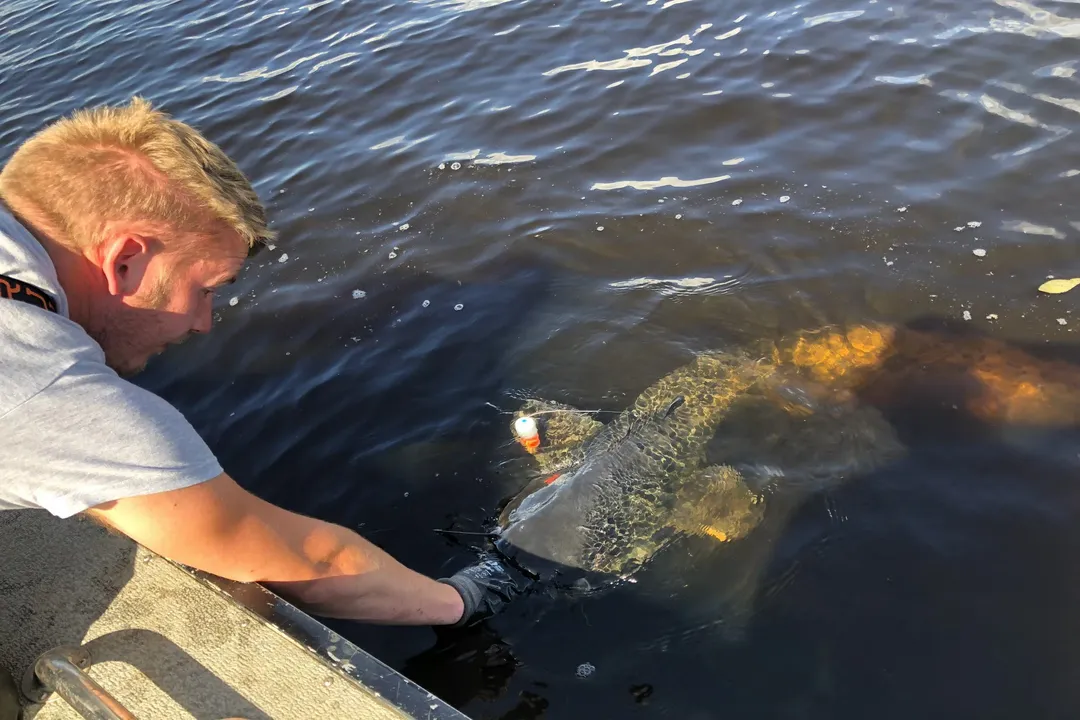
The sheer scale of the Wels Catfish is often the first thing noted by observers or anglers. [7] Mature individuals frequently surpass two meters in length and can weigh in excess of 90 kilograms, though historical records sometimes claim even greater sizes. [7] This impressive bulk is supported by a body structure built for benthic (bottom-dwelling) life. Unlike many faster-swimming teleosts, the Wels Catfish possesses long, tapering fins and a body shape optimized for slow, powerful movements along the riverbed or deep lake floor. [1] This morphology is a direct result of the environmental pressures where large food items are captured opportunistically rather than through sustained pursuit. [5]
# Lineage Traced
As a member of the family Siluridae, the Wels Catfish belongs to a group of freshwater fishes noted for lacking scales and possessing prominent sensory barbels. [7] Its native range blankets a significant portion of Europe, stretching from the Rhine catchment eastward across the continent and into western Asia. [1] This broad native distribution speaks to an ancestral tolerance for diverse freshwater conditions, from large, deep lakes to expansive, slow-flowing river systems. [1] The persistence of a single, dominant species across such varied aquatic geographies suggests a relatively stable evolutionary path where broad adaptation was favored over rapid diversification into numerous endemic forms. [1]
# Slow Life Strategy
One of the most compelling evolutionary attributes recently illuminated about S. glanis is its potential lifespan. Research published around 2022 revealed that, based on growth increments and physiological markers, the Wels Catfish can potentially reach an age comparable to that of a human being. [4] Studies analyzing the aging process in these fish confirmed they can survive for many decades. [4] This remarkable longevity is intrinsically linked to its large size and its life history strategy. Large, long-lived organisms generally evolve to invest less frequently, but more heavily, in reproduction. The physiological machinery required to maintain cellular integrity and avoid senescence over such an extended period—mechanisms studied in detail by ichthyologists—is an evolutionary achievement in itself. [3] The slow pace of life translates directly into an extended reproductive window, offering numerous chances over decades to contribute offspring to the next generation, even if reproductive success is sporadic. [3]
# Sensory Tools
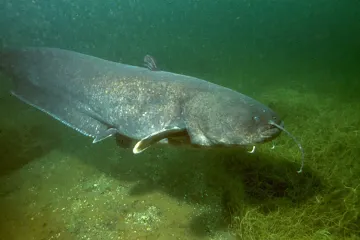
Survival for a massive, bottom-oriented predator in often turbid water depends heavily on non-visual cues, and the Wels Catfish has perfected this reliance. The most obvious evolutionary adaptation serving this purpose is the array of barbels surrounding the mouth. [1] They typically possess three pairs of these fleshy filaments. [7] These are not merely decorative; they are densely packed with chemoreceptors, effectively functioning as an external nose and tongue that constantly samples the water for chemical signatures of prey. [7] In addition to taste and smell, they possess significant mechanoreceptive capabilities, allowing the fish to sense minute water vibrations caused by distant movements. [5] This sophisticated sensory network means the Wels Catfish can effectively hunt in complete darkness or in the silt-laden water common in its habitat, a clear adaptation making it an extremely efficient ambush predator. [1][7]
Considering their reliance on chemoreception and vibration sensing over vision, it is fascinating to note how this specialization contrasts with visually oriented pelagic predators. The Wels Catfish's reliance on these senses means that its evolutionary success is less dependent on water clarity or light penetration, granting it access to ecological niches unavailable to sight-hunters. [5] This trade-off—sacrificing acute sight for unparalleled chemical and tactile awareness—is a prime example of divergent evolution within freshwater fishes.

# Ecological Success
The evolutionary trajectory of the Wels Catfish has led it to become a generalist apex predator in many European systems. [5] Its diet is incredibly broad, consuming fish, mollusks, crustaceans, insects, amphibians, and sometimes even small mammals or birds that come to the water's edge. [1][5] This flexibility is a cornerstone of its ability to persist across changing conditions, as it is not dependent on a single prey source. When ecological stability is threatened, or when it is introduced into non-native waters, this opportunistic nature becomes highly pronounced. [2] The concerns raised about its introduction, such as in North America’s Great Lakes system, stem directly from this evolved predatory capacity and lack of native checks in new environments. [2]
If we examine the sheer biomass a single large Wels Catfish represents, its role in nutrient cycling becomes significant. An animal of that size requires substantial energy input, meaning that in a stable, native environment, the population density is likely low, placing strong predatory pressure on medium-to-large prey fish populations. [5]
# Adaptability Understood
While the species is generally thought of as stable within its current range, the ability for S. glanis to be moved and established outside of Eurasia provides another clue regarding its evolutionary makeup. [2] When introduced into new systems, such as those in Western Europe outside its original historic range, it tends to establish itself rapidly, provided the temperature and habitat structure are suitable. [1] This suggests that the evolutionary toolkit—the physiology for aging, the sensory adaptation, and the broad diet—was already highly plastic, allowing rapid colonization rather than requiring a slower process of genetic mutation and natural selection in the new location.
This inherent plasticity contrasts sharply with species that require very specific environmental cues or food sources to thrive. The Wels Catfish appears genetically predisposed to thrive in large, slow-moving, warm-to-temperate water bodies globally, making it a successful colonizer when transported by human activity. [2] This generalist success, built upon a foundation of extreme longevity and highly refined sensory perception, explains why Silurus glanis remains a dominant presence in its historical habitat centuries after its ancestors first evolved their current successful blueprint. [3][7]
#Videos
The Secret Hunting System of the Wels Catfish | Ep 1 - YouTube
Related Questions
#Citations
Wels Catfish Fish Facts - Silurus glanis - A-Z Animals
Species Profile - Wels Catfish
Exceptional longevity in northern peripheral populations of Wels ...
The Wels catfish can become as old as a human being - Lnu.se
Wels catfish - LIFE PREDATOR
Here be monsters [discription in comments] : r/SpeculativeEvolution
Silurus glanis (Wels catfish) - Seriously Fish
The Secret Hunting System of the Wels Catfish | Ep 1 - YouTube
Wels Catfish - Deeeep.io Wiki