Is a kangaroo rat a herbivore or omnivore?

The small rodent found hopping across arid North American landscapes, the kangaroo rat, presents a fascinating puzzle when classifying its diet. While they are often immediately associated with seeds and desert survival, the definitive label of herbivore or omnivore requires a closer look at what ends up in their cheek pouches and stomachs. They are masters of efficiency in environments where free water is scarce, and this necessity shapes every aspect of their nutritional intake, leading to a classification that leans heavily toward plants but includes opportunistic animal protein.
# Seed Specialization
The foundation of nearly every kangaroo rat's diet across the genus Dipodomys is plant matter, specifically seeds. These tiny powerhouses, known as granivores, are perfectly adapted to extract the moisture they need from these dry stores. They thrive where water is virtually non-existent, often going months without taking a single drop of free water, deriving nearly all necessary hydration from their food.
For many species, like Merriam’s kangaroo rat, seeds from various desert grasses form the bulk of their sustenance, supplemented by items like mesquite beans. Ord’s kangaroo rats in Texas show a similar preference, with seeds of creosotebush, gramas, and dropseeds forming the major portion of their diet, alongside seeds from plants like honey mesquite and sandbur. This reliance on seeds is so pronounced that in one Colorado study of Ord’s kangaroo rat diets, seeds accounted for a staggering 74 percent of their food intake.
Beyond mature seeds, they also consume other desiccated plant parts, as well as fresh, green vegetation and flowers when available. This green material, though secondary to seeds, is important as it provides readily available moisture, especially when new growth appears in the spring.
# The Animal Component
The crucial point separating a strict herbivore from an omnivore is the regular inclusion of animal matter. Several sources confirm that kangaroo rats do, in fact, consume animal material. While this component is minor compared to their plant intake, its presence is a defining factor in their dietary classification.
For instance, in the diet breakdown for Ord’s kangaroo rat, arthropods were noted to make up about 4 percent of their consumption. Merriam’s kangaroo rat is also noted to occasionally consume insects. More definitively, the Giant Kangaroo Rat (Dipodomys ingens) is explicitly described as being omnivorous—a granivore and insectivore—with its diet including seeds, green plants, and insects such as bees and wasps. This consumption of insects, even if infrequent, moves the species outside the rigid definition of an herbivore and into the category of an omnivore, albeit one heavily skewed toward the herbivorous side.
It is interesting to contrast this with generalized "rats" (like those in the Rattus genus), which are often true, broad-spectrum omnivores eating everything from fruit and seeds to reptiles and fish. Kangaroo rats, by contrast, seem evolutionarily locked into a desert seed-based diet, only incorporating arthropods when the opportunity arises or the need for specific nutrients is present.
# Foraging and Storage Adaptations
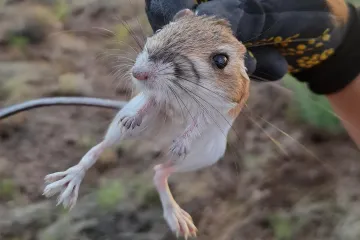
To support this specialized, moisture-dependent diet, kangaroo rats possess remarkable physiological and behavioral adaptations. The most famous is their system of external cheek pouches. These fur-lined pockets allow the rodents to transport large quantities of seeds back to their burrows in a single trip. This external storage is particularly clever because it allows them to keep their mouths closed, minimizing water loss by not moistening the seeds with saliva during transport.
Once underground, the harvested material is either eaten immediately or, more commonly, cached. They create dozens, sometimes hundreds, of shallow caches, storing seeds for later retrieval. This behavior is vital for survival during times of drought or cold weather when surface foraging is dangerous or impossible.
A fascinating ecological note emerges when considering this hoarding habit. Because kangaroo rats are highly effective at retrieving shallow caches, the seeds they forget or choose not to retrieve can germinate, making them unintentional, yet significant, seed dispersers. In fact, their activity influences plant communities; for example, after a fire, kangaroo rats have been observed encouraging the postfire dominance of certain grasses by caching their seeds, while simultaneously reducing the availability of larger shrub seeds by consuming them more readily. This means their diet selection directly engineers the future structure of their desert habitat, solidifying their role as keystone species in many arid ecosystems.
When mammologists attempt to track or trap these desert dwellers in the field, they often rely on attractants that echo their natural food preferences or chemical senses. The powerful attraction of vanilla extract in trapping studies, particularly for Merriam’s kangaroo rats, is hypothesized to be linked to the chemical precursors found in their primary food source, mesquite seeds, which are known to contain compounds similar to vanillin. This suggests their foraging decisions are influenced by a complex chemical signature associated with reliable, high-moisture seed resources, rather than just a simple visual or caloric assessment of available food.
# Classification Summary
So, is a kangaroo rat a herbivore or an omnivore?
The most accurate description is that kangaroo rats are facultative omnivores whose diet is overwhelmingly herbivorous and granivorous. They can survive almost entirely on seeds, which is the hallmark of a granivore perfectly adapted to aridity. However, the documented inclusion of arthropods, even in small percentages, means they are not technically herbivores in the strictest sense. For the general reader interested in the primary function of this animal in its ecosystem, describing them as primarily seed-eaters is the most functionally correct statement, but acknowledging their occasional insect meals places them scientifically in the omnivore camp.
Their entire existence is calibrated around maximizing seed intake while minimizing water loss through specialized kidneys and behavioral choices like dust-bathing instead of water-bathing. This dedication to dry plant matter is what defines them, even if a stray spider or beetle occasionally crosses their path on a cool desert night.
Related Questions
#Citations
Kangaroo rats | NinjaRat.org
Ord's kangaroo rat - Wikipedia
Dipodomys ordii - USDA Forest Service
Exploring the Dietary Habits of Kangaroo Rats
Is a kangaroo rat an herbivore? - Homework.Study.com
Dipodomys ingens (giant kangaroo rat) - Animal Diversity Web
Rats - Animal Facts - Vegan Peace
Kangaroo Rat Fact Sheet - Desert Museum
Desert Kangaroo Rat - Facts, Diet, Habitat & Pictures on Animalia.bio