Is a pond skater a spider?
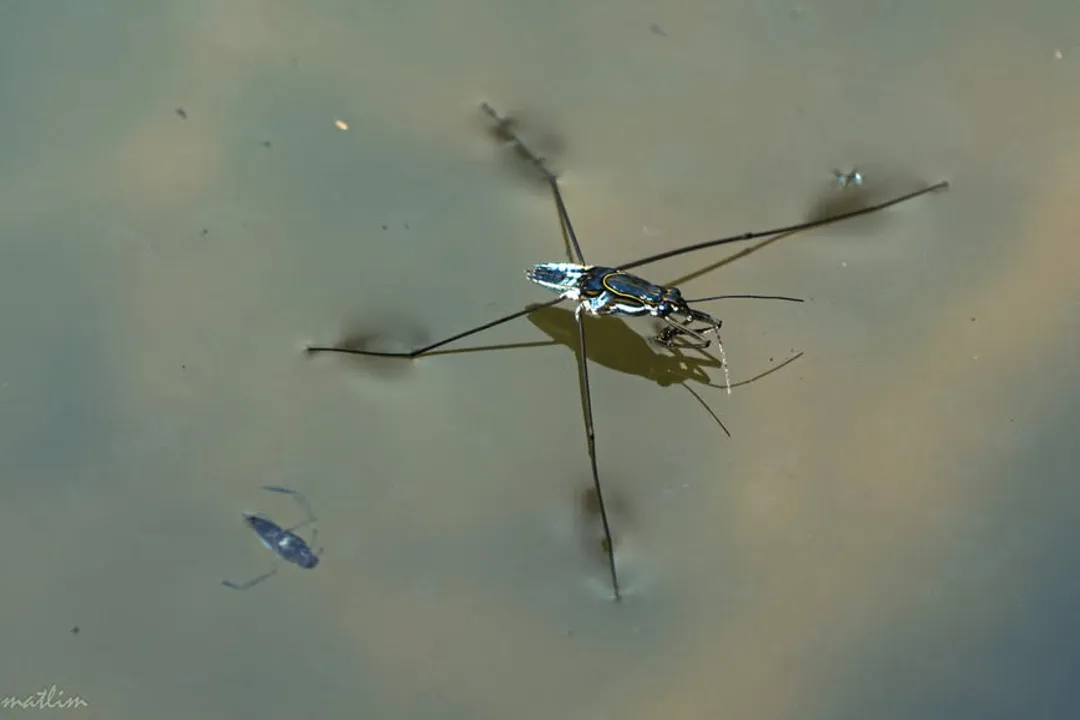
That sleek creature skimming effortlessly across the surface of a local pond or slow-moving stream is often met with assumptions, especially regarding its relationship to other eight-legged denizens of the garden. While the sight of something moving rapidly across water might immediately suggest a spider to the casual observer, the reality places these surface dwellers firmly in a different class of life altogether. The creature known commonly as the pond skater, or more formally as a water strider, is not a spider; it is, in fact, an insect. [1] This distinction hinges on fundamental differences in anatomy, ancestry, and body structure that separate the insect world from the arachnid realm. [4]
# Body Segments
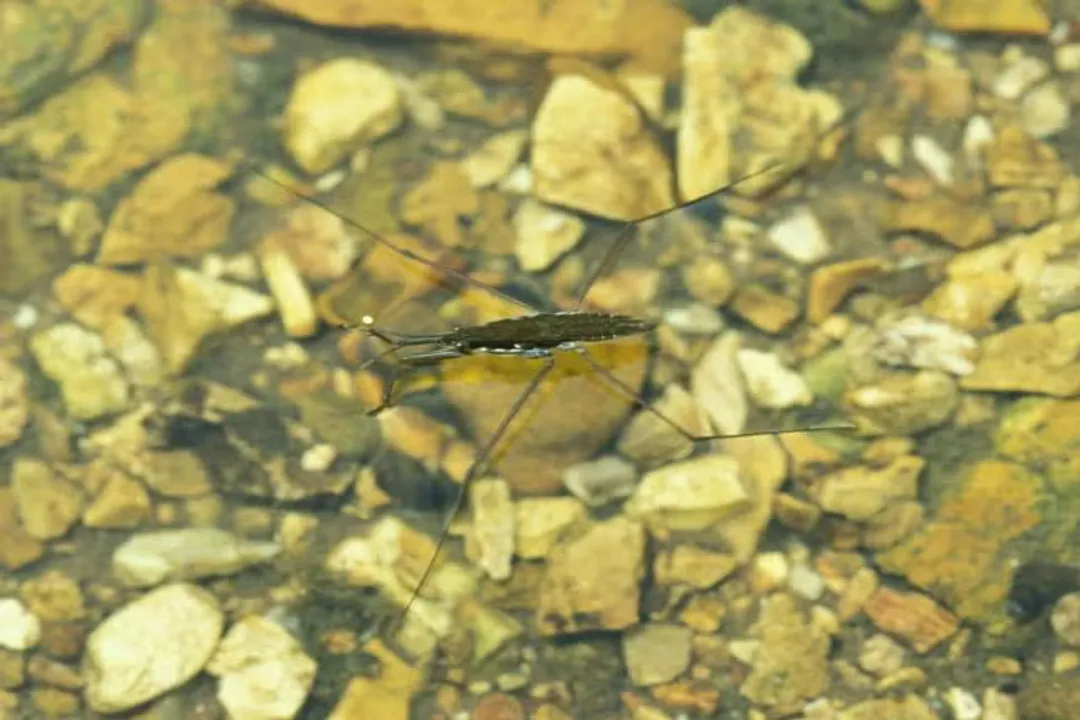
The most straightforward way to differentiate any arthropod is by counting its legs, but a closer look reveals a division in body plan as well. Spiders, belonging to the class Arachnida, possess eight legs. [1][4] They also exhibit two primary body segments: the cephalothorax (fused head and thorax) and the abdomen. [4]
Pond skaters, however, conform to the classic blueprint of an insect, class Insecta. This means they possess six legs and a body clearly divided into three distinct sections: the head, the thorax, and the abdomen. [1][3] This leg count is the single most reliable, immediate marker for separating these water-surface acrobats from any spider species that might accidentally venture onto the water. [4]
Here is a quick comparison of the defining physical traits:
| Feature | Pond Skater (Water Strider) | Spider |
|---|---|---|
| Class | Insecta | Arachnida |
| Leg Count | 6 | 8 |
| Body Segments | 3 (Head, Thorax, Abdomen) | 2 (Cephalothorax, Abdomen) |
| Order | Hemiptera (True Bugs) | Araneae |
Pond skaters belong specifically to the family Gerridae. [1] Members of the order Hemiptera, often called "true bugs," share characteristics like piercing-sucking mouthparts, although the specialized feeding methods of the Gerridae focus on prey captured on the water's surface. [1]
# Surface Mechanics
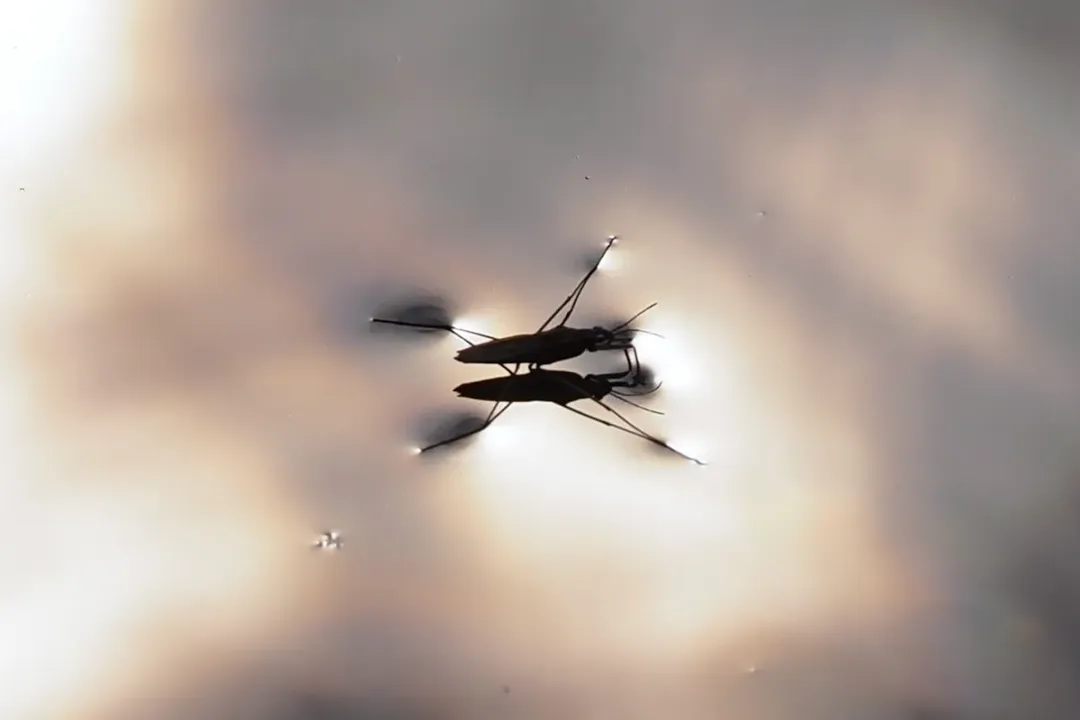
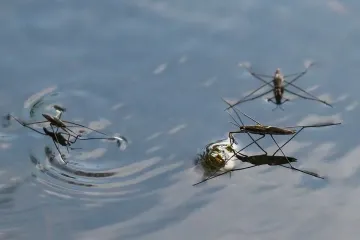
The ability of the pond skater to glide across water without sinking is what makes it so captivating, and this ability is entirely rooted in physics, not web-spinning. They utilize surface tension, the cohesive force between water molecules that creates a sort of elastic skin on the water's surface. [2]
Each of the six legs is long and slender, designed not to break this tension. Crucially, the legs are covered in microscopic, water-repellent, or hydrophobic hairs. [1] These specialized hairs trap tiny pockets of air, ensuring that the insect's body weight is spread out over a relatively large area across the water's surface. [2] Because the pressure exerted by the insect's weight is less than the force holding the water molecules together, they remain dry and afloat. [1]
It is interesting to consider the scale of this feat. If you picture the pressure exerted by that tiny insect, it is astonishingly small relative to its body mass. This finely tuned weight distribution means that an object ten times the size of a pond skater, if scaled perfectly, would still be able to skim the surface using the same physical principles. [5] This efficiency in leveraging a natural physical property separates them entirely from terrestrial spiders, whose movement relies on grip and strength rather than surface interaction. [5] A spider that attempts to rest on the water without specialized adaptations sinks because its legs displace too much water relative to the surface tension they can effectively manipulate.
# Hunting Tactics
Pond skaters are not passive drifters; they are active predators within their specialized niche. Their diet consists primarily of small insects that meet an untimely end by landing on the water's surface, unable to escape the surface film. [6] This includes creatures like gnats, flies, and other small, unfortunate terrestrial insects that become trapped. [2][8]
When a potential meal lands nearby, the water strider reacts with remarkable speed. They use their middle pair of legs like oars to propel themselves across the surface toward the prey. [1] Once they reach the victim, they use their piercing-sucking mouthparts, characteristic of true bugs, to inject digestive enzymes and then suck out the liquefied internal contents of their victim. [2] They act as a vital clean-up crew for the water's edge, removing stranded prey that might otherwise decompose in the water. [8]
For those observing these creatures in a local park pond, watching this feeding behavior is a quick way to confirm they are watching a Gerrid. If you see a water strider rapidly approach a struggling fly and then stand perfectly still over it while it feeds, you are witnessing an insect in action, not an arachnid wrapping silk. [6] They do not produce silk for catching prey; that specialization belongs to the spiders. [1]
# Winged Variations
Another area where pond skaters show diversity, setting them apart from a generalized perception of a single "water bug," is their wings. Not all water striders can fly. [1]
Like many insects, Gerridae species exhibit variation, sometimes having fully developed wings (macropterous) or being entirely wingless (apterous). [1] The presence or absence of wings can sometimes depend on the environment. In environments where ponds are stable and food is consistent, wingless forms may dominate, as maintaining the structure for flight is unnecessary energy expenditure. Conversely, in temporary or harsh habitats, the winged forms are more likely to develop, allowing them to fly away and find a new, more reliable body of water when their current home dries up or becomes overcrowded. [1]
This variation in flight capability is another characteristic firmly rooted in the insect world, contrasting with spiders, which are universally wingless. If you observe a pond skater that seems bulky or hesitant to move, it might be a wingless individual, stuck navigating only on the water film and the immediate shore. [1]
# Field Identification Tips
When you are out by the water, misidentification can happen easily if you are looking for quick answers. While the leg count is key, it is important to know what else might be sharing the surface. Sometimes, diving spiders (a specific type of arachnid) might temporarily sit on the surface, but they will look distinctly different—heavier, often darker, and possessing the tell-tale eight legs. [4]
If you see an insect with a long, thin body gliding rapidly, focus on the legs and the movement pattern. Water striders tend to skate in straight lines or quick darts, using their middle legs for propulsion and their front legs often held forward to sense vibrations or prey. [2] Their movement is characterized by an almost effortless slide, enabled by the specialized structure of their feet. [5]
For the dedicated observer, distinguishing between different species of Gerridae often comes down to subtle features, like the length of their antennae or whether they possess wings. [1] For instance, in some areas, you might find common meadow striders versus giant water boatmen (though boatmen are in a different insect order, Belostomatidae, and swim under the water, presenting a different identification challenge entirely). The key takeaway remains: if it is gliding on the surface using hydrophobic leg hairs, it is a Gerrid, an insect of the Hemiptera order, and not a spider. [1][3]
While they share the habitat of the water's surface, the evolutionary paths of the insect and the arachnid diverged long ago. The pond skater represents a masterful adaptation to exploiting surface physics—a true testament to the diverse ways life occupies every available niche, even the delicate boundary between water and air. Their six-legged elegance is a study in hydrodynamic efficiency, securing their place among the insects rather than the eight-legged spiders.
Related Questions
#Citations
Gerridae - Wikipedia
7 Cool Facts About Water Striders
Water Striders - Home and Garden IPM from Cooperative Extension
Pond Skater Insect Facts - A-Z Animals
What is the role of a pond skater in the ecosystem? - Facebook
Water Striders | Missouri Department of Conservation
TIL: Water striders (pond skaters) are not just found in freshwater ...
Pond-skaters: the water clean-up squad! - Ray Cannon's nature notes
Water strider Facts for Kids