Is a horned grebe a duck?
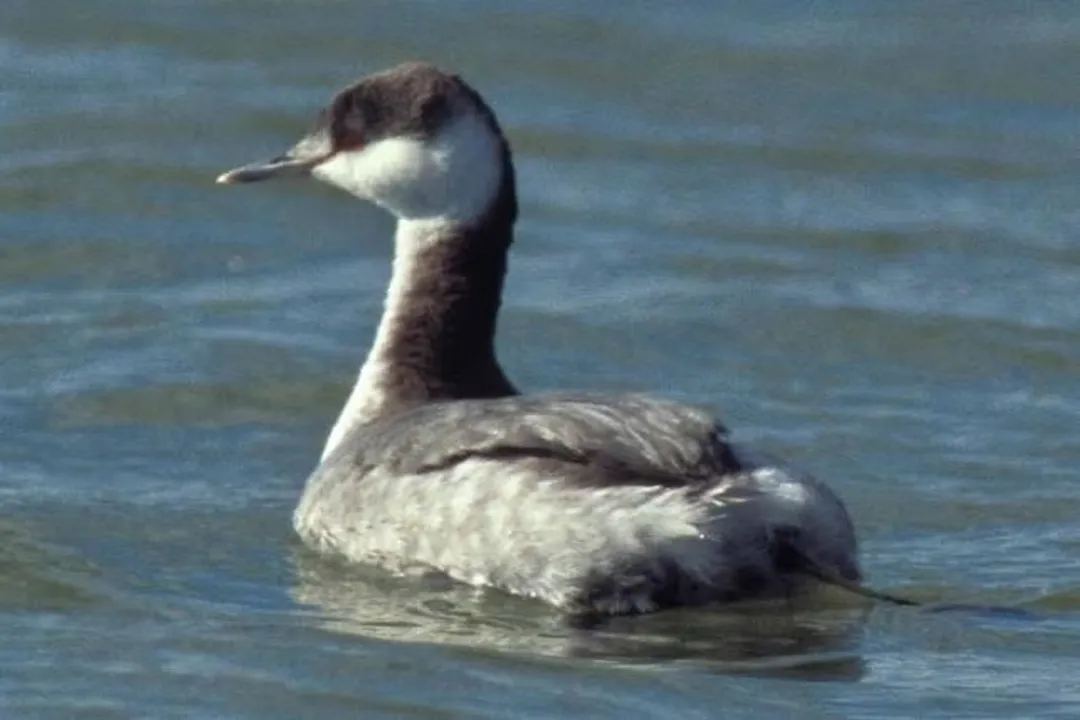
The water's surface often presents a confusing cast of characters to the casual observer, and few birds prompt the question "Is that a duck?" more frequently than the Horned Grebe (Podiceps auritus). While they share the same general habitat—coastal bays in winter and small, often hidden, freshwater ponds during the breeding season—and possess a somewhat stout, low-profile body when floating, the Horned Grebe is decidedly not a duck. This apparent similarity is a classic case of convergent evolution or simple environmental niche overlap, as their biological classifications place them in entirely separate orders of birds. [2]
# Avian Grouping
The fundamental difference lies deep within the avian taxonomy. Ducks, geese, and swans all belong to the order Anseriformes. [2] Grebes, conversely, are members of the order Podicipediformes. [2] This means that while they are both waterbirds, their evolutionary paths diverged long ago, placing them into distinct families and higher groupings within the bird world. [2] A casual glance at their appearance might suggest they are close cousins, but ornithologically, they are quite distant relatives.
# Key Structural Differences
To truly separate a grebe from a duck, one needs to look beyond the surface plumage, specifically at their feet and leg placement, which are perhaps the most telling anatomical distinctions. [2][4]
Ducks possess fully webbed feet, an adaptation that provides a broad paddle for efficient propulsion through the water. [2][4] Grebes, however, employ a far more specialized, though less terrestrial-friendly, system: they have lobed toes. [2][4] Each toe has a flap or lobe of skin that expands during the backward thrust of a stroke and collapses on the forward recovery, allowing for powerful, rapid maneuvering underwater—a design excellent for hunting fish and invertebrates beneath the surface. [2][3]
This anatomical distinction—lobed toes versus webbed feet—is intrinsically linked to another major physical difference: where their legs sit on their bodies. [2] Grebes carry their legs far back on their torso. [2][4] This rearward placement is brilliant for steering and propulsion while diving, essentially turning their legs into high-performance outboard motors. [3] However, this design makes them incredibly awkward on land. [2][3][4] Unlike ducks, which can waddle with relative ease, grebes can barely walk, often resorting to a clumsy shuffling or simply remaining in the water. [3] If you see a waterbird that seems reluctant to walk on a dock or shore, odds are high you are looking at a grebe, not a duck. [4]

# Plumage and Form
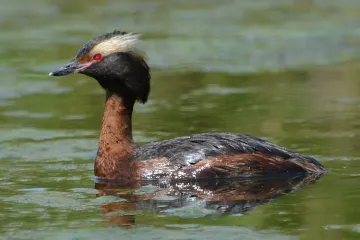
When observing a Horned Grebe in its striking breeding attire, the features become clearer than in the drab winter phase. In summer, they are small diving birds adorned with a deep, rich rusty-rufous color on their neck and flanks, sharply contrasted by a black back and crown. [1][7] The most identifying feature, which gives them their name, is the conspicuous spray of golden-orange ear tufts that flare out from behind the eye—the "horns". [1][4][7] Their bill is short, straight, and needle-like, contrasting with the broader, flatter bills typical of many duck species built for dabbling or straining. [1][7]
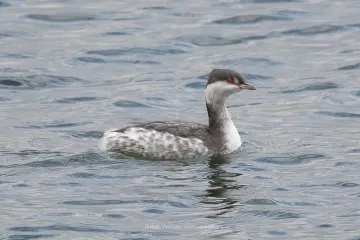
In contrast, the winter plumage is much more subdued: a dark cap extending down the back of the head and neck, with a clean white face and underparts. [1][7] Even in this non-breeding stage, the combination of the darker cap, pale face, and that compact, almost cylindrical body shape on the water sets them apart from ducks that share their wintering grounds, such as scaup or buffleheads.
# Aquatic Behavior
Both grebes and diving ducks spend significant time submerged, but their feeding styles reflect their different physical tools. Grebes are consummate divers, often swimming entirely submerged for extended periods while pursuing prey. [3] Their diet consists primarily of small fish, aquatic insects, and crustaceans, which they capture with their sharp bills. [1][7] They rely on stealth and speed underwater.
Ducks, even diving species like scaup, often employ a different pursuit technique, and dabbling ducks rarely dive at all, preferring to tip head-down with their tails up to feed on vegetation near the surface. [4] The Horned Grebe’s entire life is oriented around aquatic efficiency, leading to behaviors such as elaborate courtship displays involving synchronized movements across the water surface. [3]
# Habitat Preferences
The habitat preferences further segment the grebe from many common duck populations. During the breeding season, Horned Grebes seek out shallow, vegetated freshwater environments—lakes, ponds, and slow rivers—often preferring the cover of emergent vegetation. [1][4][5] They construct their nests on floating mats of decaying vegetation near the water's edge. [4]
When migration occurs, they shift dramatically to saltwater habitats. [1][5] During winter, they disperse widely, often found in bays, estuaries, and along exposed coastlines, sometimes far from shore. [1][7] This adaptability allows them to utilize both inland and coastal waters across their range, though their dependency on specific freshwater conditions for nesting remains crucial in areas where they are identified as species at risk, such as in certain zones of Ontario. [5] It’s worth noting that observing a Horned Grebe resting on open, choppy salt water in mid-winter might lead one to mistake it for a small sea duck, but that low, sleek profile is the grebe signature. [7]
# Locomotion Tradeoffs
The evolutionary specialization of the Horned Grebe offers a striking example of an organism maximizing one skill at the expense of another. The placement of the legs so far back is not a flaw; it is a commitment to underwater performance. Think of it like a torpedo versus a speedboat. The torpedo (the grebe) is designed for efficiency in a dense medium (water) by sacrificing balance on a less dense one (air or land). [2] Ducks, with their more centrally placed, webbed feet, strike a compromise: they are competent swimmers and divers, but they are also functional on land, capable of walking substantial distances to feed on terrestrial grasses or nest on dry ground. [4] This functional split—the grebe as a near-obligate aquatic specialist and the duck as a semi-terrestrial generalist—is a key takeaway when trying to differentiate them in the field.
# Field Identification Clues
For birders encountering these birds at a distance, especially during migration or winter when breeding colors are gone, distinguishing a grebe from a small diving duck requires careful observation of flight and silhouette. When a Horned Grebe is swimming, it sits very low, often appearing flat against the water, maintaining an incredibly streamlined profile. [7] If you can catch one in flight, this is the ultimate giveaway. Grebes have lobed feet that trail behind them like two separate tassels rather than a unified webbed foot, and their neck is often held straighter and longer in flight compared to many compact ducks. Furthermore, watching how they launch can be instructional: a duck will often spring off the surface with a few vigorous wing beats, whereas a grebe generally needs a short running start across the water, paddling furiously to gain enough momentum to lift its body into the air due to those rear-set legs. [3] This running launch is a behavior rarely, if ever, exhibited by typical duck species.
# Habitat Use and Conservation Context
While the distinction between grebes and ducks is biological, their shared vulnerability to habitat change provides a point of common concern. Organizations monitor populations of both groups closely. [5] In areas like The Land Between in Canada, the Horned Grebe is listed as a species at risk, emphasizing that the quality and availability of their breeding freshwater ponds—free from excessive disturbance and rich in the aquatic life they rely upon—are essential for their continued presence. [5] Protecting the pristine nature of these shallow, vegetated breeding waters is a management goal that birders and conservationists share, whether they are focused on waterfowl or grebes.
The visual appeal of the Horned Grebe, particularly its striking breeding phase, makes it a highly sought-after sighting for bird watchers across North America and Eurasia. [1] Yet, this beauty is cloaked in the mystery of its non-duck identity, a fact only revealed through a closer look at its specialized anatomy and ancient lineage. They are waterbirds, certainly, but they belong firmly to the grebe family, adapted for a life spent mostly beneath the waves rather than paddling easily ashore like their duck counterparts. [2][4]
#Videos
This bird is NOT a duck! Horned Grebe Animal Analysis - YouTube
Related Questions
#Citations
Horned Grebe Identification - All About Birds
Horned grebe - Wikipedia
The Horned Grebe | Coastal Interpretive Center
How to Identify a Horned Grebe - Birds and Blooms
Horned Grebe- Species At Risk in The Land Between
Horned Grebe - Maryland DNR
Horned Grebe | Audubon Field Guide
This bird is NOT a duck! Horned Grebe Animal Analysis - YouTube
Horned Grebe - Missouri Department of Conservation