What is unique about the eider duck?
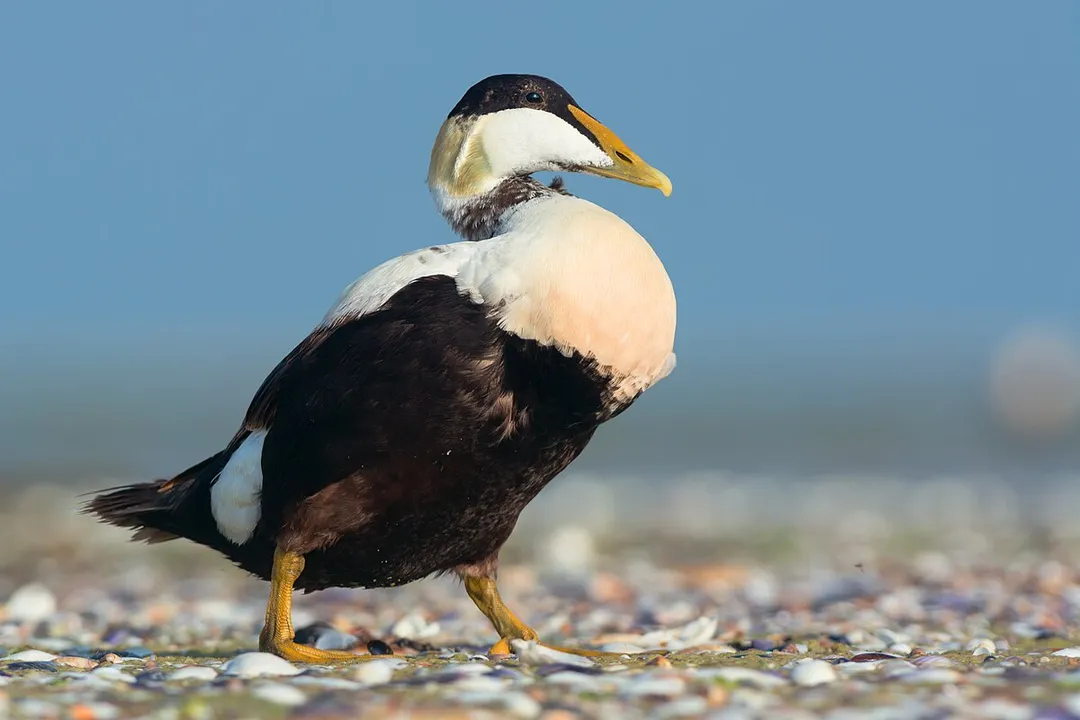
The Common Eider, Somateria mollissima, stands out immediately upon closer inspection of its life history and physiology, despite its name suggesting commonness. This bird is far from ordinary; it is a powerhouse of Arctic resilience, a creature whose very identity is woven into human history through its superlative insulation. [1][4] Its scientific designation, Somateria mollissima, directly translates from Greek and Latin to mean "very soft wool body," a perfect descriptor that hints at its most famous attribute: its down. [1][2]
# Soft Down Body
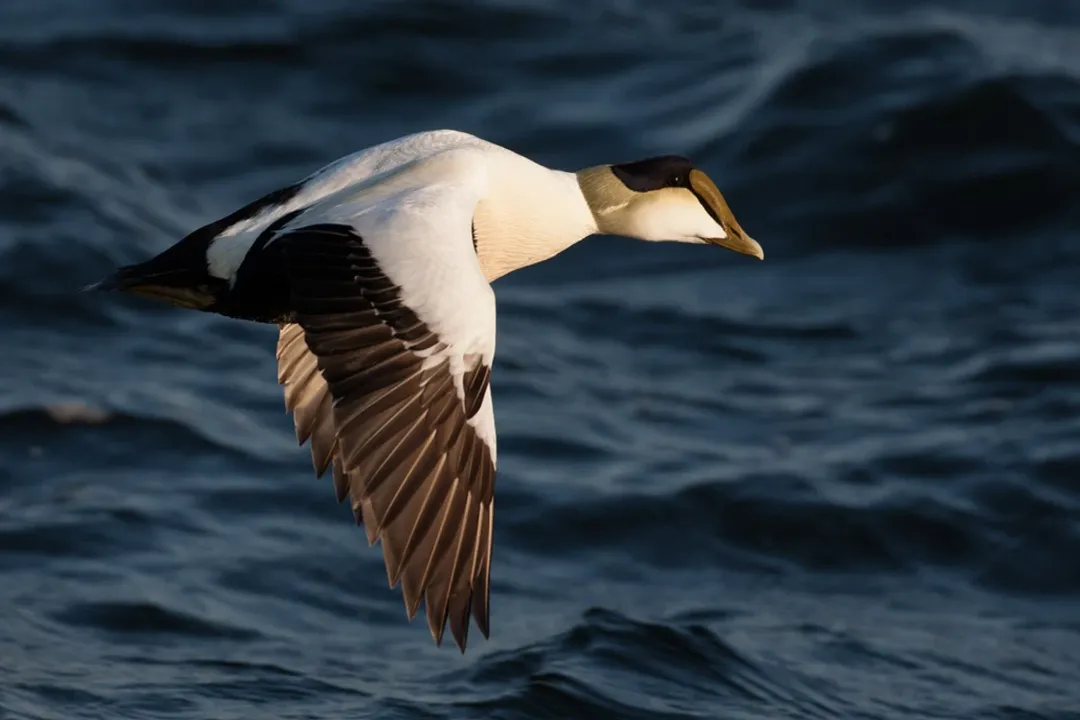
The down of the Common Eider is the stuff of legend, historically sought after by everyone from Viking settlers to modern royalty, valued for its exceptional capacity to warm. [1][4] This down is the fluffy underlayer of feathers, a lifeline that allows the bird to survive frigid Arctic ocean winters where water temperatures approach freezing. [1] The unique quality is so tied to the species that the bird’s scientific name immortalizes it. [2]
The feather collection process itself has evolved into a unique human-avian partnership, particularly in Iceland. Farmers have created sanctuaries, sometimes building nests in old tires or under doorways, to encourage the ducks to settle. [1] In exchange for this protection from natural predators like foxes and gulls—a protection that was necessary because hunting had nearly driven them to extinction by the 19th century—the farmers receive the down after the ducklings have left the nest. [1][4] This practice, which has been illegal to hunt in Iceland since 1847, ensures the collection is sustainable and causes no harm to the parent birds. [1] Today, Iceland accounts for roughly 80% of the world’s eiderdown, showcasing an ancient, symbiotic relationship that has endured for over a thousand years. [1]
# Largest Duck
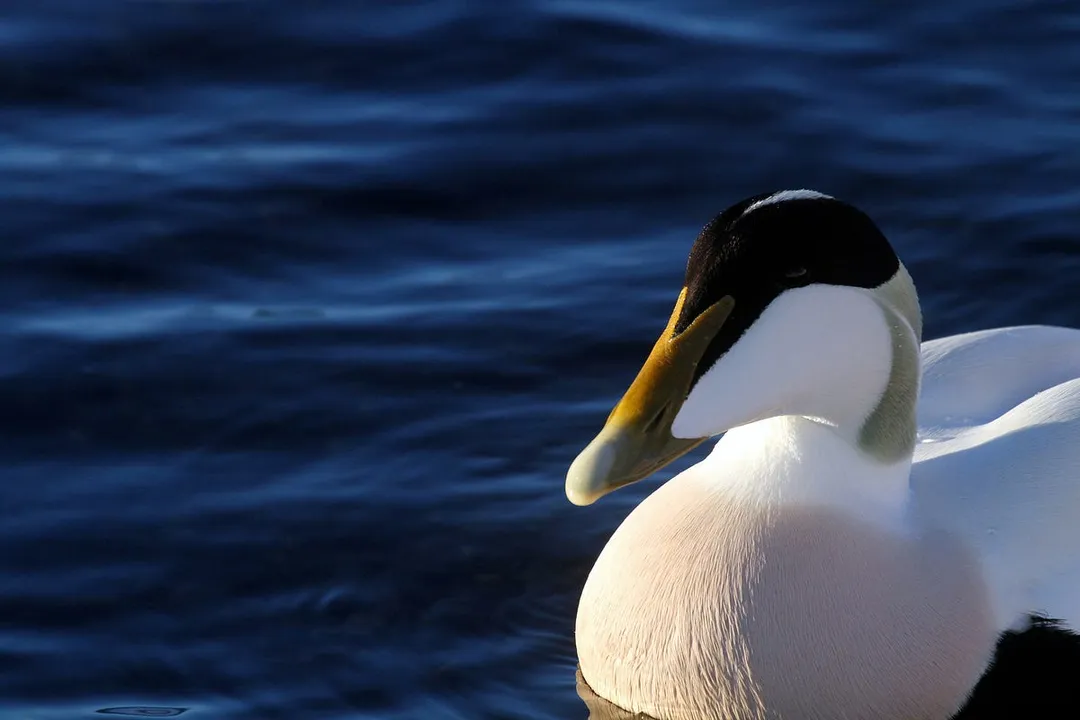
The Eider is not just a sea duck; it is the largest duck species found in the Northern Hemisphere. [1][3] In North America, only some Muscovy ducks might exceed it, and those are often feral populations. [4] Its sheer size contributes to its hardiness, with adult males in the North Atlantic averaging around (), and females slightly lighter at (). [4] This mass, combined with specialized physical characteristics like feet set far back on the body, makes it an exceptional diver—a necessary adaptation given its primary diet. [7]
When hunting, the Common Eider is far more comfortable submerged than in flight. [1] It routinely dives up to in search of prey. [1][2] Its menu is robust, consisting almost exclusively of aquatic invertebrates like blue mussels, starfish, sea urchins, crabs, and marine worms. [3][7] It consumes many items whole; for instance, it pries mussels off rocks and crushes the shells in its gizzard before excretion. [3][4] If the meal is a crab, the eider neatly removes the claws and legs before swallowing the body. [4] Furthermore, like other true seabirds such as gannets and cormorants, the Eider possesses a specialized gland that allows it to process and drink salt water, a critical feature for life spent almost entirely on the ocean. [1]
In considering its aquatic prowess, one cannot help but compare its capabilities to those of its close relatives. While the Common Eider is an agile diver, the King Eider, another species found in Alaska, holds records for even greater depths, with one King Eider observed feeding in water deep. [7] This specialized diving ability contrasts sharply with their terrestrial movements; the Common Eider is described as having rather unsmooth takeoffs, perhaps preferring to remain on the water where it excels. [2]
| Feature | Common Eider (S. mollissima) | King Eider (S. spectabilis) | Observation |
|---|---|---|---|
| Max Dive Depth (Documented) | Up to [1][2] | Up to [7] | King Eider is a deeper specialist. |
| Male Head Color | Black cap, green nape/neck wash [4][7] | Pale blue-gray top of head, orange frontal lobe [7] | Clear visual distinction in males. |
| Female Bill Feature | More feathering along the side of the bill [7] | Less feathering along the side of the bill [7] | Subtle but useful field mark. |

# Extreme Fasting
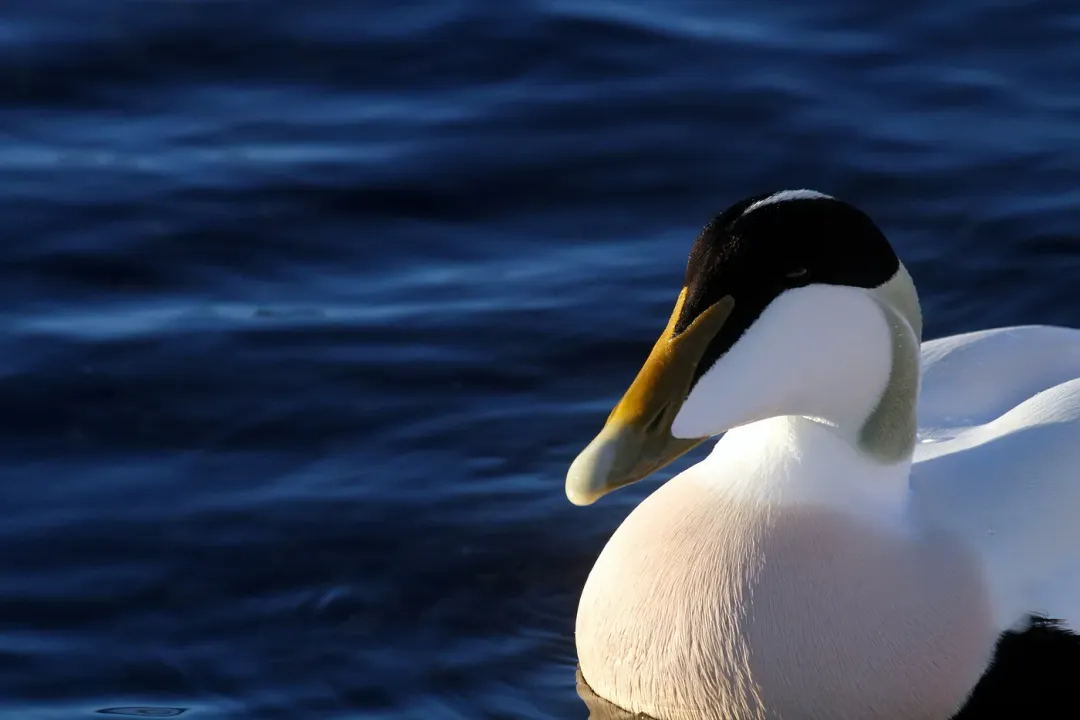
The dedication of the female Common Eider during the nesting period is perhaps the most extreme example of maternal sacrifice in the duck world. Once she settles onto her ground nest, which is meticulously lined with her own insulating down, she remains there for the entire incubation period, which lasts between $24$ and $30$ days, sometimes taking $25$ or $26$ days. [2][3][4][7] During this time, she essentially starves herself, halting feeding almost entirely and leaving the nest only for a quick drink every two to five days. [1][2] This commitment results in the female losing as much as one-third of her total body weight. [1] It is so critical that if a female arrives to nest underweight, she may deposit her eggs in the nest of another female to ensure at least some of her genes are passed on. [1] Any disturbance that forces her off the nest during this period depletes her precious energy reserves, highlighting why conservation efforts stress leaving nesting eiders undisturbed. [3]
# Colonial Rearing
The social structure of the Common Eider around their young is another highly unique trait. While pairs may bond year-round and appear monogamous, reuniting for consecutive seasons, the cooperative care of the young is entirely female-driven. [3] Shortly after hatching—sometimes just $24$ hours later—the ducklings leave the nest and head to the water, capable of feeding themselves on small crabs and crustaceans. [3]
Instead of mothers immediately taking on solitary care, the young often join massive groups called crèches. [2][3] These groups can be so large that one or more female eiders—affectionately termed "aunts"—will take guardianship of broods that can number up to one hundred ducklings. [1][2][3] This communal approach provides enhanced protection against predators like gulls and jaegers. [3] Once the young have fledged, or developed their flight feathers, their mother departs for the sea to resume her ten-month cycle of fishing and surviving, leaving the now independent young to fend for themselves. [1]
This reliance on kin-based social structures—where females often return to breed on the same island where they were born (natal philopatry)—has likely driven the evolution of these cooperative breeding behaviors, such as egg-sharing and the formation of crèches. [4]

# Unique Calls
While many ducks are recognized by their quacks, the Common Eider possesses a distinctive vocal repertoire that sets it apart. The male, or drake, expresses himself during courtship with a strange, almost human-like, hollow moan or a series of soft cooing notes. [4] This contrasts with the female's vocalizations, which are described as hoarse quacks. [4] The males begin displaying this behavior, involving head-tossing and wing-flapping, in the autumn, months before the nesting season even begins. [3]
If we consider the stark contrast between their underwater life and their aerial performance, we can draw an analytic observation: the Eider trades flight grace for aquatic mastery. While they can reach speeds up to in direct flight, their bulkiness makes takeoffs clumsy. [4][2] This indicates an evolutionary trade-off where near-total dedication to marine foraging and insulation—reflected in their body mass and diving skills—has meant less pressure to perfect smooth, rapid flight, which is less critical when one’s food supply is exclusively on the seabed. [7]
# Historical Protection
The Common Eider’s uniqueness is also cemented in its historical relationship with people, particularly concerning protection. On the Farne Islands in Northumberland, England, a colony of Eiders was the subject of one of the first documented bird protection laws, established by Saint Cuthbert in the year $676$. [4] This history is so strong that the Eider is still sometimes known locally in that region as "Cuddy's duck," a familiar reference to Saint Cuthbert. [4]
This long history of human appreciation, though sometimes leading to near-extinction through unsustainable harvesting (as seen in the 19th century), has resulted in protective measures that continue today. [1][3] Globally, the IUCN lists the species as "Near Threatened," noting population declines in Europe and significant historical drops in the Pacific population. [1][4][6] The threats they face today are modern derivatives of old problems: pollution, oil spills, and the impact of climate change altering their sea ice habitats. [1][2]
In many areas, particularly where commercial down farming has established the symbiotic relationship mentioned earlier, the birds are safeguarded. [1][6] For instance, breeding access has been restricted in New Brunswick's South Wolf Island Nature Preserve annually from May $1$ to August $31$ to protect nesting grounds. [3] A point of specific modern concern that warrants attention is the pressure on their food source; their near-exclusive diet of mussels means that commercial shellfish harvesting, aquaculture, and rockweed harvesting can directly threaten the Eider population by depleting their primary food supply. [3] For conservation managers, understanding the demographic data becomes difficult when large, vital wintering flocks, like those found in the Bering Sea, remain under-studied in terms of population trends. [2] The continued existence of this giant sea duck, thriving in harsh conditions while simultaneously supporting a luxury global trade, remains a fascinating testament to avian adaptation and the human impulse to both value and protect nature.
Related Questions
#Citations
What's so special about the Common Eider?
7 facts you don't know about the common eider - Medium
Common eider - Wikipedia
The Common Eider: a Bird of Uncommon Resilience - Icelandic Down
Eider Duck Facts | Somateria Mollissima - RSPB
Common Eider | Audubon Field Guide
[PDF] Eiders - Alaska Department of Fish and Game
Common Eider | Mass.gov