Is a boxfish a real fish?
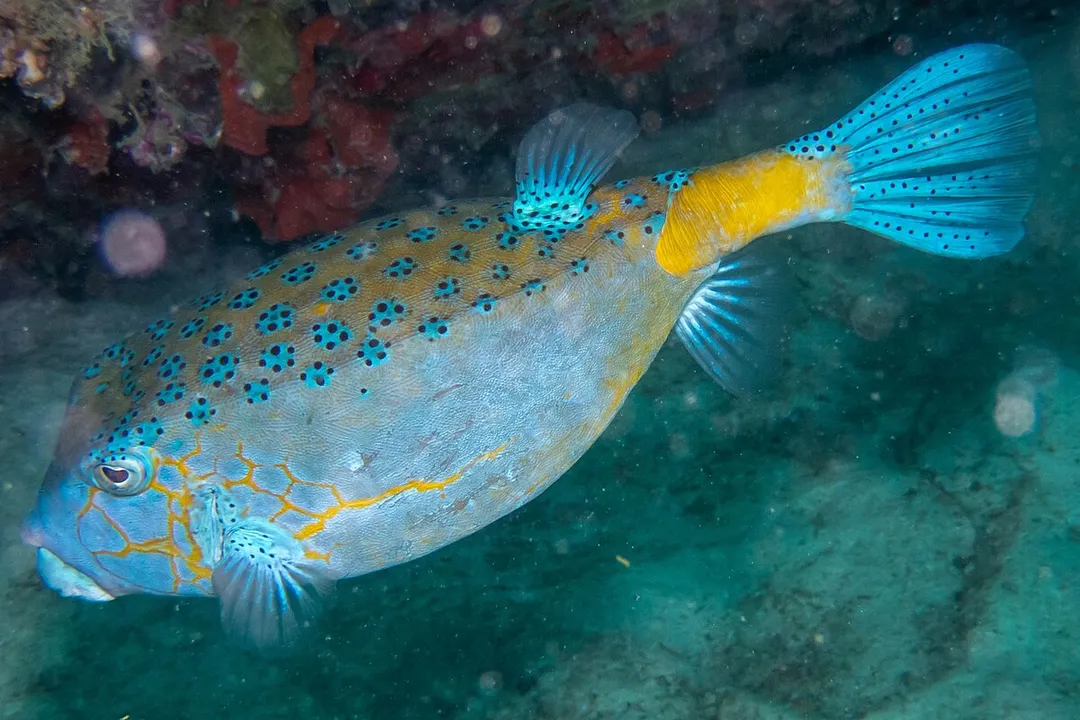
That unmistakable, angular profile of a boxfish immediately raises questions about its identity. It looks less like a creature designed for hydrodynamic speed and more like a child’s toy molded from geometric shapes. Yet, despite its peculiar appearance—a rigid, boxy physique—the boxfish is absolutely a real fish, swimming the world’s tropical waters. [6][8] The very features that make them seem alien are simply evolutionary adaptations that place them firmly within the bony fish classification, specifically the family Ostraciidae. [1][5][8]
# Strange Form
The most defining characteristic of any boxfish, whether it’s the Yellow Boxfish famous for its bright coloration or the Whitespotted Boxfish found in similar regions, is its shell-like exterior. [1][7] This isn't just tough skin; it is a carapace formed by interlocking, hexagonal bony plates called scutes that completely encase the body. [8][9] This structure effectively turns the fish into a stiff, angular container. [9]
This heavy armor dictates much of their life underwater. Unlike streamlined fish that rely on side-to-side undulations of their entire body for propulsion, boxfish move in a completely different manner. [9] Because their body is essentially fixed within this bony framework, they have to rely on the minute, rapid fluttering of their small fins—the dorsal, anal, and pectoral fins—to propel themselves and steer. [9] This results in a slow, precise, almost hovering form of locomotion, making them surprisingly adept at navigating complex reef structures where they can maneuver slowly into small crevices. [9]
It is interesting to consider the trade-off here: the ultimate defense against predators that bite or crush is also the ultimate impediment to escape. A typical pelagic fish can achieve bursts of speed to evade danger, but the boxfish sacrifices this speed for near-impenetrable plating. This single anatomical constraint—the rigid box—is why their secondary defense mechanism has become so potent.
# Aquatic Classification
To place the boxfish accurately within the biological hierarchy, we look to its scientific grouping. Boxfishes belong to the family Ostraciidae, which is part of the order Tetraodontiformes, placing them near pufferfish and filefish. [1][5] Within Ostraciidae, there are generally three subfamilies: trunkfish, cowfish, and boxfish. [5] While the common names are sometimes used interchangeably in casual conversation, the differences often relate to features like the presence of spines or horns. [5] For instance, Cowfish often possess prominent spines projecting forward from near their eyes, whereas the classic Boxfish does not. [5]
The Yellow Boxfish (Ostracion cubicus) provides a fantastic example of sexual and age dimorphism within the group. [1] Juvenile yellow boxfish are usually a brilliant, intense yellow punctuated by deep black spots. [1] As they mature into males, they retain this striking coloration, though the spots may become less distinct. [1] Conversely, females often transition to a duller, more brownish or grayish hue with fewer, less vivid spots. [1] This dramatic color shift suggests visual signaling plays a significant role in their social structure, perhaps in mate attraction or territorial defense, given the high visibility of the mature males. [1]
The Whitespotted Boxfish (Ostracion meleagris) offers another visual contrast, covered in small, often white or bluish spots across a dark body, sometimes exhibiting a different coloring pattern between males and females as well. [7] These fish are generally found in tropical and subtropical waters across the Indo-Pacific. [1][7]

# Defense Toxin
The most famous, and potentially most dangerous, characteristic of the boxfish is its ability to release a potent poison into the water when stressed, threatened, or injured. [4][6][8] This substance is specifically called ostracitoxin. [4]
This is not a simple slime or irritating secretion; ostracitoxin is a powerful hemolytic (blood-cell destroying) and neurotoxic compound. [4] The toxin is stored in specialized granular cells within the skin and is only released when the fish is under severe duress. [4] For marine aquarists keeping boxfish, this presents a significant risk. If a boxfish becomes highly stressed in an enclosed tank environment, the release of this toxin can quickly contaminate the water, potentially killing the boxfish itself, as well as any other fish sharing the same water volume. [3][4] This is why careful monitoring and appropriate quarantine/tank management are essential when keeping them. [3]
The existence of such a strong chemical defense highlights an ecological necessity. Since the boxfish trades speed for armor, it cannot easily outswim a determined predator. [9] Instead, when cornered or captured, the toxin acts as a final, often fatal, deterrent to the attacker. [4] Imagine a predator finally breaking through the bony armor only to be poisoned by the very flesh it intended to consume—it’s a highly effective, if costly, survival strategy for the fish. [4]
# Diet and Habitat
Boxfish primarily inhabit shallow tropical reefs and lagoons, environments rich in hiding places but also high in competition and predation pressure. [1][7][9] Their diet reflects this reef association. They are generally omnivores, feeding mainly on benthic invertebrates, which includes small crustaceans, worms, and mollusks found on or within the substrate. [1][7] They use their small mouths to pick, probe, and perhaps even suck these food items out of the sand or coral rubble. [1]
When considering how a boxfish feeds, the slow, deliberate swimming motion, powered by those tiny fins, actually becomes advantageous. It allows them to hover precisely over a patch of sand or rock to inspect potential food items without stirring up excessive sediment or alerting prey too quickly, a feat harder for a larger, faster-moving fish to accomplish. [9]
The difference in appearance between the sexes in species like the Yellow Boxfish also suggests specific territorial or breeding behaviors tied to their localized reef habitats. [1] While a smaller fish might move over vast distances, the distinct coloration might help maintain pair bonds or warn off rivals in a more static home range. [1]
# Considerations for Keeping
For those interested in marine aquariums, boxfish are undeniably attractive specimens, but they require specialized attention. [3][6] Their rigid bodies mean they are not suited for fast-moving community tanks. [3] They need ample swimming space, stable water quality, and importantly, tank mates that are non-aggressive and won't nip at their fins or stress them to the point of toxin release. [3]
If we were to map out a simple guideline for potential boxfish owners based on their needs, it might look something like this:
| Parameter | Ideal Condition | Rationale Based on Biology |
|---|---|---|
| Tank Size | Large (minimum 100+ gallons) | To minimize stress from confinement and dilution of potential toxins. [3][4] |
| Water Flow | Low to Moderate | Accommodates their slow, fluttering locomotion. [9] |
| Tank Mates | Peaceful, large-bodied, non-nippers | To avoid physical harassment that triggers ostracitoxin release. [3][4] |
| Feeding | Varied invertebrates, algae | Matches natural benthic diet. [1][7] |
The fact that these creatures, which look like animated geometric puzzles, possess such a complex chemical defense mechanism underscores the sheer diversity hiding within the classification of "fish." They remind us that being a fish does not necessitate a torpedo shape; it simply requires adaptation to an aquatic environment, whether that adaptation is built for speed, camouflage, or chemical warfare. They are indeed real, complex, and utterly fascinating residents of the sea. [8]
#Videos
Facts: The Boxfish - YouTube
Related Questions
#Citations
Yellow boxfish - Wikipedia
Facts: The Boxfish - YouTube
Saltwater Aquarium Fish Species Profile: Boxfish - LiveAquaria
Boxfish: Little Fish, Big Toxins | Shit You Didn't Know About Biology
Sorting the Boxfishes - NIGEL MARSH PHOTOGRAPHY
Is The Yellow Boxfish the Cutest Fish in the World?
Whitespotted boxfish - Seattle Aquarium
Boxfish - SSI
Boxfish | Great Southern Reef