How do ocellated turkeys differ from others?
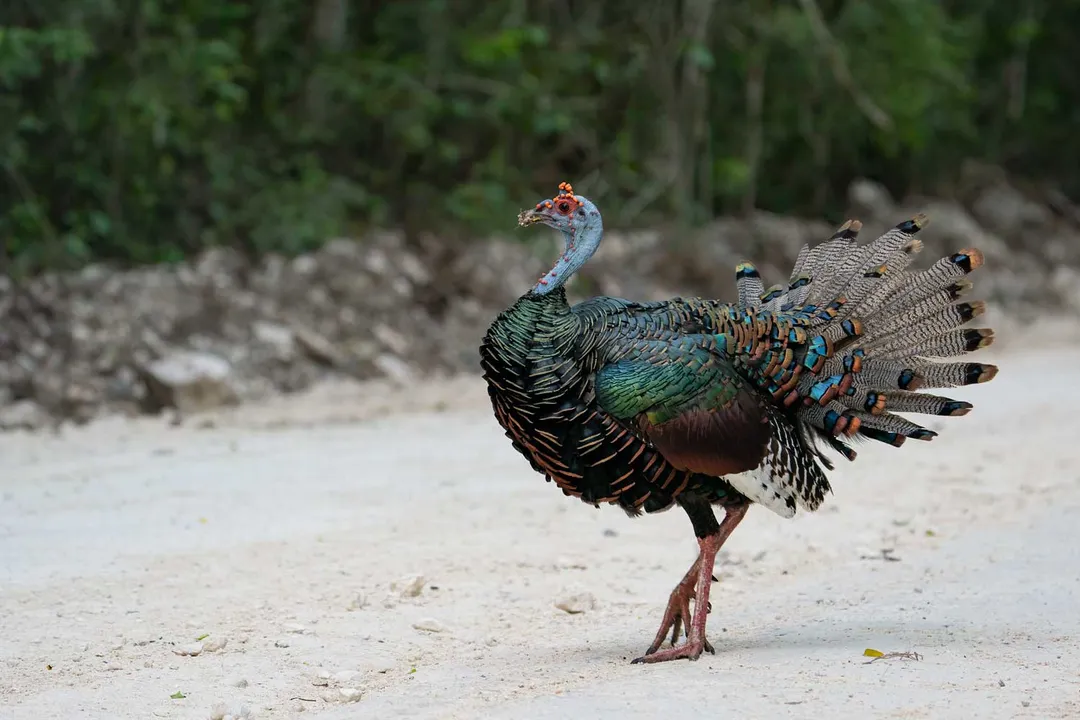
The turkey roaming the dense, humid forests of Central America is a creature of spectacular difference from its more familiar North American cousin. While both share the genus Meleagris, the Ocellated Turkey (Meleagris ocellata) presents a profile so distinct it often surprises those familiar only with the Wild Turkey (Meleagris gallopavo). [1][5] The most immediate and stunning divergence lies in its coloration; where the North American bird often displays earthy browns and duller iridescence, the Ocellated Turkey is clad in brilliant, jewel-toned plumage. [5]
# Plumage Brilliance
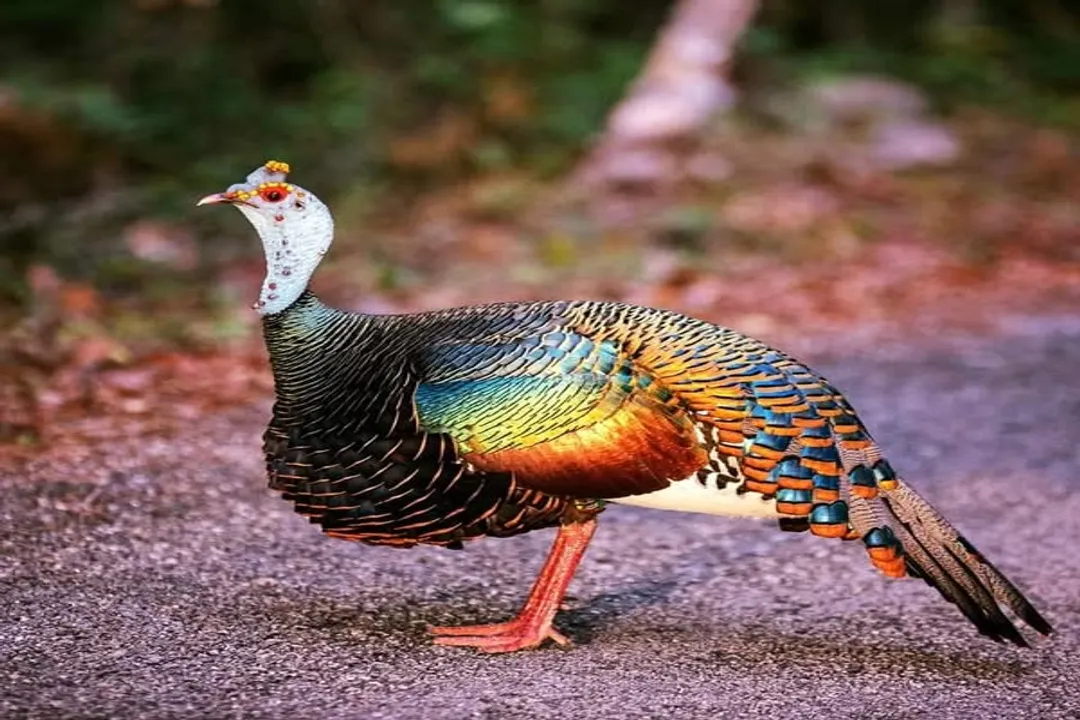
The defining characteristic giving the Ocellated Turkey its name is the presence of large, unmistakable eyespots, or ocelli, decorating its tail feathers. [1] These markings are not subtle; they are brilliant rings of bronze, gold, and iridescent blue. [5] This pattern is quite different from the North American Wild Turkey, whose tail feathers usually feature a single, broad, dark band near the tip. [5]
Beyond the tail, the entire body of the Ocellated Turkey shines with intense iridescence, often described as a vibrant blue-green hue. [1] The skin on the head and neck is also notable, typically appearing as bare, blue skin, which contrasts sharply with the often reddish-blue, warty caruncles seen on the Wild Turkey male during mating displays. [1] When a male Ocellated Turkey struts, it displays a visual intensity rarely matched in other ground birds. [2] Even the female birds, while less vibrant than the males, possess a subtle but definite iridescence not always present or as pronounced in female North American wild turkeys. [5]
# Geographic Residence
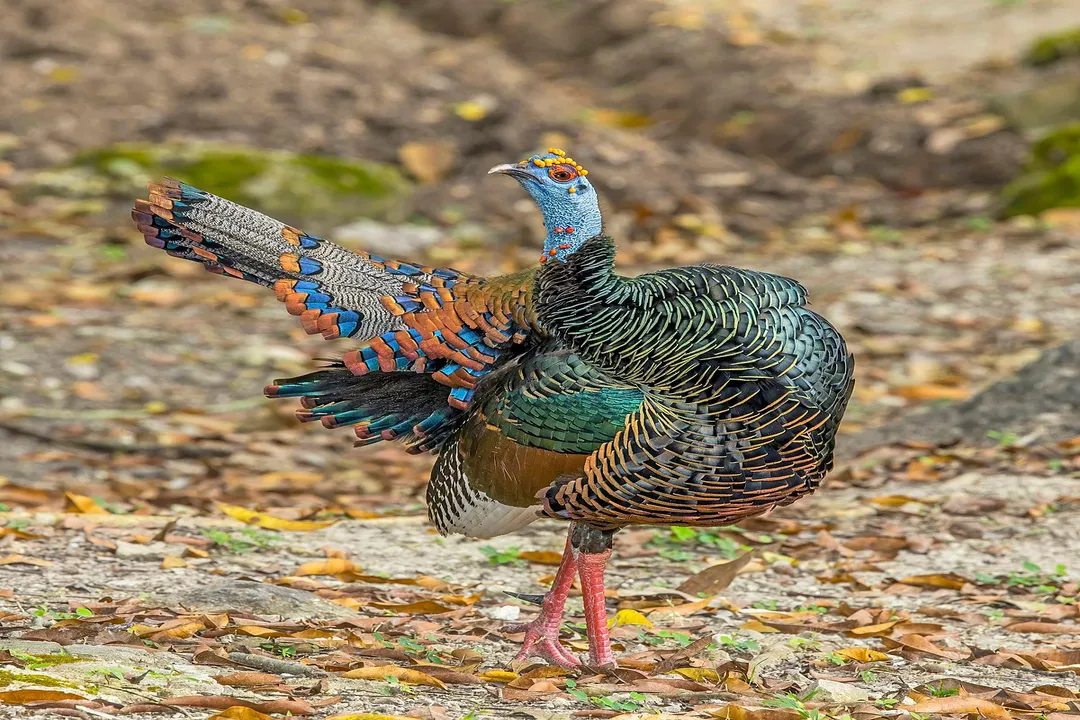
The ecological separation between these two groups is absolute, which has driven their distinct evolutionary paths. Ocellated Turkeys are strictly inhabitants of the lowland tropical rainforests of the Yucatán Peninsula. [6] Their range is geographically isolated, encompassing parts of southern Mexico, Belize, and Guatemala. [1][2][4] This confinement to the tropics means they have never shared territory with the four subspecies of the North American Wild Turkey, which are distributed across temperate and subtropical woodlands further north. [5]
This deep geographic separation is more than just a location marker; it represents millions of years of independent adaptation. The selective pressures within a dense, sun-dappled tropical canopy—different predators, different food sources, and different visual signaling requirements—have resulted in the evolution of this unique, highly ornate species, whereas their northern relatives evolved for camouflage and display within deciduous and coniferous forests. [5] It’s a classic case of allopatric speciation driven by continental barriers and distinct climate zones.

# Size and Stature
When comparing the physical dimensions, the Ocellated Turkey presents as the more delicate of the two main groups. Adult males of M. ocellata are generally smaller and lighter than the large Wild Turkey toms found in North America. [5] While a large male Wild Turkey can easily exceed 25 pounds, the Ocellated Turkey male typically weighs around 11 pounds (approximately 5 kilograms). [1] This smaller stature might be an adaptation to navigating the denser undergrowth of the tropical jungle environment more effectively than a bulkier bird. Hens of the Ocellated Turkey are even smaller, consistent with the typical sexual dimorphism found across the turkey family. [5]
Another subtle physical difference often noted by observers relates to the head structure. While both species possess fleshy appendages, the size and specific development of the snood (the fleshy projection hanging over the bill) can differ, though both rely on these features for visual communication during courtship. [1]
# Vocalizations and Social Life
While both species rely on distinct vocalizations to communicate across distances, the specific calls used by the Ocellated Turkey vary from those produced by M. gallopavo. Ocellated Turkeys produce a peculiar, high-pitched, whistling sound, unlike the familiar loud gobble associated with the males of the North American species. [1]
In terms of social structure, reports suggest that the Ocellated Turkey can be somewhat more gregarious than some of the more solitary North American subspecies, such as Gould's Turkey, though group dynamics can change seasonally. [1] Observing these birds in their natural habitat reveals social units that coordinate movements through the forest floor, relying on visual cues and their distinct calls to maintain flock cohesion in the dense foliage. [4] Understanding the exact social complexities remains an area requiring more dedicated study compared to the well-documented North American species.
# Habitat Threats
The very environment that shaped the Ocellated Turkey’s beauty also places it at risk. Because its existence is tied so closely to the lowland tropical rainforests of the Yucatán, it is particularly vulnerable to deforestation and habitat fragmentation. [6] The species is currently listed as Vulnerable on the IUCN Red List. [2]
In North America, Wild Turkey populations have rebounded significantly due to successful conservation management and reintroduction programs in many areas. [5] However, the Ocellated Turkey faces challenges related to ongoing agricultural expansion and logging within its smaller, more ecologically sensitive range. [6] Protecting the remaining tracts of old-growth jungle is paramount to ensuring the long-term survival of this spectacularly adorned bird. [2]
To better appreciate the distinctions, one can map out the differences concisely:
| Feature | Ocellated Turkey (M. ocellata) | North American Wild Turkey (M. gallopavo) |
|---|---|---|
| Primary Color | Highly iridescent blue-green/bronze | Earth tones, browns, grays, with iridescence |
| Tail Markings | Brilliant, distinct bronze/gold/blue eyespots (ocelli) [1][5] | Single, wide, dark band near the tip [5] |
| Head Color | Predominantly bare blue skin [1] | Red/blue wattles and caruncles |
| Weight (Male) | Generally lighter, around 11 lbs (5 kg) [1] | Can exceed 25 lbs in larger subspecies [5] |
| Vocalization | High-pitched whistling sounds [1] | Loud gobble |
| Range | Yucatán Peninsula (Mexico, Belize, Guatemala) [1][2] | Widespread across North America |
Considering the extreme visual difference, an interesting point arises when one thinks about breeding success in these two environments. In the open temperate woodlands of North America, a turkey needs to project his voice loudly across open clearings, hence the gobble. Conversely, in the perpetually shaded, visually complex, and sound-dampening environment of the deep tropical rainforest, the Ocellated Turkey’s visual display is arguably more crucial for signaling fitness, explaining the intense, almost metallic iridescence that catches the slightest shaft of light filtering through the canopy. This reliance on dazzling visual signaling might also explain why their calls are described as more whistling and less booming; the visuals do the heavy lifting for long-distance attraction.
For anyone interested in avifauna conservation, understanding these distinctions underscores the importance of specific habitat protection. A management strategy that works for a recovering population in a North American state park simply cannot be directly applied to saving a rainforest-dependent species like the Ocellated Turkey, where the threats are linked to clear-cutting and agricultural encroachment rather than over-hunting in open country. [6] The preservation of this avian gem requires a focus squarely on maintaining the integrity of the fragile Mesoamerican forests it calls home.
#Videos
Creature Comparison: Wild Turkey vs. Ocellated Turkey - YouTube
Related Questions
#Citations
Ocellated turkey - Wikipedia
Ocellated Turkey - American Bird Conservancy
Wild Relatives: The ocellated turkey
What is the difference between the Ocellated Turkey and North ...
Ocellated Turkey vs Wild Turkey: See Who Wins | Animal Matchup
Ocellated Turkey | Rainforest Alliance
Ocellated Wild Turkeys - I AM Turkey Hunting!
Creature Comparison: Wild Turkey vs. Ocellated Turkey - YouTube
A relative of the North American wild turkey, the ocellated ... - Reddit