How can you tell if a caterpillar is a swallowtail?
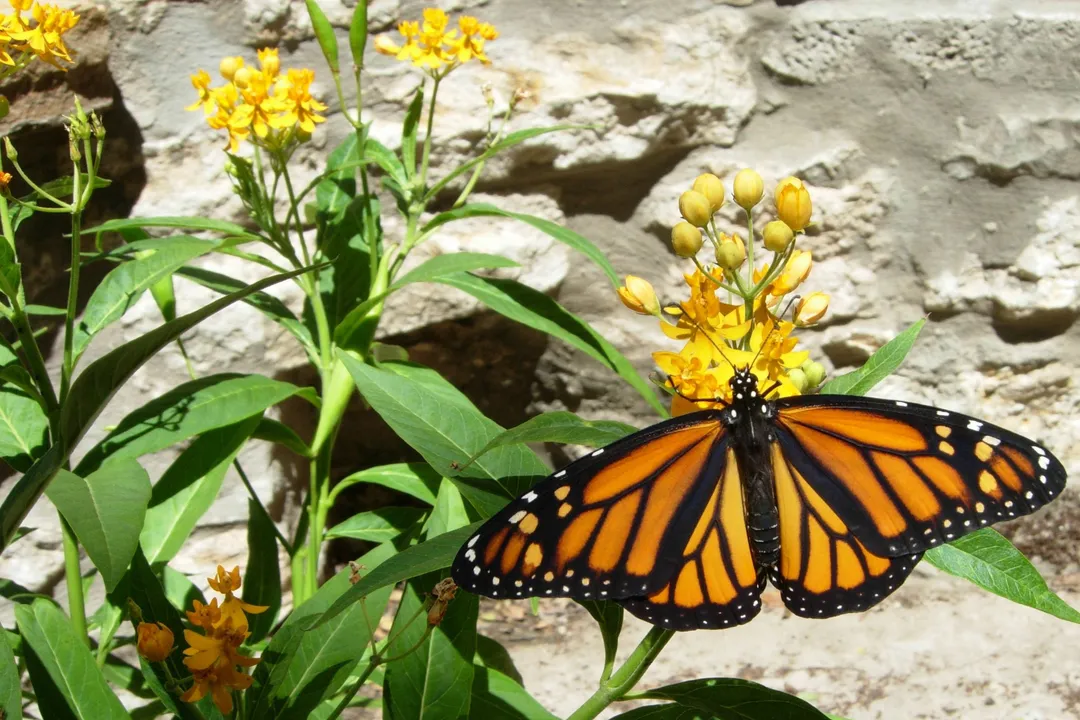
Identifying a caterpillar as belonging to the swallowtail family can sometimes feel like solving a mystery, especially when a garden is shared by several common species. The key lies in looking closely at patterns, colors, and even the caterpillar’s defensive reactions, as these characteristics often change dramatically as the larva grows through its various stages. [2] While many caterpillars are fuzzy or plain green, swallowtails generally exhibit a smoother skin texture and often sport striking, conspicuous markings that set them apart from other common garden larvae, such as the Monarch. [5][8]
# Key Features
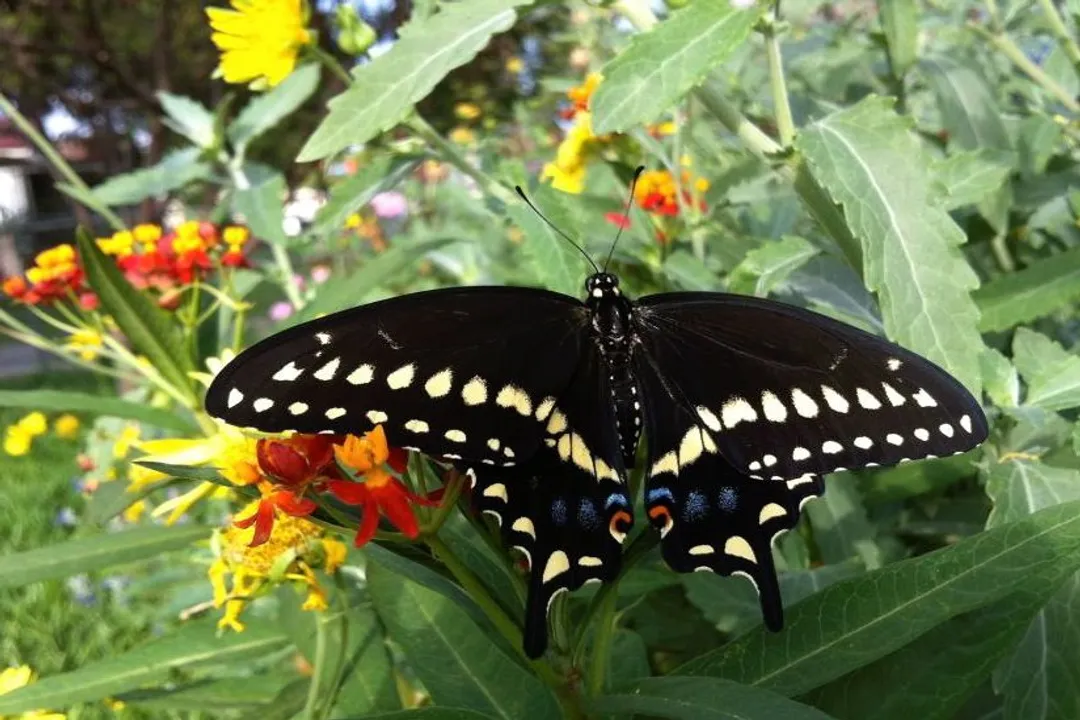
Swallowtail caterpillars are generally quite distinctive, belonging to the family Papilionidae. They are known for their relatively large size and often brightly colored bodies. [7] A key feature to watch for, though not always visible on the youngest larvae, is the presence of "tails"—fleshy, horn-like appendages extending from the rear end of the body, which give the family its common name. [7]
One of the most recognizable members of this group in many regions is the Black Swallowtail (Papilio polyxenes). Examining its life cycle provides an excellent case study for identifying swallowtails in general, though remember that other species, like the Giant Swallowtail, will look different. [2][7]
# Black Swallowtail Stages
The Black Swallowtail caterpillar undergoes significant transformations from hatching to its final instar before pupation. The very young larvae look quite different from the older ones. Newly hatched Black Swallowtails are small and dark, often appearing almost black with a reddish-brown saddle marking. [6] This initial appearance helps them blend into the dark stems and leaves of their host plants. [6]
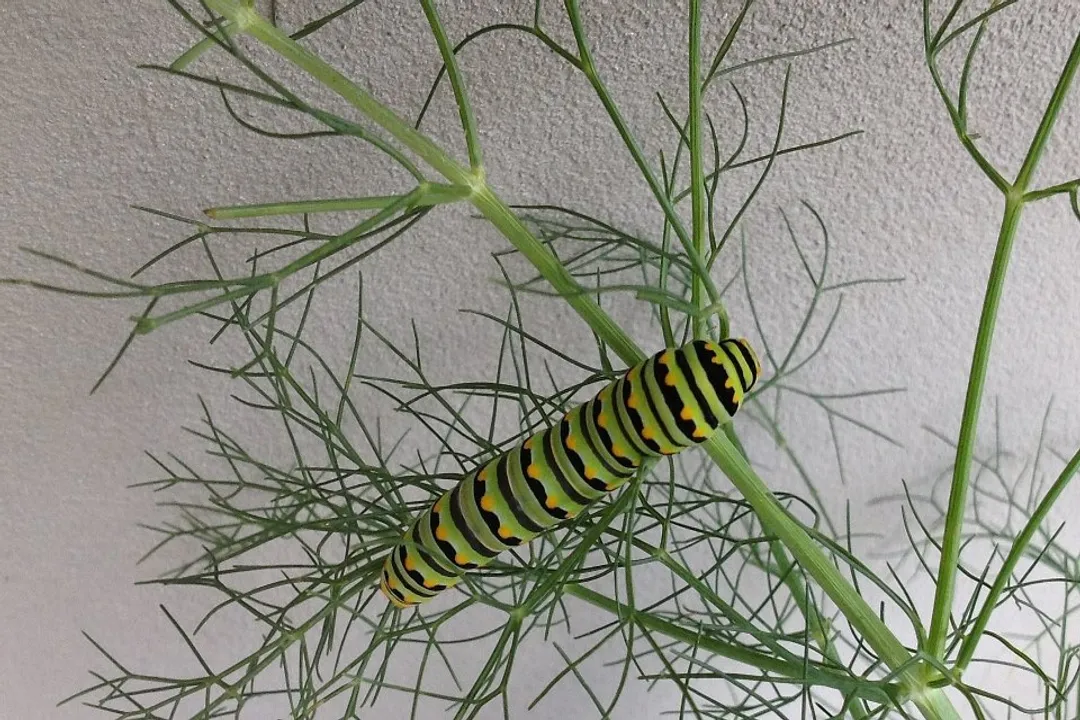
As they mature, their appearance changes. A crucial identification marker for the Black Swallowtail is the development of bright, contrasting markings. In later stages, they become vividly colored, typically featuring a pattern of black bands interspersed with bright green or yellowish-green stripes. [6][9] Embedded within these bands are distinctive orange or reddish-brown spots that can sometimes resemble eyespots. [9] This disruptive coloration helps break up the outline of the caterpillar’s body when viewed against foliage. [9]
Contrast this with the Monarch caterpillar, which is another common identification challenge. Monarchs are characterized by bold black, yellow, and white transverse stripes running across their bodies, and they possess a pair of black, fleshy filaments both at the front and rear end, unlike the two visible "tails" seen on some swallowtails. [5][8] If you see bright yellow and black bands with no prominent green, you are likely looking at a Monarch, not a Black Swallowtail. [8]
# Defensive Mechanisms
When threatened, many caterpillars rely on camouflage, but swallowtails often have a unique, somewhat startling defense mechanism. This is where the Black Swallowtail truly stands out from its striped rival, the Monarch. [8]
# Osmeterium Presentation
If a swallowtail caterpillar feels stressed or approaches the size where it needs to warn off predators, it can deploy a special organ called the osmeterium. [7] This structure is typically hidden within a fold behind the head. [7] When unfurled, the osmeterium is a fleshy, forked, Y-shaped structure that pops out, often in a bright orange or reddish color. [7][9] Furthermore, this organ releases a distinctive, foul-smelling odor—often described as unpleasant or rancid—to deter birds and other predators. [7][9] This sudden appearance of a brightly colored, smelly structure is a highly reliable indicator that you are looking at a swallowtail larva, particularly the Black Swallowtail, as opposed to a Monarch, which does not possess this feature. [8]
A helpful field observation: If you gently nudge a caterpillar and it retracts its head while suddenly presenting a bright orange, forked structure that smells strange, you can be almost certain it belongs to the swallowtail family. This response is not seen in Monarchs. [8]
# Plant Association Clues
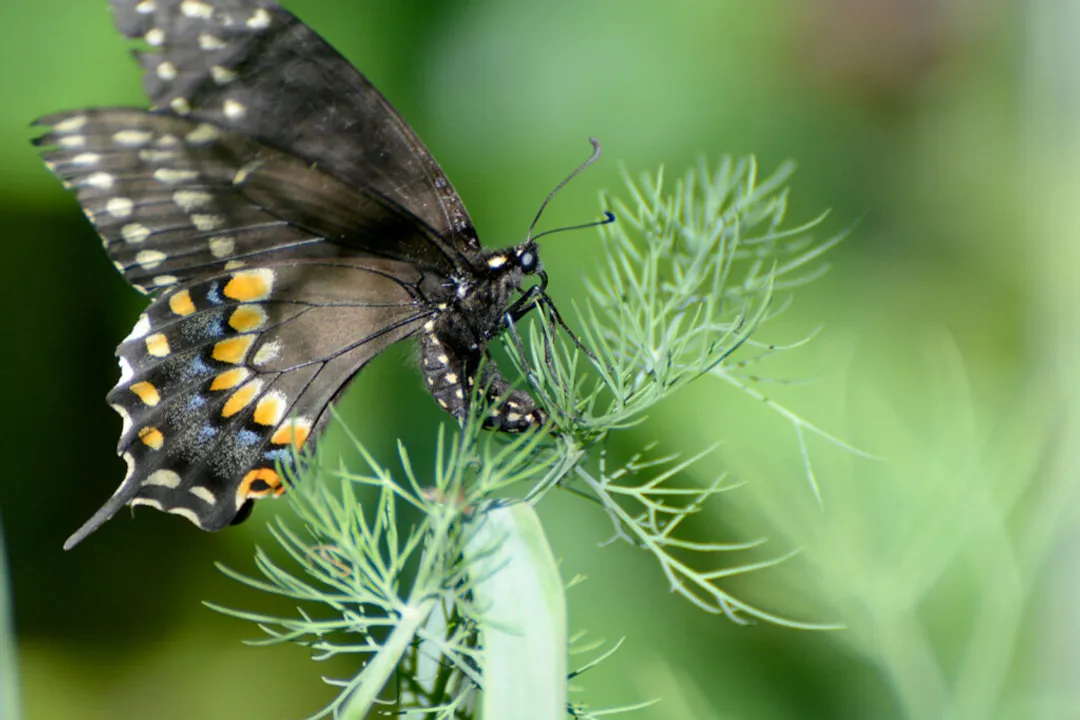
While visual identification is primary, knowing what the caterpillar is eating can provide essential context, especially when distinguishing between similar species or when caterpillars are very small. [8] Different swallowtail species specialize in particular host plants.
For instance, the Black Swallowtail has a very specific dietary preference. They are strongly associated with plants in the carrot family (Apiaceae). [6][9] This includes common garden plants like parsley, dill, fennel, and Queen Anne's lace. [6][9] If you find a caterpillar with black, green, and orange markings munching on your parsley, it is almost certainly a Black Swallowtail. [9]
This specialization is a powerful identification tool. If you find a caterpillar eating milkweed, you are looking at a Monarch (Danaus plexippus), not a swallowtail. [8] Conversely, Giant Swallowtail caterpillars (Papilio cresphontes) favor plants in the citrus family (Rutaceae), such as citrus trees or prickly ash. [7] Knowing the local flora and what the caterpillar is feeding on can quickly narrow down the possibilities, acting as a crucial preliminary check before focusing on fine visual details. [8]
# Analyzing Instar Transitions
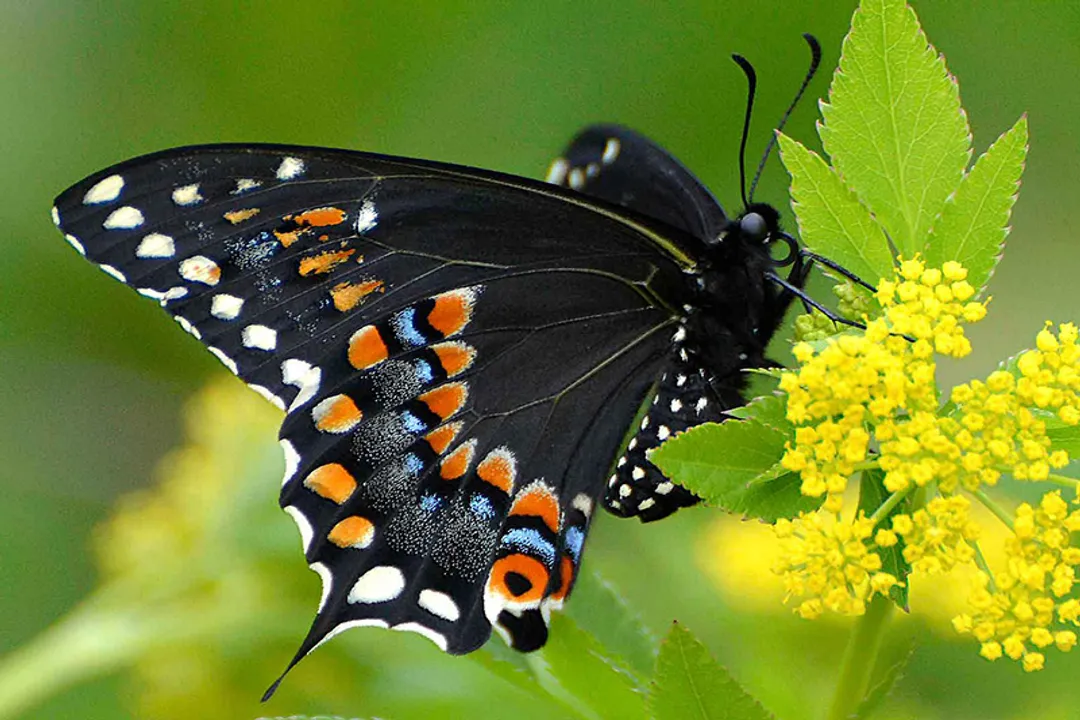
One area where identification can get tricky is when caterpillars are in their intermediate stages—not quite newly hatched, but not yet showing their final, bold colors. The timing of color shifts can sometimes be more consistent than the exact shade of green in a specific light.
For the Black Swallowtail, the transition from the very early, dark stage to the later, boldly marked stage happens relatively quickly, often passing through four distinct molts. [6] While the exact timing depends on local temperature and food availability, gardeners often report that by the time the caterpillar reaches about half an inch to an inch in length, the characteristic green/yellow banding starts to become more defined, making the identification clearer than the tiny, dark hatchling. [6]
If you notice a caterpillar that has a series of segments, each marked with a distinct color block, and lacks the fuzziness or dense hair common to other families like the Tussock moths, it leans toward being a swallowtail. [2] Furthermore, the general body shape—smooth, somewhat plump, and possessing that rear tail structure (even if small in early instars)—is a strong differentiator from the stout, heavily striped Monarch. [5]
# Regional Variations
It is vital to remember that the term "swallowtail" covers many species, and the appearance can vary significantly based on geography. While the Black Swallowtail is common across much of North America, other species inhabit different areas with their own unique looks. [7]
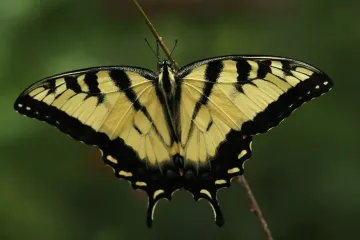
For example, the Eastern Tiger Swallowtail (Papilio glaucus) is another very common species. Its larvae often look very similar to the Black Swallowtail's later instars—greenish with bands—but they usually lack the sharp black borders around the yellow/green segments seen in the P. polyxenes (Black Swallowtail). [2] Furthermore, the Eastern Tiger Swallowtail has a distinct "phase" in some regions where the female mimics the distasteful Pipevine Swallowtail, appearing entirely dark or black. [2] This means a plain black caterpillar could be a female Tiger Swallowtail, emphasizing why the osmeterium test is so helpful when dealing with suspected swallowtails. [2][7]
A helpful comparison matrix for common North American species might look something like this, though keep in mind visual identification relies on clear lighting and a good look at the markings:
| Feature | Black Swallowtail | Monarch | Eastern Tiger Swallowtail |
|---|---|---|---|
| Primary Color | Green/Yellow with Black Bands | White, Yellow, Black Stripes | Green/Yellow with Black Bands |
| Defense | Orange Osmeterium | None (Aposematic coloring) | Orange Osmeterium |
| Host Plant | Parsley, Dill, Carrot | Milkweed only | Tulip Poplar, Cherry, Wild Carrot |
| Tail Filaments | Two prominent tails | Two filaments front and back | Two prominent tails |
When in doubt about a dark caterpillar, especially one found near plants like citrus or spicebush (hosts for other swallowtails), gently provoke it to check for that signature osmeterium. [7] If it's a Monarch, it will just wiggle; if it's a swallowtail, it might reveal its defense.
# Practical Tips for Gardeners
For those actively trying to monitor their garden for swallowtails, a few actionable strategies can make confirmation easier.
First, establish a baseline by planting known swallowtail host plants—parsley, dill, or fennel—near your pollinator beds. [9] If you see any caterpillar on these, you are already starting from a strong position to confirm it as a Black Swallowtail, provided it lacks the Monarch's distinct white markings. [8] If you find damage, immediately examine the undersides of the leaves, as younger, smaller caterpillars often hide there during the hottest parts of the day. [6]
Second, when photographing potential candidates, try to capture an image both in clear daylight and when the subject is slightly disturbed. A photo showing the caterpillar curled up defensively, even if the osmeterium isn't fully deployed, can sometimes reveal a bright patch of color near the head that hints at this structure. [7] Remember that scale matters; a large, smooth larva eating parsley is a much better candidate for a swallowtail than a tiny, hairy one found on a maple tree, which is likely a different family entirely. [2] By synthesizing the knowledge of host plant, general size/texture (smooth vs. hairy), and specific markings (stripes vs. bands), you build a high-confidence identification profile that goes beyond just one visual cue.
Ultimately, identifying a swallowtail caterpillar is about layering clues: habitat points to the family, color patterns help specify the species, and the presence of the osmeterium confirms the Papilio genus when confusion arises with non-swallowtail mimics or species like the Monarch. [2][7][8]
#Videos
Meet The Black Swallowtail Caterpillar - YouTube
Related Questions
#Citations
Distinguishing between monarch and swallowtail caterpillars
Distinguishing Swallowtail Butterflies | Little Wild Streak
Everything You Need to Know About Swallowtail Butterflies
Meet The Black Swallowtail Caterpillar - YouTube
Need help identifying if Swallowtail or Monarch caterpillar : r/Butterflies
Black swallowtail - Our Habitat Garden
Swallowtails - University of Kentucky
Caterpillar Quiz: How to Tell the Difference between Monarchs and ...
Black Swallowtail Caterpillar | A Round Rock Garden - WordPress.com