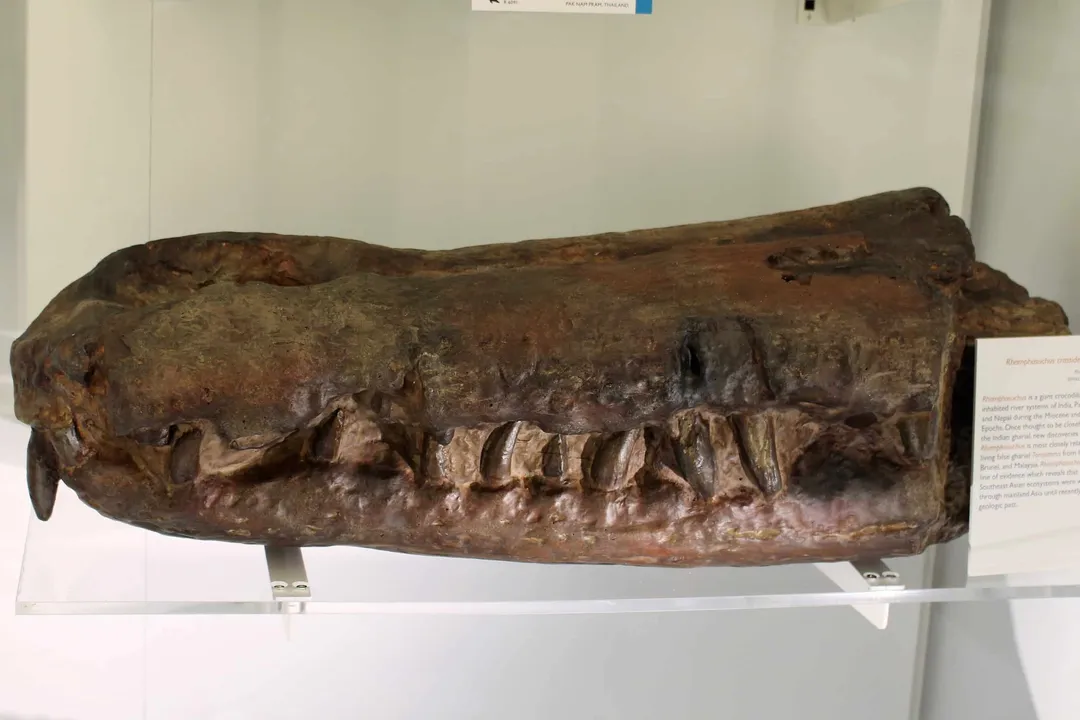
What feature in *R. pachyrhynchus* suggests it might have engaged in complex sexual signaling behaviors?
Answer
Bony depressions near the external naris.
The presence of bony depressions near the external naris (nostril) in *R. pachyrhynchus* is an osteological correlate that hints at the possibility of a *ghara*, the soft tissue knob found on modern male gharials used for signaling.
Related Questions
What does the name *Rhamphosuchus* directly translate to?Who coined the generic name *Rhamphosuchus* in 1886?What initial genus did Cautley and Falconer assign the *Rhamphosuchus* remains to in 1840?What key finding caused the initial size estimate of *Rhamphosuchus* to be drastically revised downward in the 2000s?How did the snout of *Rhamphosuchus* differ structurally from that of the modern Indian gharial?What feature indicated that *Rhamphosuchus* had a bite mechanism similar to modern alligators, unlike gharials?What geological epoch does the type species, *Rhamphosuchus crassidens*, date back to?What specific characteristic marks the snout tip of *Rhamphosuchus pachyrhynchus*?What ecological paradox arises from the evidence regarding *Rhamphosuchus*'s diet?What feature in *R. pachyrhynchus* suggests it might have engaged in complex sexual signaling behaviors?