What does the name Rhamphosuchus mean?
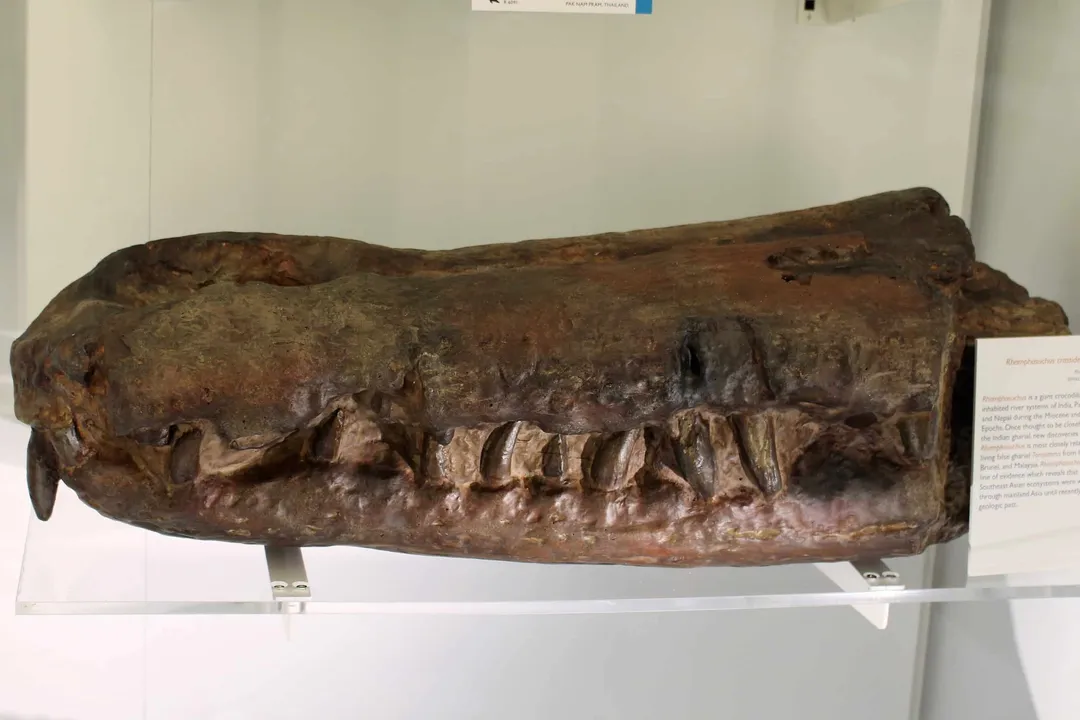
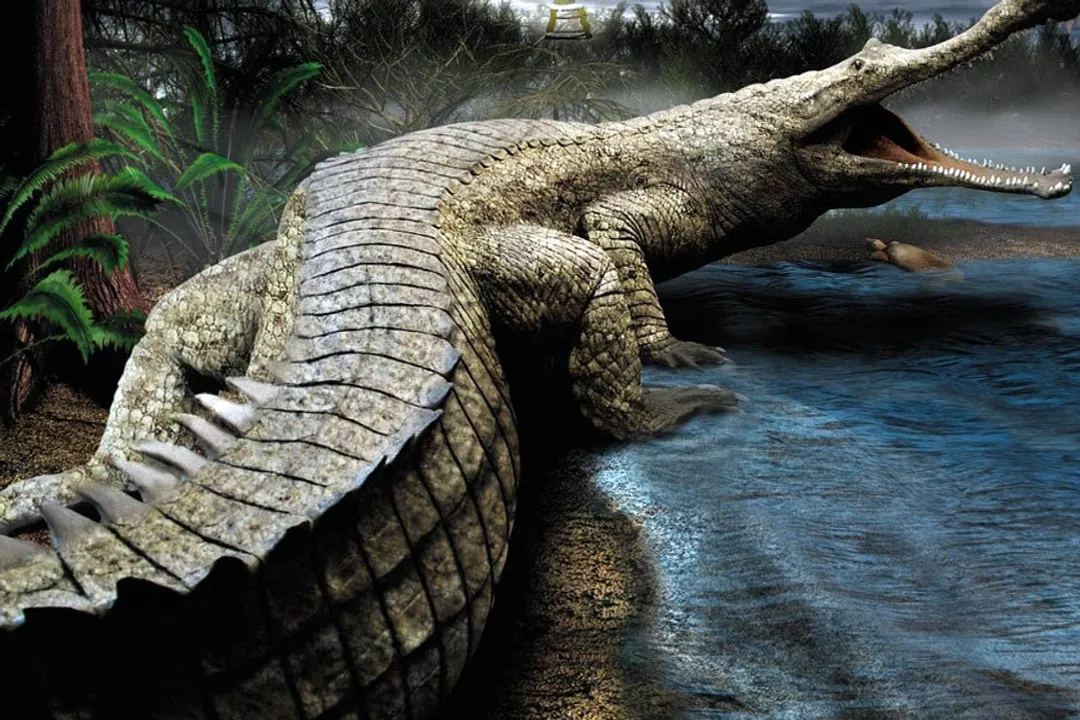
The name Rhamphosuchus translates directly to the evocative description of "beak crocodile". This moniker, attributed by Richard Lydekker in 1886, perfectly captures the most striking anatomical feature of this extinct, gigantic relative of the modern gharial: its remarkably long and narrow snout, which possessed a distinct beak-like appearance. The pronunciation of this ancient predator is rendered as Ram-foe-soo-kus. It belongs to the superfamily Gavialoidea, a group characterized by elongated jaws, and its very name hints at a specialized aquatic existence in the river systems of the ancient Indian subcontinent.
# Naming History
The story behind the name is one of incremental scientific discovery and revision, beginning in the early 19th century. Pioneer fossil collectors Proby Thomas Cautley and Hugh Falconer first unearthed fragments of this enormous crocodylian in the Siwalik Hills of India during excavations related to irrigation canal construction. In their initial 1840 description, they assigned the remains to Leptorhynchus crassidens, placing it within the genus Crocodilus at the time. The holotype specimen, a partial tip of the snout, provided enough evidence to suggest an animal of massive proportions. Over the subsequent years, the fossils were re-evaluated and moved to the genus Gharialis. It was Lydekker, in 1886, who conducted a detailed study of the material and concluded that the morphology differed too significantly from modern gharials (Gavialis) to remain grouped together. This critical distinction led him to coin the entirely new generic name, Rhamphosuchus, establishing the basis for what we know today.
# Size Revisions
The initial discovery of Rhamphosuchus crassidens fueled grand interpretations of its size. Lydekker, extrapolating from the fragmentary fossils against the proportions of modern gharials, proposed an astonishing length ranging from 15 to 18 meters, potentially reaching up to 59 feet. For decades, this speculation positioned Rhamphosuchus as the largest, or at least among the largest, crocodilians ever to have walked the Earth. This historical reputation, where the initial fragments suggested a behemoth dwarfing all others, highlights a common challenge in paleontology: the danger of overestimating size based on incomplete material.
The narrative surrounding the animal’s stature underwent a significant downward correction in the 2000s, driven by more rigorous study of the available fossil evidence. Jason J. Head's research, particularly abstract discussions prompted by a more complete skull find in 2000, revised the estimated length for R. crassidens down substantially, settling the potential body length between 8 and 11 meters (26 to 36 feet). Even with this "downsizing," Rhamphosuchus remains categorized as gigantic among crocodilians, though it yielded the title of the absolute largest to competitors like Sarcosuchus or Deinosuchus. This process—where the type species shrinks from an almost mythical giant to merely one of the largest—demonstrates the crucial, self-correcting nature of scientific authority. It shows how expert analysis, even preliminary, based on better-preserved or newly contextualized fossils, can drastically reshape our perception of deep time's largest inhabitants.
# Morphological Distinction
While the common name emphasizes the snout’s beak-like shape, the internal anatomical details reveal a creature structurally different from its modern, slender-snouted relatives, the Indian gharial (Gavialis gangeticus). Both the known species, R. crassidens and R. pachyrhynchus, exhibited a rostrum that was proportionally narrow compared to generalized crocodiles, yet it was notably more robust than that of a modern gharial. This robustness is evident because the margins of the upper and lower jaws diverged outwards toward the back of the skull, meaning the snout widened considerably closer to the eye sockets, a contrast to the parallel jaws of the modern Indian species.
Furthermore, the way the teeth intersected speaks volumes about its feeding mechanics. Unlike modern gharials, which possess interlocking teeth, Rhamphosuchus featured teeth that resulted in an "overbite," similar to modern alligators, with occlusal pits located medial to the teeth rather than between them. This suggests a bite designed for crushing or holding forcefully, rather than just snapping shut on slippery fish. Another fascinating feature noted in R. pachyrhynchus is the presence of bony depressions near the external naris (nostril), features that suggest the possibility of a ghara—the cartilaginous, knob-like soft tissue structure found on the snouts of modern male gharials. This osteological correlate hints that the gigantic Miocene predator might have engaged in similar, complex sexual signaling behaviors seen in its much smaller contemporary cousins.
# Ecological Role and Diet
The name Rhamphosuchus suggests a specialized piscivore, a conclusion supported by its long, narrow snout and conical, gripping teeth, structures ideal for catching fast, slippery fish. Its physical design—including a strong tail for propulsion—made it an efficient swimmer, capable of hunting prey in the productive river systems it inhabited. This diet aligns well with its classification within the Gavialoidea family.
However, the sheer scale of the animal, even at its revised size of up to 11 meters, suggests a more varied menu than just fish. Paleontological evidence from the same geological formations hints at a broader predatory scope, which presents a compelling ecological paradox. Fossil bones belonging to large Oligocene mammals like chalicotheres and rhinocerotoids (including juveniles of the enormous Paraceratherium) found in the Bugti Hills bear distinct tooth marks from large crocodilians. While attributing these specific marks solely to Rhamphosuchus is difficult because it shared its habitat with other large predators like Astorgosuchus, the implication remains strong that Rhamphosuchus was not restricted to aquatic life alone. This contrast between a specialized "beak" morphology—built for speed and fish capture—and the capacity, implied by its bulk, to tackle terrestrial megafauna, suggests Rhamphosuchus occupied a flexible, generalist niche unavailable to modern, hyper-specialized gharials. It seems to represent an evolutionary instance where gigantism allowed a specialized lineage to broaden its feeding strategy to exploit abundant large prey, essentially making it an apex predator capable of attacking animals far larger than its slender-snouted kin.
# Species and Timeline
Rhamphosuchus is known primarily from the Indian subcontinent, spanning the Oligocene through the Pliocene epochs. Scientists currently recognize at least two distinct species within the genus, though research continues to refine the classification of other associated remains.
The type species, Rhamphosuchus crassidens, is known from Pliocene sediments (around 3.6 to 2.6 million years ago) in the Siwalik Hills of Northern India. This species is characterized by a snout tip that maintains a consistent height and width, lacking the expansion seen in its relative.
The second recognized species is Rhamphosuchus pachyrhynchus, which is geologically older, originating from Oligocene and Miocene deposits in the Laki Hills and Bugti Hills of Pakistan. This species differs by possessing a snout tip that is prominently expanded both sideways and upwards. Recent estimates place R. pachyrhynchus as slightly smaller than R. crassidens, at about 6 to 8 meters in length.
The environment these giants inhabited was dynamic. In the Bugti Hills (Oligocene/Miocene), the ecosystem transitioned from coastal deltas and estuaries into complex floodplain networks, featuring tropical rainforests alongside more open landscapes. By the Pliocene, when R. crassidens was prevalent in India, the climate had generally become drier and cooler, leading to the prevalence of more open grassland environments, though substantial river systems remained to support these massive crocodilians. Their disappearance remains uncertain, perhaps linked to climate shifts or the disappearance of preferred prey resources that sustained their massive size. The legacy of Rhamphosuchus is thus one of initial awe based on fragments, followed by scientific refinement, revealing a truly colossal, yet structurally complex, example of a specialized predator that adapted to shifting paleo-environments.
Related Questions
#Citations
Rhamphosuchus - Wikipedia
Rhamphosuchus crassidens - A-Z Animals
-Rhamphosuchus | ROBLOX Cenozoic Survival Wiki | Fandom
Rhamphosuchus – one of the largest crocodiles - DinoAnimals.com
Rhamphosuchus | Dinopedia - Fandom
Meaning of RHAMPHOSUCHUS and related words - OneLook
Rhamphosuchus - Prehistoric Wildlife