Are red junglefowl still around?
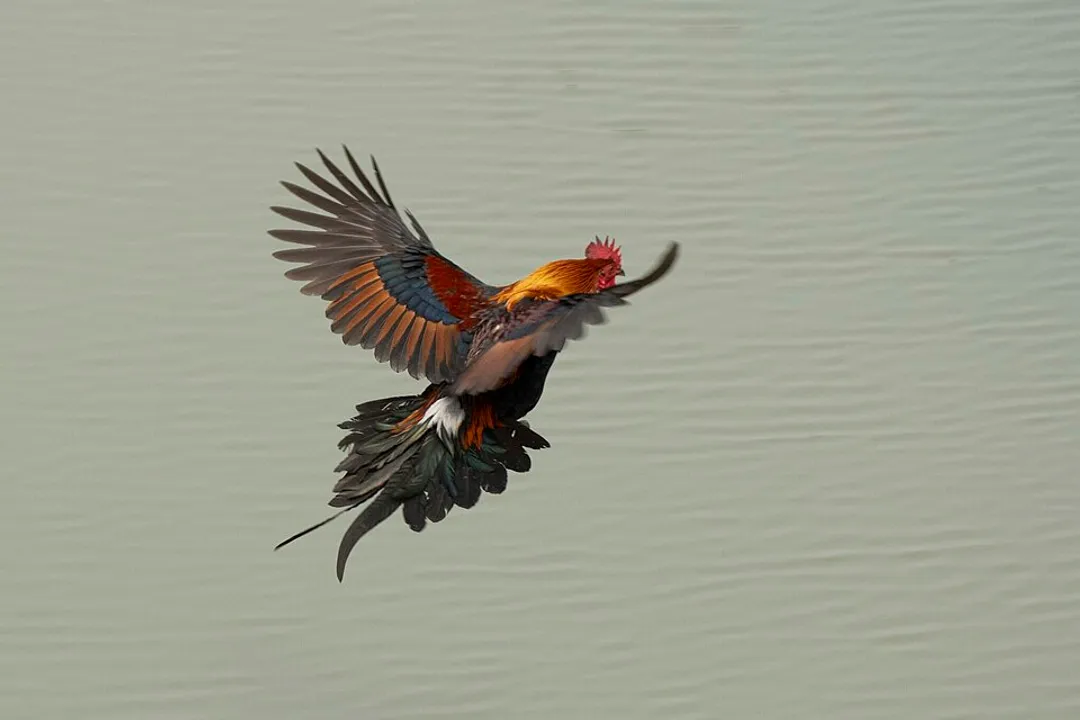
The existence of the Red Junglefowl, Gallus gallus, is not a matter of historical conjecture; these magnificent birds are absolutely still present in the wild today, though their story is deeply intertwined with the most successful domesticated animal in human history: the chicken. [1][6] For many, the very mention of the Red Junglefowl conjures images of a primitive ancestor, a footnote in the history of agriculture. In reality, this species represents a living link to deep evolutionary time, maintaining its wild identity across the forests and scrublands of South and Southeast Asia. [2][4] Understanding their current status requires looking beyond the farmyard and into the dense habitats where they continue to thrive, evade predators, and maintain their natural behaviors, distinct from their ubiquitous domestic cousins. [8]
# Current Range
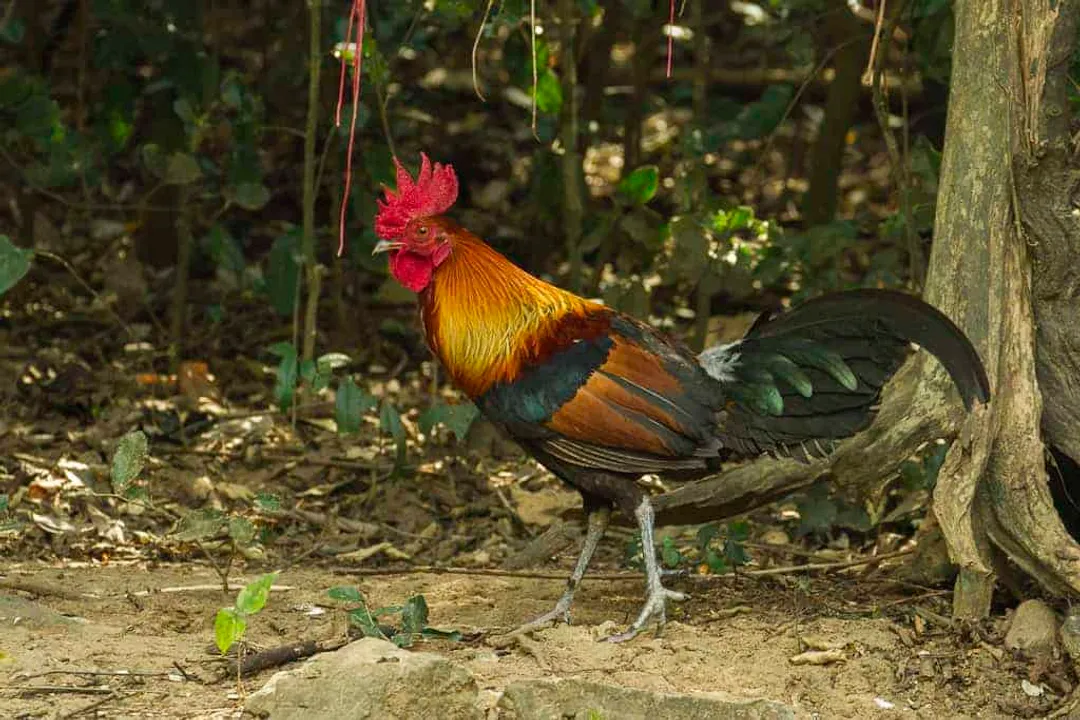
Geographically, the Red Junglefowl has a significant, though fragmented, native range stretching across a vast swath of Asia. [1][4] They are found in countries including India (particularly the Northeast), Nepal, Bangladesh, Sri Lanka, Myanmar, Thailand, Laos, Vietnam, Cambodia, peninsular Malaysia, and parts of Indonesia, such as Sumatra and Java. [1][2][4] Their preferred habitat leans toward secondary growth forests, scrublands, and the edges of cultivated areas, suggesting an inherent adaptability that likely aided their eventual domestication. [1][4] While they are widespread across this region, the quality and security of these populations are what raise concerns for conservationists. [6] For instance, in areas like the Malay Peninsula, they persist in various forest types, showing a preference for the cover of trees, where they roost at night well above the ground. [4] Observing them in the wild, such as through citizen science reporting platforms, confirms their continued presence, though specific sightings are often localized to protected areas or remote terrain. [2]
# Evolutionary Origin
The most profound connection the Red Junglefowl has to the modern world is its role as the primary, and perhaps near-exclusive, ancestor of the domestic chicken, Gallus gallus domesticus. [1][3][6] Archaeological and genetic evidence strongly points to their domestication occurring thousands of years ago in Asia, with various theories suggesting locations ranging from the Indus Valley to Southeast Asia. [3][7] While genetic studies have confirmed the Red Junglefowl as the main contributor, some research indicates a minor introgression, or mixing, from the Grey Junglefowl (Gallus sonneratii) may have occurred in the early stages of domestication. [1] This relationship means that every modern broiler or laying hen carries a significant genetic echo of this wild, jungle-dwelling bird. [3] It is a remarkable case of co-evolution where one species transitioned from a wild inhabitant of the jungle floor to a global commodity, fundamentally altering human food systems in the process. [7]
# Distinguishing Traits
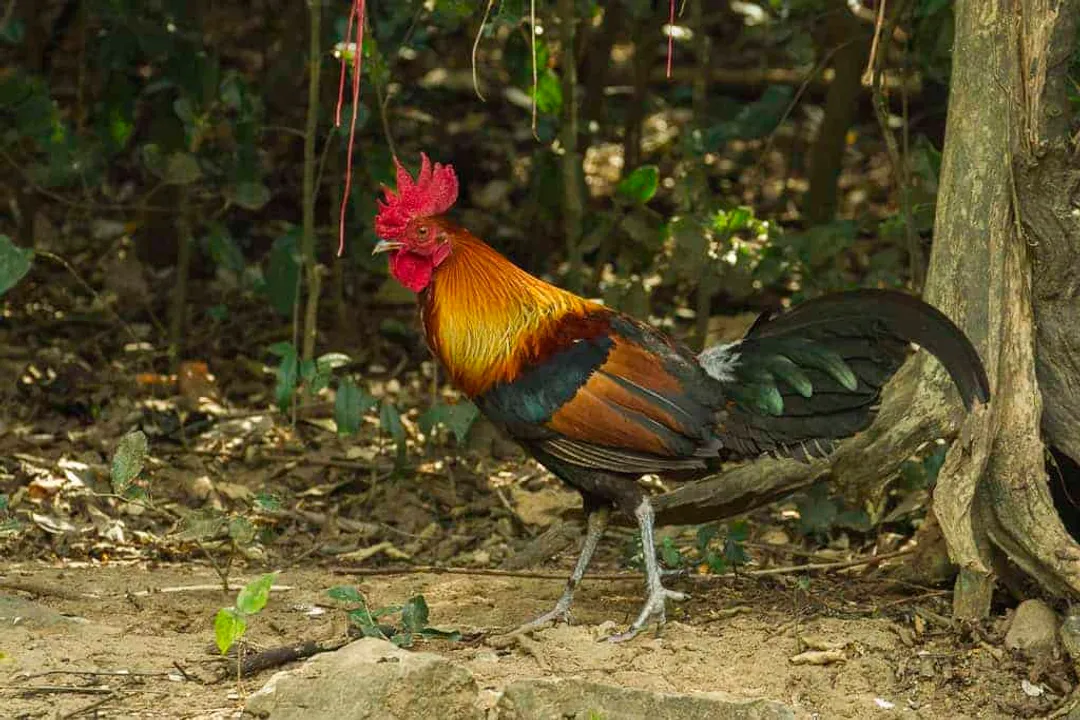
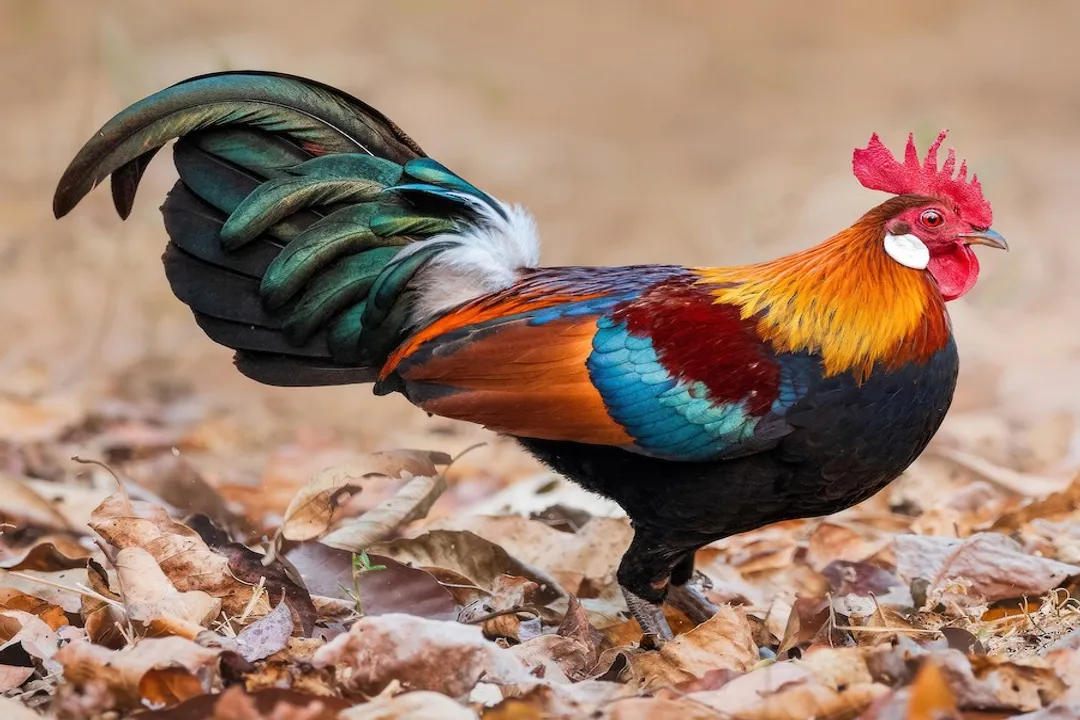
Telling a true wild Red Junglefowl apart from a feral chicken—a domestic bird that has returned to a wild-like state—can be challenging, especially where the two populations overlap. [1][6] However, the wild birds generally exhibit distinct characteristics. The male, or rooster, is instantly recognizable for his striking, ornamental plumage, quite unlike the often pale or uniform colors of commercial breeds. [4][8] He sports brilliant red or golden hackle feathers around the neck, glossy black or greenish-black body feathers, and a prominent, fleshy red comb and wattles. [4][8] In contrast, the female, or hen, is much more subdued, colored in mottled browns and buffs that offer superb camouflage while she is incubating eggs or tending chicks on the forest floor. [4][8] Generally, wild Red Junglefowl are leaner and slightly smaller than their domestic descendants, an expected consequence of natural selection favoring agility and vigilance over sheer mass. [1][4] The structure of their tails and the shape of their spurs can also differ subtly from common barnyard fowl. [8]
The very traits that made them successful in the wild—acute awareness, quick reflexes, and cryptic coloration in females—are often the first to be bred out in domestic lines in favor of traits like rapid growth or high egg production. [7] This divergence highlights an important point: while a bird running loose in a field might look like a Red Junglefowl, its behavior and genetic makeup might scream "domestic escapee." True wild populations persist where these selective pressures of domestication have not yet erased the ancestral blueprint. [6]
# Conservation Complexities
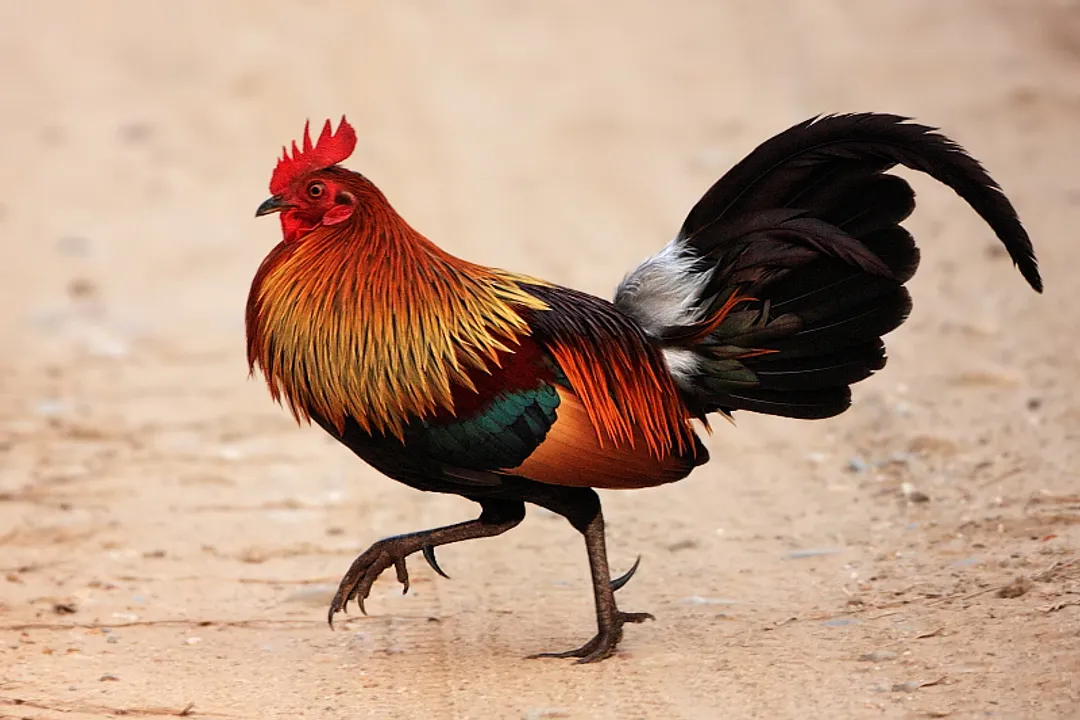
The greatest threat facing the pure Red Junglefowl today is not outright habitat loss, though that remains an issue, but rather hybridization. [1][6] As human settlements expand, domestic chickens invariably escape or are released into the periphery of the junglefowl's habitat. [6] When domestic roosters mate with wild hens, the resulting offspring carry domestic genes, diluting the pure wild gene pool over successive generations. [1] This genetic pollution can erode the specific adaptations that allow the species to survive in its natural niche. [6] In some areas, this hybridization is so extensive that pure populations are difficult to locate, leading scientists to treat the remaining populations as genetically distinct management units rather than a single, continuous species entity. [1] Protecting them, therefore, becomes a matter of preserving tracts of land with minimal domestic chicken intrusion, a much finer challenge than simply creating a large national park. [4]
When considering the historical reach versus the current secure distribution, it becomes clear that the bird's stronghold is shrinking toward pockets of relative isolation. [2] Areas like the protected forests in parts of Northeast India or specific reserve forests in Malaysia might hold the most genetically vital populations, as the surrounding human density and subsequent feral chicken presence are lower. [4] This geographical fragmentation means that conservation efforts must be highly localized, focusing on maintaining barriers—natural or otherwise—between wild and domestic populations to ensure the survival of Gallus gallus as a distinct species, rather than just an ancestor in the wild. [1] The bird's persistence is a quiet testament to its hardiness, but its purity requires constant vigilance against the very species it helped create.
# Behavioral Differences
The behavioral profile of the Red Junglefowl is markedly different from the often-docile behavior associated with farm chickens. In the jungle, survival depends on alertness and quick decision-making. [8] Red Junglefowl are wary and typically flush into flight or run for cover at the slightest disturbance, a stark contrast to many domestic birds that might simply stop and look when approached. [4] They exhibit complex social structures within their small flocks, establishing clear dominance hierarchies typical of wild galliform birds. [8] Roosters are highly territorial, especially during the breeding season, engaging in ritualized displays and fights to maintain their harem of hens. [4] The complex vocalizations, including distinct alarm calls and mating calls, are also fine-tuned for communication in the dense forest environment, features that have been significantly altered or lost in many commercial breeds optimized for confined living. [8]
The roosting behavior is another key differentiator; wild junglefowl invariably roost high in the canopy of trees at night, a defense mechanism against ground predators like snakes, wild cats, or civets. [4] Domestic chickens, especially modern breeds, often prefer ground coops or low perches, as they have been bred to be less capable or less inclined to fly high or far. [8] This reliance on vertical safety is an instinctive survival mechanism that highlights the gap between the wild survivor and the farm animal.
# Legacy of Domestication
The process that turned this shy jungle bird into the global chicken involved selecting for traits that benefitted human needs, often at the expense of the bird's wild fitness. [7] Early domestication likely centered on easy capture, docility, and meat/egg production. [3] The spread of Gallus gallus across the globe, carried by human migration and trade routes, cemented its place in human society. [7] It is fascinating to consider that the development of specialized breeds—from the tiny Serama to the massive Brahma—represents an incredibly rapid evolutionary divergence spanning only a few thousand years, driven entirely by artificial selection. [1][3] This history means that while the Red Junglefowl persists, it serves as a baseline for comparison: what the chicken was before human intervention dictated its form and function. [7] The domestic bird is a testament to human impact, whereas the wild bird is a reminder of nature's original design.
# Maintaining Wild Populations
For those interested in the persistence of the species, understanding where to look—or rather, where not to look—is key. Truly secure populations are likely found far from commercial agriculture and dense human habitation, often within the core areas of national parks or remote hill forests. [2][4] Supporting the conservation of these large, intact forest ecosystems, rather than focusing on localized bird rescues (which often deal with feral or hybrid stock), is the most direct way to ensure the Red Junglefowl's continuation as a wild species. [6] Recognizing the subtle signs of hybridization—the appearance of non-standard colors, unusually large size, or overly tame behavior in a supposedly wild flock—is the first step for researchers and local enthusiasts in identifying where conservation efforts must be most intensely focused to prevent genetic dilution. [1] The fate of the Red Junglefowl is thus tied directly to the success of preserving large, undisturbed Asian forest tracts where the pressures of domestication are held at bay.
# Distinguishing Junglefowl vs. Feral Stock
The genetic boundary between a true wild Red Junglefowl and a feral chicken that has reverted to a wild lifestyle is often fluid, especially in areas where mixing has occurred for decades or centuries. [6] Feral populations, though perhaps behaving more like their wild ancestors due to environmental pressures—like needing to find food independently and avoid predators—still carry the genetic baggage of domestication, such as changes in growth rate or feather retention. [1] However, the core wild populations have maintained a very high degree of genetic uniformity compared to the staggering diversity found within domestic fowl. [3] This difference in genetic architecture is critical; wild populations possess the specific allele combinations necessary for long-term survival in their native ecosystem, features that have been selected against in commercial lines. [6] If a bird exhibits the pure, non-recessive coloration and maintains the lean body structure typical of the species across multiple generations in a given area, it is far more likely to be a genuine wild individual. The very fact that we must continuously debate this distinction underscores the ongoing conservation challenge: securing the habitat and monitoring the genetic integrity of the remaining birds. [1]
# Habitat Resilience
While we discuss their survival, it is important to acknowledge the resilience inherent in the Red Junglefowl's chosen environment. They are not strictly confined to primary, untouched rainforests; they thrive in secondary growth and the edges of human activity, which speaks to a degree of ecological flexibility. [4] This means that small, sustainable agricultural practices that maintain forest cover, as opposed to large-scale clear-cutting or intensive monoculture farming, may be less detrimental to their local survival than an outright loss of all vegetation. [2] Their ability to utilize scrub and secondary forest areas provides small, scattered refugia that might serve as stepping stones between larger protected zones, allowing for some level of gene flow that might otherwise be impossible if they were restricted only to deep jungle interiors. [4] This ecological niche flexibility has historically been their strength, allowing them to remain viable even as human landscapes shifted around them, but this trait is now being severely tested by the proximity of feral domestic birds. [6]
# Visual Summary Comparison
To better illustrate the differences often sought by observers, a simplified comparison between the archetypal wild bird and its most common domestic counterpart is helpful, though remember that many farm mixes exist:
| Trait | Red Junglefowl (Wild Type) | Domestic Fowl (Common Farm Type) |
|---|---|---|
| Body Shape | Lean, agile, medium-sized | Varies widely; often heavier breast/body mass |
| Male Plumage | Brilliant, well-defined colors (red/gold/black/green) [4][8] | Highly variable; often white, black, brown, or barred patterns |
| Female Coloration | Cryptic browns and buffs for camouflage [4][8] | Extremely variable; white, black, mottled, often less camouflage-optimized |
| Temperament | Extremely wary, quick to flush, flight capable [4] | Generally docile, slower reaction time, less flight capability |
| Roosting Height | High in trees (canopy level) [4] | Often low perches or ground level |
This table illustrates that the "wild" look is not merely about color but about a suite of linked adaptations for survival in a predator-rich, non-provisioned environment. [8]
# The Genetic Reservoir Concept
The existence of pure Red Junglefowl populations in the wild serves a purpose beyond mere species preservation; they function as a vital genetic reservoir. [1] Commercial chicken lines are incredibly uniform genetically, having been bottlenecked through generations of selection for productivity. If a new avian disease emerges that exploits a weakness common to all modern breeds—perhaps related to immune response or bone density—the untapped genetic diversity within the wild Gallus gallus could hold the key to breeding resistance back into domestic stocks. [6] Therefore, protecting the wild bird is not just an ecological act; it is an indirect form of biosecurity for the global poultry industry. The traits that make a wild bird a survivor—hardiness, disease resistance, and efficient foraging—are exactly the traits that become priceless when domestic lines face novel environmental or pathogenic challenges. [7] This realization elevates the importance of their continued survival from a conservation interest to one of subtle, long-term agricultural utility.
Related Questions
#Citations
Red junglefowl - Wikipedia
Red Junglefowl - eBird
Red Junglefowl is the bird that domesticated chickens come ... - Reddit
Red Junglefowl Overview, All About Birds, Cornell Lab of Ornithology
Red Junglefowl: Origin of Domesticated Chicken - Manas NP
Red Junglefowl Ancestor of Chicken Living with Singaporeans Today
Red Junglefowl. Scientific Name: Gallus gallus | by Quiet Frame
Chickens: How We Got Here - The Open Sanctuary Project
[PDF] RED JUNGLEFOWL Gallus gallus - Bishop Museum