Is the Archelon turtle still alive?
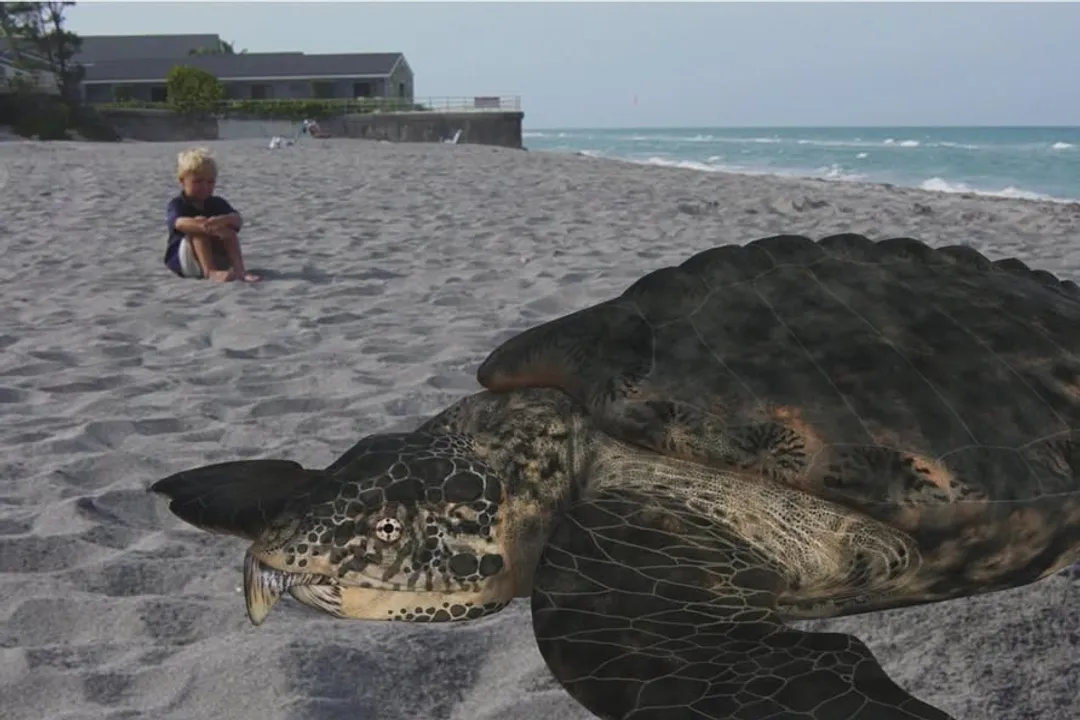
The immense creature known as Archelon, the largest sea turtle ever known to have swum the Earth’s oceans, captures the imagination like few other prehistoric animals. Its sheer scale suggests a titan of the Late Cretaceous period, a time when marine reptiles dominated the warm, shallow seas. While the idea of such a magnificent relic surviving into the modern age sparks frequent discussion online, the scientific consensus places the Archelon firmly in the past, millions of years gone, known to us only through the fossil record. [5][9] Understanding its reality requires looking back at the evidence paleontologists have uncovered, rather than forward to any potential modern sighting. [6]
# Immense Scale
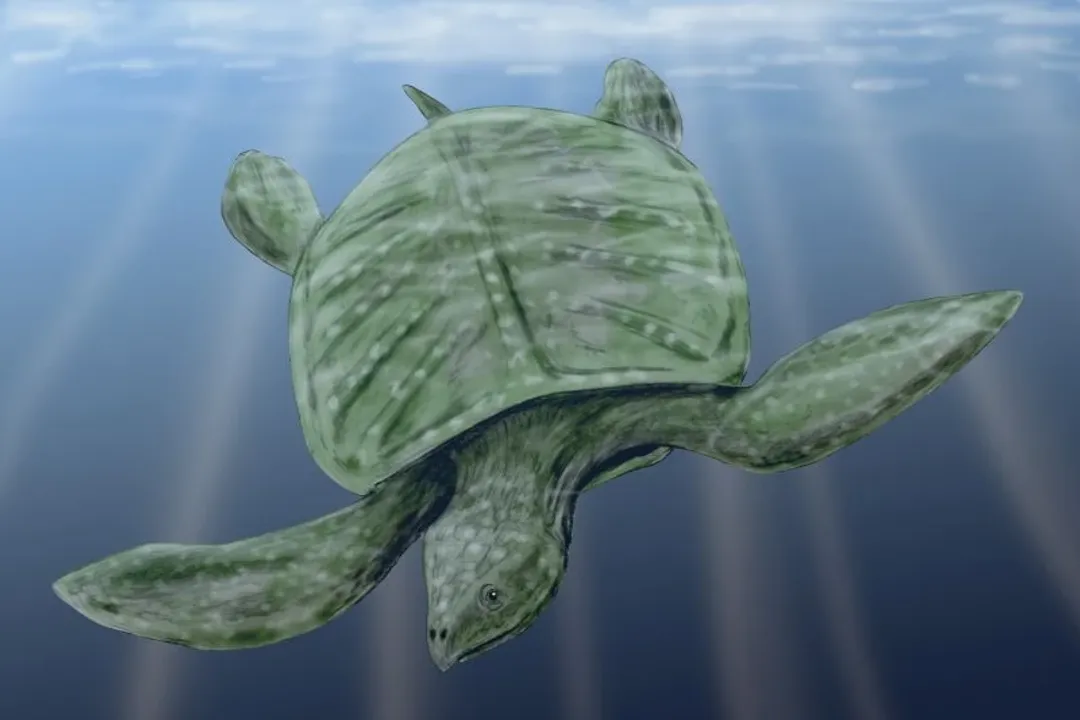
The primary feature that distinguishes Archelon is its colossal size, setting it apart from any sea turtle alive today. [1][6] Estimates of its length often reach up to 7 meters, or roughly 23 feet, from head to tail tip. [1][6] Considering its shell alone could stretch up to 3.7 meters (about 12 feet) long, it dwarfs even the largest extant marine turtle, the Leatherback, which rarely exceeds 2 meters in carapace length. [1][5][7] Some paleontological descriptions suggest an overall body length near 14 feet or more, establishing it as the absolute largest turtle known to science. [4][7] This staggering size suggests an animal requiring vast amounts of food to sustain itself in the ancient seas. [6] If we take an average modern giant Leatherback weighing around 2,000 pounds, a conservative estimate for the sheer biomass of a fully grown Archelon might easily approach double or triple that figure, illustrating an evolutionary pathway toward gigantism unmatched by its modern cousins. [1]
# Physical Traits
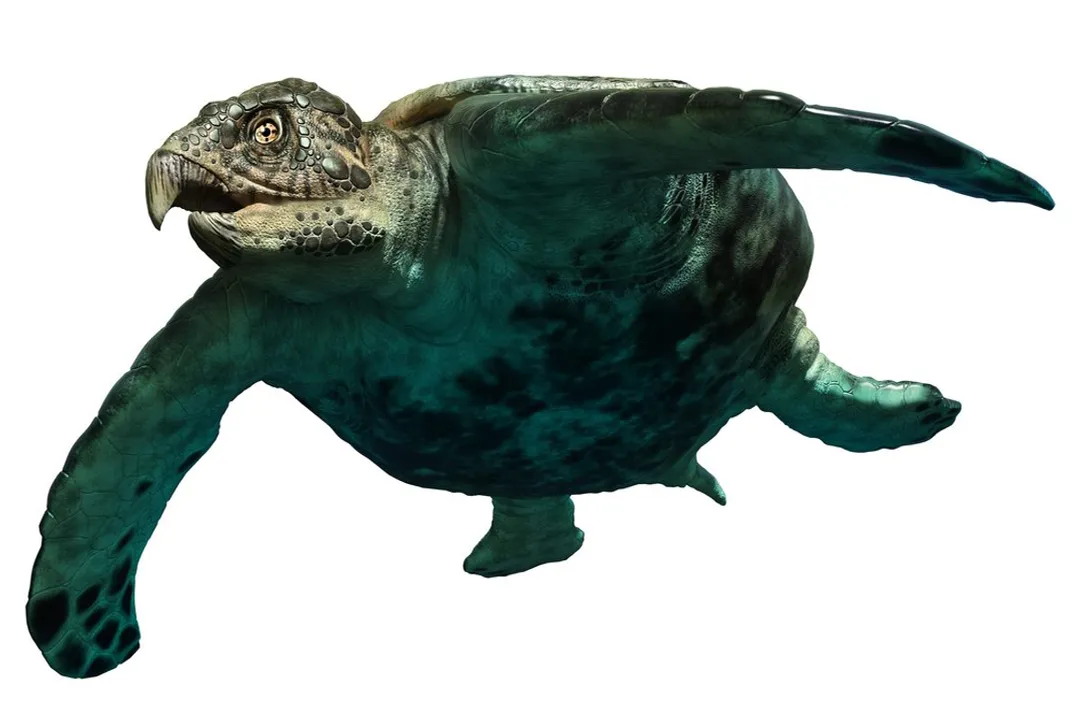
Archelon was clearly built for an open-ocean existence, perfectly adapted to life far from coastal shallows. [5] Its limbs had evolved into massive, powerful paddles, unlike the more manageable flippers of modern sea turtles. [5][9] These enormous fore-flippers, which could measure up to 2.4 meters (nearly 8 feet) in span, were specialized for efficient, long-distance swimming, suggesting a creature that spent most, if not all, of its life paddling through the open ocean currents. [1][5][7] The shape of its shell, or carapace, was also distinctive; it was lighter and more streamlined than that of many modern turtles, lacking the high doming often seen in terrestrial or shallow-water species. [1][9] Its shell was also somewhat reduced compared to earlier relatives, potentially to save weight necessary for active swimming. [9]
The head featured a sharp, hooked beak perfect for gripping slippery prey. [6] While its diet would have included various marine life, analysis of its jaw structure suggests it specialized in feeding on soft-bodied organisms like jellyfish and squid, much like extant sea turtles, though its larger size would necessitate consuming much greater quantities. [1][7] One fascinating aspect, perhaps overlooked by casual observers, is how different its swimming stroke must have looked; its massive paddles would have provided incredible thrust but likely required a much slower, more deliberate stroke cycle compared to the rapid flutter of a modern Leatherback, implying a different style of oceanic migration or hunting. [5]

# Cretaceous Seas
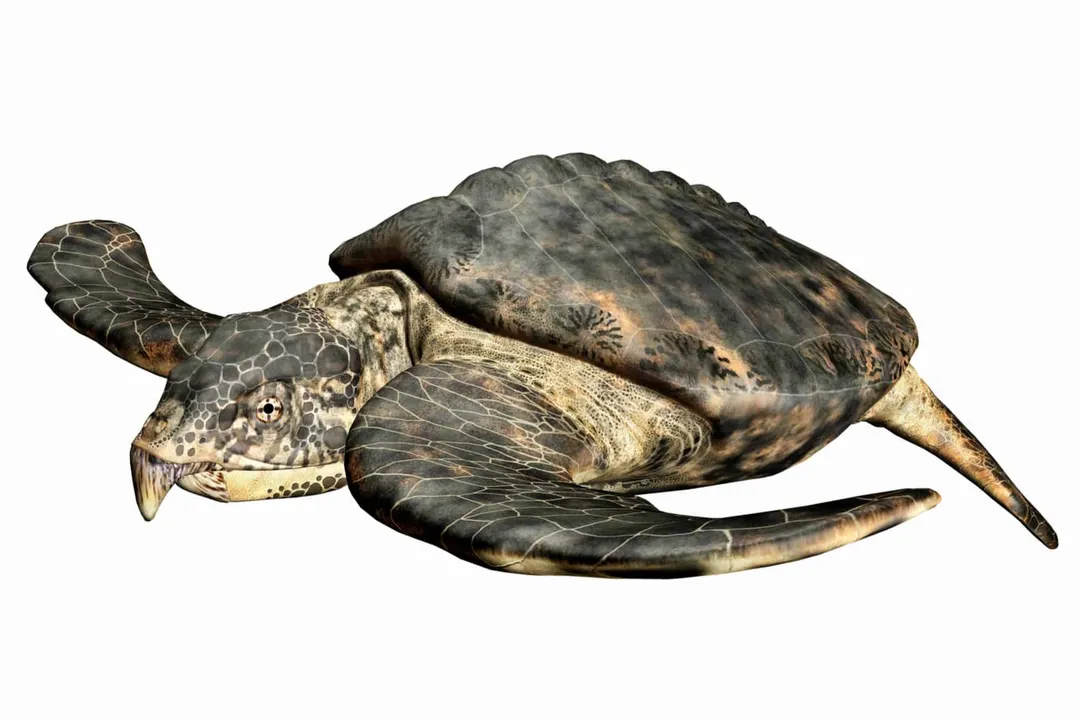
This ancient leviathan navigated the world during the Late Cretaceous period, approximately 70 million years ago. [3][6] At that time, much of North America was covered by the Western Interior Seaway, a vast, shallow sea that stretched from the Arctic Ocean to the Gulf of Mexico. [6][9] Archelon fossils are primarily found in the marine deposits of this ancient seaway, specifically in areas corresponding to modern-day Kansas and South Dakota, entombed in what is now known as the Niobrara Chalk or Pierre Shale formations. [6][9] This environment was teeming with large marine predators, including mosasaurs and plesiosaurs, meaning Archelon lived in a highly competitive and dangerous marine ecosystem. [6] The quality of preservation in some of these chalk formations is remarkable, occasionally capturing near-complete skeletons, which grants paleontologists significant detail about its anatomy. [3]
# Vanished Past
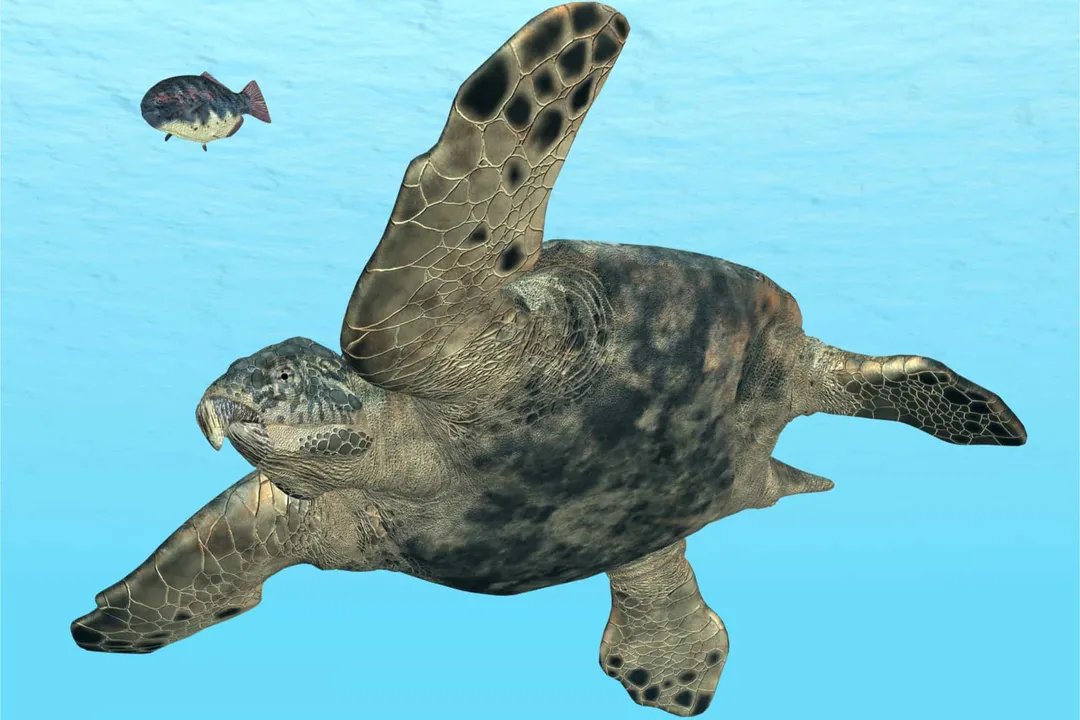
The era of Archelon ended with the Cretaceous–Paleogene (K-Pg) extinction event, the cataclysmic impact that wiped out the non-avian dinosaurs 66 million years ago. [3][9] While sea turtles survived this mass extinction—a testament to their adaptability—the gigantic form of Archelon did not persist into the Cenozoic Era. [3][9] There is no evidence suggesting that Archelon survived the K-Pg boundary; it simply disappeared from the fossil record along with many other marine reptiles of that time. [5] The subsequent cooling of the global climate and changes in ocean chemistry likely rendered its specialized, large-bodied existence unsustainable, allowing smaller, more generalized turtles to thrive in the aftermath. [9]

# Living Sightings
Despite the firm paleontological dating, the digital age frequently resurrects the question of whether Archelon is still around. Online forums and social media occasionally host sensational claims of modern sightings, sometimes citing videos or blurry photographs. [4] One specific viral claim suggested a massive 14-foot specimen had been "spotted," often accompanied by text implying it was previously thought extinct. [4] Such reports almost invariably turn out to be misidentifications of unusually large modern Leatherback sea turtles, hoaxes, or simply imaginative creations. [4][8] Paleontologists regard these sightings with skepticism because no living Archelon has ever been captured, photographed clearly, or recovered as a specimen, which would be required to overturn the millions of years of fossil evidence placing it firmly in prehistory. [6] It’s a case where the allure of a lost giant prompts wishful thinking, but the concrete facts only point backward in time. [1][5]
# Turtle Lineage
To better understand its place, it is helpful to see where Archelon fits within the broader history of turtles. Archelon ischyros is the best-known species, but the genus also includes smaller relatives like Protostega, which also inhabited the Cretaceous seas. [6][9] Archelon belongs to the extinct family Protostegidae. [6] While it is related to modern sea turtles, the lineage diverged long ago. [9] Modern sea turtles, such as the Green sea turtle or the Loggerhead, belong to the family Cheloniidae, or in the case of the Leatherback, the family Dermochelyidae. [5] The evolutionary path taken by the Protostegids led them to extreme sizes specialized for the Late Cretaceous environment, a path that ultimately failed to endure beyond the great extinction event. [3][9] Seeing the fossilized remains of Archelon provides a tangible example of an evolutionary experiment that peaked and then concluded, leaving modern turtles as its more modest, yet successful, survivors. [5]
#Videos
Archelon: The Largest Turtle Ever To Have Lived - YouTube
Related Questions
#Citations
Archelon Turtle - A-Z Animals
Archelon The Largest turtle that has ever lived was an absolutely ...
Archelon: The Largest Turtle Ever To Have Lived - YouTube
Sea Turtle Conservancy - Facebook
This prehistoric sea monster was the size of a car, weighed the ...
Archelon | Dinopedia - Fandom
Archelon Sea Turtle - Black Hills Institute of Geological Research
Archelon | Giant Sea Turtle, Extinct Species & Prehistoric Reptile