What are the characteristics of a red bellied snake?

The characteristics of the Red-bellied Snake (Storeria occipitomaculata) immediately present a study in deceptive subtlety, beginning with its size and culminating in its surprisingly colorful underbelly. [2][3] This species belongs to the family Colubridae and is considered harmless across its range in North America, spanning parts of Canada and the United States. [2][1] Despite its commonality in suitable environments, its secretive nature means many outdoor enthusiasts may pass by its chosen hiding spots without ever realizing the small reptile was close by. [2][5]
# Appearance
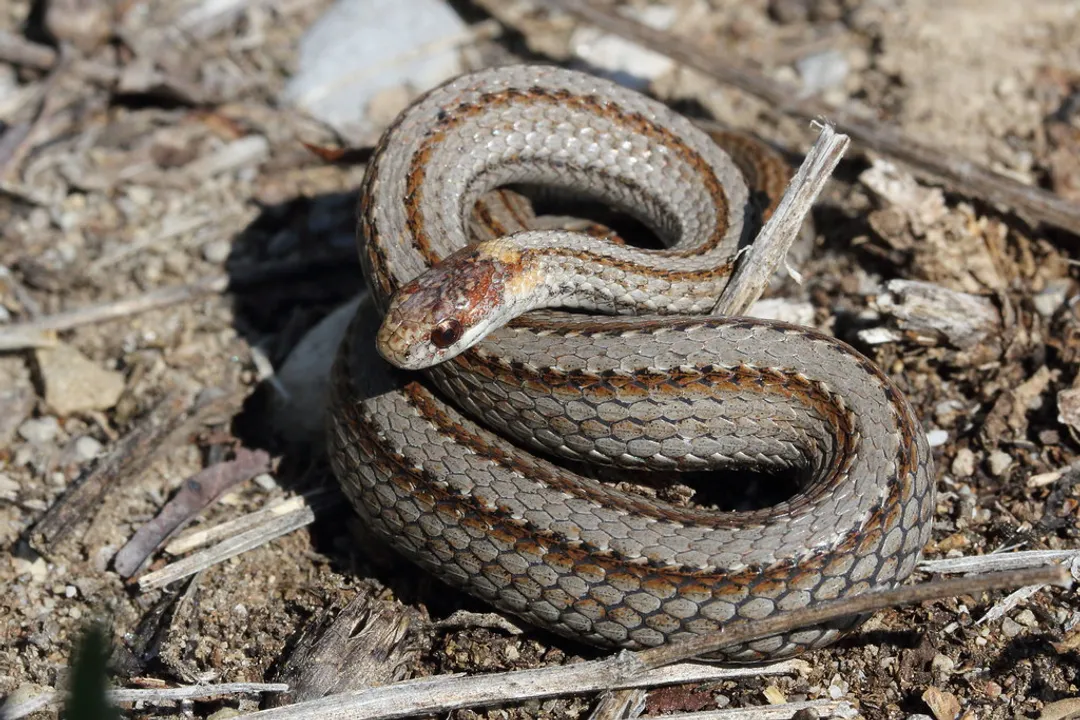
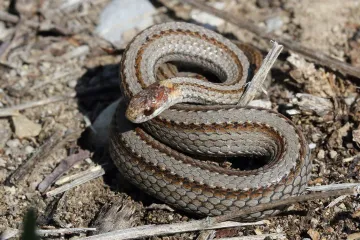
The dorsal coloration of the Red-bellied Snake is highly variable, a trait that sometimes complicates identification if one only relies on the assumption of a uniformly colored back. Adults most commonly present as shades of brown, gray, or black. [2][4] This cryptic top coloring allows them to melt into the leaf litter and soil where they spend much of their time. Patterning can include a solid dorsal color, or the presence of two or four thin, dark longitudinal stripes. [4][6] Some individuals even display a faint, lighter stripe running down the center of the back. [1][4]
The head is frequently darker than the rest of the body, offering a slight contrast. [1] A key diagnostic feature, present in many but not all individuals, is found on the nape of the neck, just behind the head: there are typically three distinct light spots. [1][5] These spots, which can occasionally merge to form a single tan or white collar marking, give rise to the species' scientific name, occipitomaculata, meaning "spotted on the back part of the head". [2][3][5] Furthermore, some sources note the presence of a small white spot below each eye. [5]
The defining feature, which contrasts sharply with the muted dorsal tones, is the underside. The belly is characteristically a bright red or orange, though variations including pink, yellow, or even gray/black do occur, with the bright colors being the most widely recognized marker. [1][2][4][5] Even when the belly is not pure red, it is often bordered by a thin black line, and the chin and throat tend to be off-white or very lightly colored. [4][6]
When comparing the Red-bellied Snake to its close relative, the Dekay's Brownsnake, the belly color is a primary differentiator; Brownsnakes possess paler bellies. [1][4][6] Another essential structural characteristic is the texture of the scales. Red-bellied Snakes possess keeled dorsal scales, meaning each scale has a ridge down its center, a feature shared with the Brownsnake but different from the smooth scales of the Ring-necked Snake. [2][4][6] Additionally, the anal plate, located where the belly scales end near the tail, is divided in this species. [2][4][6]
# Dimensions

The Red-bellied Snake is definitively a small species. Adults usually measure between 8 to 10 or 12 inches in total length, though lengths reaching up to 16 inches have been reported occasionally. [1][3][4][5] Their small stature means that newborns are tiny, often measuring only about 3 inches long, small enough to comfortably coil upon a U.S. quarter. [2][5] Sexual dimorphism in size is minimal, with males exhibiting slightly longer tails, but otherwise, sexes are similar in length.
# Habitat
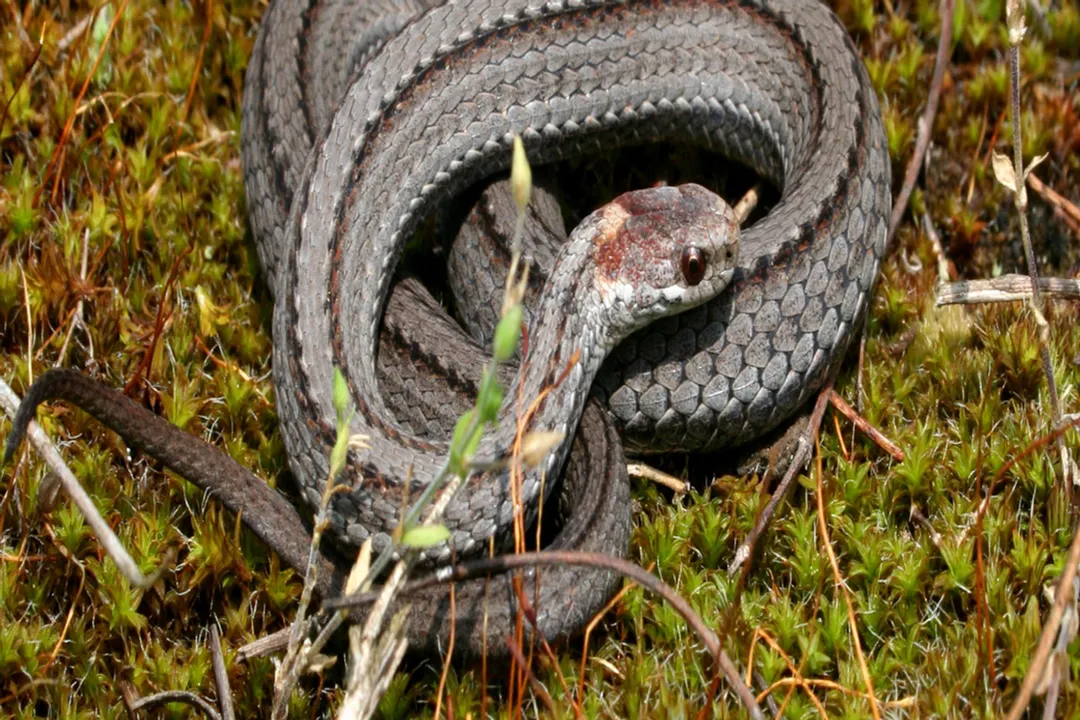
The preferred dwelling of S. occipitomaculata centers around areas that offer both moisture and abundant cover. [1][5] They thrive in woodlands, often preferring moist soils, though they can adapt to drier sites as well. [4] Rocky, wooded, or hilly terrain seems particularly favored in some regions. [1][5] Beyond deep forests, they can be found inhabiting forest edges, fields, pastures, marshes, and bogs, frequently associating with ground cover like logs, scattered tree bark, rocks, and thick leaf litter. [1][4][6]
For populations situated near the northern limits of their geographic spread, a fascinating adaptation involves using abandoned ant mounds. [2] These mounds serve a vital purpose: they absorb solar radiation, providing insulation that extends the snake's active season, which is crucial when cold temperatures otherwise limit activity. [2] Since the species is not an effective burrower, these structures offer necessary thermal refuge. [2] The snake’s secretive disposition means it spends the vast majority of its time hidden under these various cover objects, only occasionally venturing out to bask in the sun. [1] One observation from an area like Missouri notes their presence on rocky, north-facing, wooded hillsides, suggesting an orientation toward specific sun exposure to manage body temperature. [1]
It is worth noting that habitat preference can sometimes appear erratic, even among closely situated areas. Biologists have recorded that Red-bellied Snakes might be abundant at one specific location exhibiting ideal characteristics—moist soil, plenty of debris—yet be completely absent from a nearby site that appears virtually identical. [2] This phenomenon underscores the importance of understanding microclimates and specific substrate availability that may not be immediately apparent to a casual observer. For local conservation efforts, knowing this preference means that preserving a variety of natural debris, rather than just large tracts of forest, can be an actionable step to supporting their presence in developed or fragmented landscapes. [6]
# Evasion Tactics
Despite their generally docile nature and reluctance to bite humans, Red-bellied Snakes have developed a unique repertoire of defensive behaviors to deter potential predators like birds, raccoons, and larger snakes. [1][5] They are noted for being gentle when handled, though a freshly captured individual may emit a foul-smelling musk from glands near the tail base. [1]
Their primary deterrents involve visual and physical displays:
- Death-Feigning (Thanatosis): When harassed, the snake will often stiffen, roll onto its back, and remain motionless. [1][3] This behavior exposes the brilliant red or orange belly, which may momentarily startle or confuse a predator, allowing the snake a chance to escape. [1] This state of immobility can sometimes be triggered by sheer fright rather than conscious acting. [1]
- Lip-Curling: A highly distinctive behavior involves curling its upper "lips" outward to expose its small teeth. [2][3][5] While researchers continue to study its exact function, it is theorized to aid in handling slippery prey or serve as a direct warning to predators. [2]
- Mock Display: Some individuals may mimic the posture of venomous snakes by flattening their bodies, raising their heads, and flexing their necks—a visual bluff designed to deter attacks. [2][3]
Because their teeth are small and ineffective against anything larger than their invertebrate prey, these behavioral tactics are essential for survival.
# Diet
The diet of the Red-bellied Snake centers almost entirely on soft-bodied invertebrates, positioning them as important local regulators of certain garden pests. [1][5] The slug is considered their primary food source. [2][5][6] They also actively consume earthworms and land snails. [1][3] Beyond these gastropods, their menu can include pillbugs (sow bugs), grubs, soft-bodied insects, and occasionally small salamanders. [4]
Members of the Storeria genus, including this species, possess specialized dental structures. Their teeth are slender and curved at the tip, adaptations biologists believe help them grip and persistently tug at the slippery bodies of snails until the prey can be extracted from its shell. [1] This specialized feeding adaptation highlights a significant ecological contribution, as controlling slugs and snails—organisms often considered injurious to cultivated plants—makes the Red-bellied Snake a beneficial neighbor in gardens and agricultural areas. [1][5]
# Reproduction
Red-bellied Snakes reproduce through ovoviviparity, meaning the young develop inside the mother and are born live, rather than hatching from eggs laid externally. [2] Mating can occur during several periods, often in the spring, summer, or autumn. [1][3] Females carry the young until late summer or early fall (specifically late July through early September) before giving birth. [1][3][5]
Litter sizes show a wide range, documented from as few as one up to twenty-one young, though the average litter size tends to center around seven to nine offspring. [1][3] Sexual maturity is generally attained around two years of age, with a minimum size threshold noted around $22$ centimeters ($8.7$ inches) for reaching reproductive capability. [2][3] Lifespan is estimated to be at least four or five years, with some captive individuals living longer. [1]
An interesting aspect of their reproductive timing, especially in cooler climates, is the potential for breeding to occur in the fall, leading to delayed fertilization until spring, although annual spring/summer breeding is also documented. [2][3] This variation in breeding timing within the species suggests a flexibility that allows them to maximize reproductive success based on local thermal cues—a characteristic often found in species living near the edge of their climatic tolerance, such as those in Ontario or northern areas of their range. [6]
# Distribution and Activity
The distribution of S. occipitomaculata covers much of eastern and central North America, generally east of the Rocky Mountains and north of the Gulf Coast, extending into southern Ontario and Minnesota in the north. Within specific states, like Massachusetts, they are locally common statewide, though absent from islands like Nantucket County. [2] In Kentucky, they are generally found state-wide, though less common in the Bluegrass Region and Western Coal Fields. [3]
Activity patterns are tied closely to ambient temperatures. In spring and fall, they often display diurnal behavior, making use of the moderate warmth to move about. [2] However, during the height of summer heat, they tend to become nocturnal to avoid overheating, spending the day concealed. [2]
A notable behavioral feature is their seasonal migration. In autumn, they often move from lower-lying areas, like floodplains, toward sheltered overwintering sites in rocky, wooded hillsides. [1] These hibernation sites are critical for survival and can include rock crevices, mammal burrows, or the insulating environment of those ant mounds previously mentioned. [1][3] They are reported to be cold-tolerant, which contributes to their presence in northern latitudes.
# Confusion Risks
Due to their small size, secretive habits, and general resemblance to other small brown snakes, the Red-bellied Snake is frequently misidentified or persecuted. [1] The closest visual match is often the Dekay's Brownsnake. [2][4] Key identifiers to separate them include the Brownsnake's paler belly and the presence of two rows of dark spots down its back, rather than the solid or striped pattern with a red belly seen in S. occipitomaculata. [6][4]
Another potential point of confusion, arising from unwarranted fear, is mistaking a Red-bellied Snake for a young Copperhead. [1] This mistake can be dangerous for the harmless snake. Copperheads are physically distinct: they are stouter, possess characteristic hourglass-shaped markings across their backs, have vertical (elliptical) pupils, and possess sensory pit organs between the eye and nostril—features entirely absent in the non-venomous Red-bellied Snake. [1] In Ontario, the Ring-necked Snake is another look-alike, but it possesses smooth scales and a distinct yellow neck ring, contrasting with the Red-bellied Snake’s keeled scales and spotted or fused neck markings. [6]
# Conservation Standing
Globally, the IUCN assesses the Red-bellied Snake as a species of Least Concern, suggesting it is widespread and not facing overwhelming threats overall. [2][6] However, like many small, secretive species, local populations can still be vulnerable. Their reliance on specific ground cover means that habitat loss or significant disturbance of rocks, logs, and leaf litter can negatively impact local densities. [6] Furthermore, since they undertake migrations to and from hibernation sites in the spring and fall, they are particularly susceptible to road mortality during these active transit periods. [1] Their role in controlling slugs and snails, however, means they are generally considered beneficial to human interests concerned with garden health. [1]
Related Questions
#Citations
Northern Red-bellied Snake - HRM
Storeria occipitomaculata - Wikipedia
Red-bellied Snake (Storeria occipitomaculata)
Redbelly Snake - BioKIDS
Learn about red-bellied snakes - Mass.gov
Red-bellied Snake | Reptiles & Amphibians in Ontario
Red-Bellied Snake - Missouri Department of Conservation