What are the characteristics of a red frog?
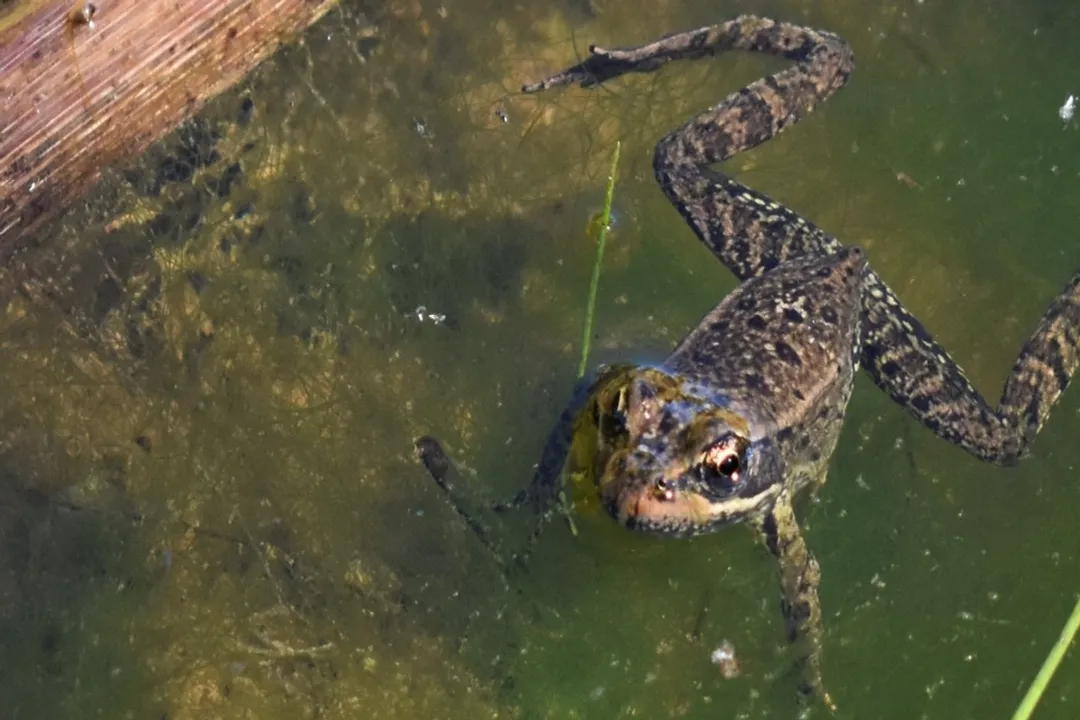
The term "red frog" often conjures an image of dazzling, uniform scarlet, but in the temperate forests and wetlands of North America, the reality is often more nuanced, involving shades of brown, olive, and most significantly, red coloration appearing on the underside. When naturalists speak of red frogs, they are usually referring to specific species in the Rana genus, primarily the Northern Red-legged Frog (Rana aurora) and the California Red-legged Frog (Rana draytonii), both highly recognizable amphibians with distinct characteristics that set them apart. [1][6][7] It is also important to note that other species, like the popular Red-eyed Tree Frog, carry "red" in their common name, though their primary characteristics differ significantly from the ground-dwelling Rana species. [5]
# Appearance Detail
Differentiating between the various "red" frogs begins with a close look at their skin and overall build. The California Red-legged Frog (Rana draytonii) holds the distinction of being the largest native frog found in the United States. [6] Adult specimens can reach quite a size, which is one immediate distinguishing feature when compared to many smaller woodland frogs. [6] Their dorsal coloration—the back—typically ranges from a reddish-brown to an olive-brown. [3][6] A key field mark for this species involves spotting dark, somewhat irregular spots on the back that are often ringed by lighter halos—a subtle but important pattern. [3][6] The namesake red hue is not usually the dominant color on top; instead, it appears as a distinct red or pink wash underneath, covering the lower flanks, the belly, and the inner thighs. [3][6]
In contrast, the Northern Red-legged Frog (Rana aurora) presents a slightly different palette. While they can also be shades of brown, they may also appear green or olive. [1] A very reliable feature for identifying the Northern Red-legged Frog, particularly in the Pacific Northwest where it is common, is the presence of a dark, conspicuous mask that runs around the eye area. [1] Like its southern cousin, the red on this species is primarily found on the undersides of the hind legs, often described as red or orange. [1][7] While both species share the "red-legged" descriptor, paying attention to the presence of the light-ringed spots (more characteristic of R. draytonii) or the distinct dark mask (more characteristic of R. aurora) can help a keen observer distinguish them in areas where their ranges might overlap or be confused. [1][3]
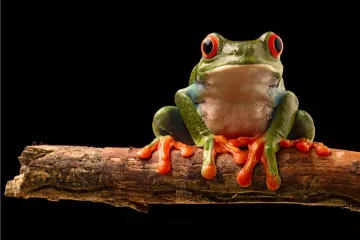
A notable contrast comes from the aforementioned Red-eyed Tree Frog. While not generally grouped with the red-legged frogs by habitat or range, its defining characteristic is immediately obvious: vivid red eyes. [5] This species is arboreal, meaning it lives in trees, which sets it apart from the riparian or terrestrial habits of the Rana species. [5][9] Its body is typically bright green, providing excellent camouflage in foliage, a very different strategy than the mottled browns and olives of the red-legged species blending into leaf litter or mud. [5][9]
| Feature | California Red-legged Frog (R. draytonii) | Northern Red-legged Frog (R. aurora) |
|---|---|---|
| Size | Largest native US frog [6] | Generally smaller than R. draytonii |
| Dorsal Color | Reddish-brown to olive-brown [3][6] | Brownish to reddish-brown, sometimes green or olive [1] |
| Key Pattern | Dark spots with light borders [3][6] | Dark mask around the eye [1] |
| Red Location | Lower flanks, belly, inner thighs [3][6] | Undersides of legs (red or orange) [1][7] |
It is fascinating to consider how these colorations function. The deep, mottled colors of the Rana species suggest crypsis—blending into the shadowed, muddy banks of slow-moving water. [1][6] Conversely, the vividness of the Red-eyed Tree Frog's eyes is thought to be a startling display, a sudden flash of color intended to momentarily confuse a predator, known as deimatic behavior. [5] This variation shows that the need for "red" in a frog's appearance serves vastly different evolutionary purposes based on lifestyle.
# Habitat Range
The distribution of these frogs helps define their general characteristics, as environment shapes behavior and appearance over time. The California Red-legged Frog is, as its name implies, strongly associated with California, though its historic range extended into Baja California and southern Oregon. [3][4] Its primary requirement is stable aquatic environments, favoring slow-moving streams, ponds, and permanent wetlands. [3][6] Unlike some amphibians that migrate long distances, these frogs often stay close to water sources, sometimes only moving short distances into upland vegetation during non-breeding seasons. [4] They especially need deep pools that persist through the dry summer months, as they depend on these features for survival when surface water disappears. [6]
The Northern Red-legged Frog has a broader, more northerly distribution. It can be found from the Pacific coast of extreme southern Alaska down through Washington State, where it is a recognized species, [1] and into British Columbia. [7] It is also found in Oregon. [5] This species is highly adaptable regarding water bodies, using temporary ponds, marshes, swamps, and forested streams, though adults prefer streams with permanent water. [1][7] In Oregon, it is listed as a species of conservation concern, suggesting that while it is widespread, local populations face pressures that limit their ability to persist. [5]
If we consider the Red-eyed Tree Frog, its habitat is strictly tropical and humid rainforests, primarily in Central America, which starkly contrasts with the cooler, more temperate zones inhabited by the North American Rana species. [9]
A valuable insight for anyone attempting to find these amphibians is understanding their water dependency. Both primary red-legged species thrive where water is stable. For instance, an ephemeral ditch that dries completely by July might support breeding for a time, but it cannot sustain an overwintering population of adult R. draytonii that needs deep pools. [6] Therefore, the presence of perennial, deep, slow-moving water is a much stronger indicator of a viable habitat than temporary wet areas, even if those temporary areas are used for initial breeding. [1][6]
# Life Cycle Notes
The breeding cycle is a critical period that shapes the ecology of any frog. For the Northern Red-legged Frog, breeding typically occurs from late winter through spring, often beginning as early as December or January in warmer regions, with activity peaking in February and March. [1] The eggs are laid in large, gelatinous masses, often attached to submerged vegetation or debris near the water's edge. [1][7] The developing tadpoles must mature before the water source disappears, which is less of a concern in the permanent streams they often prefer as adults. [1]
The California Red-legged Frog has a breeding season that generally runs from December to April, though this can vary based on elevation and local climate conditions. [6] Similar to R. aurora, they deposit their eggs in masses attached to underwater structures. [6] The tadpoles of this species are known to take a relatively long time to metamorphose, sometimes remaining in the larval stage for months, occasionally up to two years, which heavily relies on the availability of those deep, non-drying pools we noted earlier. [6]
While the sources do not provide extensive dietary overlap data, generally, these frogs are carnivorous predators. Adults consume insects, spiders, slugs, and snails. [1] The larval stage (tadpoles) of the Rana species tends to feed more on algae and detritus. [7]
# Conservation Status
The health of red frog populations across their ranges has attracted significant attention from conservation agencies. The California Red-legged Frog is federally listed as a threatened species. [3] This listing reflects substantial historical population declines across its range. [6] Protection measures are aimed at preserving the slow-moving streams and permanent water sources essential for their multi-stage life cycle. [3][4] For conservationists, understanding the specific stream velocity and pool depth requirements becomes more than academic; it dictates land management practices in critical corridors. [6]
The Northern Red-legged Frog, while not federally listed throughout its range, is recognized as a species of conservation concern in certain states, such as Oregon. [5] This designation suggests that while perhaps not facing the same level of imminent risk as the California species, local populations require monitoring and careful habitat management to prevent future declines. [5]
When observing these amphibians, it is important to remember the sensitivity tied to their conservation status. Any attempt to handle them, while sometimes necessary for scientific study, must be done with extreme care, or ideally, avoided entirely by the general public, as oils and residues on human skin can negatively impact their permeable skin—a vital consideration that underpins all amphibian conservation efforts. [7] Recognizing these species as indicators of ecosystem health is paramount; if the red-legged frogs are thriving, it usually signals that the local hydrology and riparian habitat are in excellent shape.
Related Questions
#Citations
Northern red-legged frog | Washington Department of Fish & Wildlife
Northern red-legged frog - Wikipedia
California Red-legged Frog (Rana draytonii) | U.S. Fish & Wildlife ...
California Red-Legged Frog | Midpeninsula Regional Open Space ...
Red-Eyed Tree Frog Fact Sheet | racinezoo.org
Rana draytonii (California Red-legged Frog) - Animal Diversity Web
[PDF] factsheet - Ministry of Environment and Parks
Northern Red-legged Frog - Oregon Conservation Strategy
Red-Eyed Tree Frog | Rainforest Alliance