Are potoos and frogmouths related?

The immediate similarity between the Potoo and the Frogmouth often leads bird enthusiasts down a rabbit hole of confusion, prompting the central question of their relationship. At a glance, these birds appear almost interchangeable: masters of disguise, specializing in freezing motionless while perfectly imitating a jagged, broken tree stump or snag. Both are primarily nocturnal insectivores equipped with wide mouths and large eyes suited for their nighttime hunting habits. Yet, despite this striking superficial resemblance, which is a textbook case of convergent evolution, taxonomists place them on notably separate branches of the avian family tree.
# Potoo Order
The Potoo, belonging to the family Nyctibiidae, holds a surprisingly isolated position within the bird world. Unlike many groups that nest neatly within an established order, the Potoos are distinct enough that they are placed into their own dedicated order: Nyctibiiformes. This classification highlights just how unique their evolutionary trajectory has been, separating them from other groups that share similar characteristics. These fascinating birds make their homes exclusively in Central and South America.
# Nightjar Link
While Potoos are set apart into their own order, they are not entirely without close cousins. They share a closer evolutionary bond with the Nightjars (family Caprimulgidae) than they do with the Frogmouths. Both Potoos and Nightjars are often grouped together based on their shared general appearance and lifestyle, though the Potoo’s unique characteristics warrant its own order, Nyctibiiformes. This relationship suggests a common ancestral lineage that diverged significantly over time, resulting in the Potoo’s specialized adaptations.
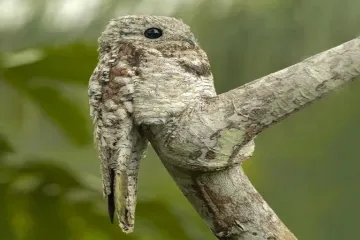
# Visual Mimicry
The Frogmouths reside in the family Podargidae. Their appearance and habits parallel those of the Potoos so closely that confusion is inevitable for the casual observer. Both families have evolved incredible camouflage techniques to hide during the day, relying on posture to break up their silhouette against wood.
To better illustrate the taxonomic separation despite the visual overlap, consider this breakdown:
| Bird Group | Family | Order | Primary Location (Based on Sources) |
|---|---|---|---|
| Potoo | Nyctibiidae | Nyctibiiformes | The Americas |
| Frogmouth | Podargidae | (Not specified) | (Not specified) |
| Nightjar | Caprimulgidae | Caprimulgiformes | (Not specified) |
The key takeaway here is that the similarity between the Potoo and the Frogmouth is a classic example of convergent evolution—where unrelated species independently evolve similar traits as a result of having to adapt to similar environments or ecological niches. In this case, the niche is nocturnal hunting and the need to avoid diurnal predators by mimicking inert wood. An interesting way to conceptualize this is to imagine two different branches of a great family tree that grew branches pointing in the exact same direction due to the pull of the sun (or lack thereof, in their case).
# Identifying Differences
Given that their general appearance and habits (being nocturnal insectivores that perch still) are nearly identical, a birder attempting to distinguish a Potoo from a Frogmouth needs to rely on secondary, often subtle, cues derived from their classification and geography. Because the sources confirm Potoos are strictly New World birds found in Central and South America, location becomes the single most reliable immediate differentiator if you are observing one of these birds in the field. If you are in the Amazon basin, you are looking at a Potoo; if you are in Southeast Asia or Australia, you are observing a Frogmouth.
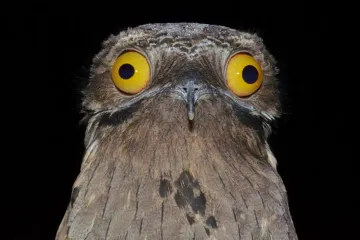
Furthermore, while the sources note both have large mouths, the specific structure and fine details of the beak and facial feathering often differ significantly, though these are better discerned through close, trained observation or high-quality photography rather than a fleeting glance in low light. The Potoo often adopts a more rigidly vertical posture when hiding, relying on its eye-closing mechanism to complete the illusion of a broken stub, whereas Frogmouths might sometimes sit more horizontally, resembling a mossy branch. Observing the subtle differences in their cryptic patterns—the specific arrangement of bars, spots, and mottling on their feathers—is necessary for species identification, but the continental divide simplifies the family identification immensely. For instance, in the Americas, any bird fitting this description must be a Potoo, as Frogmouths simply do not occur there. This geographical separation reinforces their status as distinct evolutionary entities despite sharing a common survival strategy.
# Evolutionary Pathways
The fact that the Potoo sits in its own order, Nyctibiiformes, suggests a significant evolutionary split occurred a very long time ago from the lineage that led to Nightjars (Caprimulgiformes) and the lineage that led to Frogmouths. This deep divergence means that while they all ended up looking like they were sculpted from the same piece of wood, their underlying skeletal structures, genetic makeup, and developmental pathways are substantially different.
Think of it this way: If you asked two people from completely different continents, who had never met, to each design the perfect camouflage for blending into a specific type of oak tree, they might arrive at surprisingly similar brown-and-grey mottled patterns simply because the bark dictated the pattern. The Potoo and the Frogmouth are those two people. Their evolutionary pressures—avoiding daytime detection by predators—forced their forms toward a common solution (cryptic camouflage), even though their distant ancestors were quite different. The Potoo’s relationship to the Nightjar, while closer than to the Frogmouth, still indicates a divergence significant enough to warrant placing the Potoo in its own distinct order, cementing its status as a truly singular group of birds.
Related Questions
#Citations
Potoos vs Frogmouths – @caprimulgiblog on Tumblr
Potoos are a group of birds related to the nightjars and frogmouths ...
Potoo - Wikipedia
Potoos (family Nyctibiidae) are a group of Caprimulgiformes birds ...
Bird Nyctibiidae - Potoos - Fat Birder
Potoos (Family Nyctibiidae) - iNaturalist
Potoo Facts for Kids