What is Macrauchenia's closest relative?
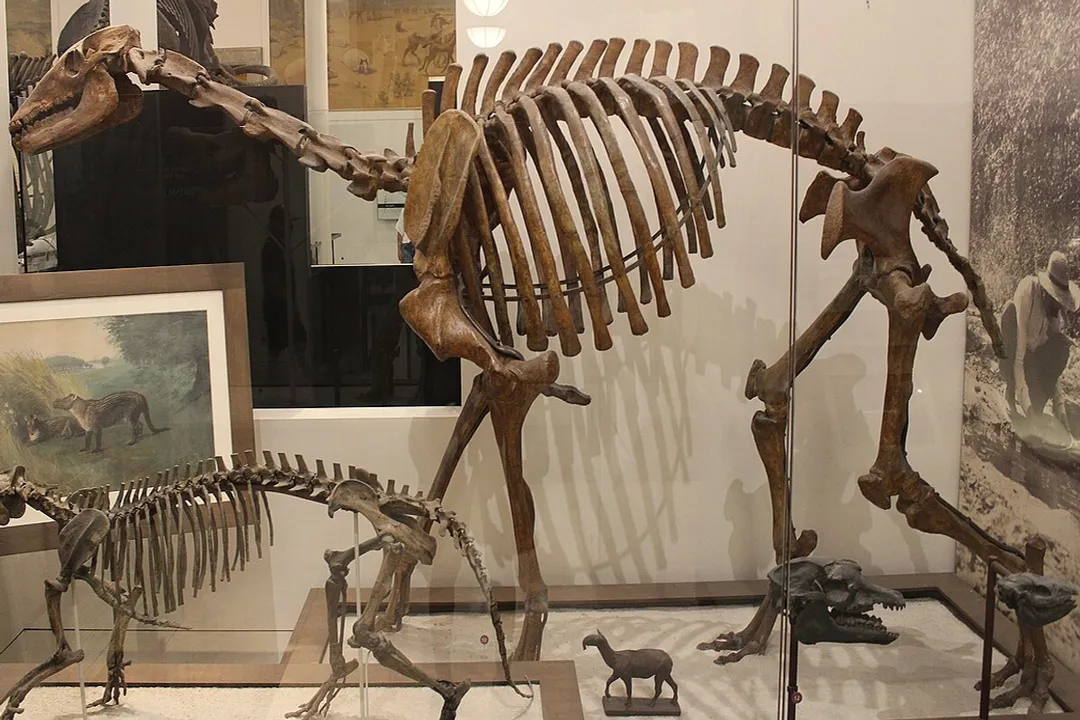
The story of Macrauchenia is one of paleontology’s great detective tales, centering on an enigmatic South American mammal whose true family tree was obscured for over a century by misleading physical traits. For a long time, establishing Macrauchenia’s closest living relative was a matter of intense scientific debate, with prominent candidates swinging between two vastly different mammalian groups based on which skeletal feature a researcher prioritized. This creature, which roamed the plains of South America through the Pliocene and Pleistocene epochs, ultimately reveals a fascinating chapter in the evolution of mammals isolated on that continent.
# Ancestral Puzzle
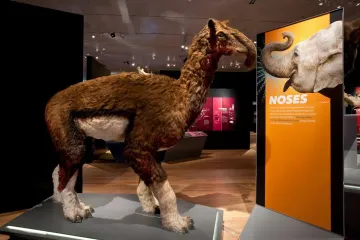
Macrauchenia patachonica, the best-known species, was a striking animal. Estimates place its size as comparable to a modern llama or even a small camel. Its most distinctive and confusing feature, the subject of much early speculation, was its short, flexible proboscis or trunk, indicated by the high placement of its nasal opening on the skull. This feature, combined with its general body plan, initially sent scientists down the wrong path when trying to connect it to living animals.
# Misleading Skeletons
The historical attempts to classify Macrauchenia illustrate the pitfalls of relying solely on external morphology. Early anatomists, examining features like its high-set nose, were strongly inclined to group it with the Camelidae—the family that includes camels, llamas, and alpacas. This placed it tentatively within the order Artiodactyla, the even-toed ungulates. However, the structure of its feet told a different story. The toes, which were reduced to three digits bearing hooves, presented a structural similarity to the Perissodactyla, the odd-toed ungulates. This internal conflict—a "camel-like" head and a "horse-like" foot—left its exact placement uncertain for decades.
This persistent morphological ambiguity, where similar features evolved independently in response to similar environmental pressures—a concept known as convergent evolution—is precisely what made Macrauchenia such a difficult subject to pin down within the mammalian family tree. The very features that defined its life as a South American browser seemed to tie it to disparate groups in the Old World.
# Order Identity
The resolution to the Macrauchenia puzzle came not from a new bone discovery, but from the application of molecular biology to ancient remains. Macrauchenia is firmly established as belonging to the order Litopterna. Litopterns were an entirely South American lineage of ungulates, meaning they evolved in isolation on the continent for millions of years, developing specialized forms that make them distinct from the ungulates that populated Africa, Asia, and Europe.
The Litopterna order itself is extinct, meaning Macrauchenia does not have a direct, living counterpart that shares the same immediate family designation. It is a representative of a unique evolutionary experiment that vanished when the continent was reconnected to North America during the Great American Biotic Interchange.
# Genetic Breakthrough
The turning point in understanding Macrauchenia came with the successful extraction and analysis of ancient DNA. For years, the debate was limited to skeletal comparisons, leading to the competing hypotheses of Artiodactyla versus Perissodactyla affiliation. Molecular evidence, however, provided a much clearer signal, overriding the noise created by superficial similarities.
This genetic analysis definitively rooted Macrauchenia and the entire Litopterna group outside of Artiodactyla and instead placed them as sister taxa to the Perissodactyla. This confirmed that the three-toed feet were not a case of convergent evolution with horses, but rather an indication of a deeper, shared ancestry that predates the Artiodactyl/Perissactyl split. The historical link to camels and llamas, supported by the "trunk," was decisively overturned by the genetic data.
This methodological shift—moving from pure osteology to integrating ancient DNA—marks a significant maturation in paleontology, where Macrauchenia serves as a prominent case study demonstrating how external appearance can be severely misleading when mapping deep evolutionary relationships.
# Living Kin
When discussing the closest living relative of Macrauchenia, the answer points squarely to the Perissodactyla. This order encompasses the odd-toed ungulates that survived the Cenozoic Era and are still present today.
The Perissodactyla group includes three distinct families:
- Equidae: Horses, donkeys, and zebras.
- Rhinocerotidae: The rhinoceroses.
- Tapiridae: The tapirs.
These three modern groups—horses, rhinos, and tapirs—share a more recent common ancestor with Macrauchenia than they do with any member of the Artiodactyla, such as deer, cattle, or camels. While Macrauchenia itself was a litoptern, its lineage branched off from the ancestors of the modern Perissodactyla. The fact that Macrauchenia was a browser suggests its ecological role might have been somewhat similar to modern tapirs or ancient browsers within the horse lineage, even though its specific anatomy, like the trunk, made it unique.
To better visualize this close relationship, we can compare the placement of the major ungulate groups based on the modern genetic consensus:
| Group | Examples | Toe Count | Relationship to Macrauchenia |
|---|---|---|---|
| Perissodactyla | Horses, Rhinos, Tapirs | Odd (1 or 3) | Closest Living Relatives |
| Artiodactyla | Camels, Llamas, Deer | Even (2 or 4) | Distant Relatives (Older Hypothesis) |
| Litopterna | Macrauchenia | Odd (3) | Extinct Order |
# Evolutionary Divergence
The South American context is critical for understanding Macrauchenia. For millions of years, South America was an island continent, allowing its native mammals—the endemic ungulates, including the litopterns, notoungulates, and astrapotheres—to diversify into unique forms without direct competition from placental mammals evolving elsewhere. This isolation resulted in creatures like Macrauchenia filling ecological niches that, in North America and Eurasia, were occupied by rhinos or camels.
The fact that its lineage, Litopterna, is now extinct, while its closest living relatives (Perissodactyla) successfully crossed over from North America during the interchange, provides an interesting evolutionary contrast. The South American endemic ungulates largely failed to compete successfully against the influx of North American forms after the Isthmus of Panama formed. Macrauchenia's demise around 10,000 years ago coincided with this faunal exchange and the arrival of early humans, marking the end of a distinct evolutionary experiment that had lasted for tens of millions of years.
One way to conceptualize the separation is to look at the deep time scale. While Macrauchenia shares a connection with horses and rhinos, that shared ancestor lived deep in the Cenozoic era, long before the specialized forms of either group became recognizable. The Litopterns essentially followed a separate evolutionary road map for the continent's native ungulates, making them distant cousins to the modern Perissodactyla, rather than close siblings. The differences in their anatomy, like the Macrauchenia's distinct nasal structure, represent adaptations to localized South American environments that the Perissodactyls never developed. This unique path highlights how independent continental evolution can produce stunningly similar solutions to locomotion (hooves) alongside wildly different solutions for feeding apparatuses (the short trunk).
Related Questions
#Citations
Macrauchenia - Wikipedia
Macrauchenia patachonica - The Extinctions
Macrauchenia | Walking With Wikis - Fandom
Prehistoric South American Ungulate Mammals are Relatives of ...
Horse of a different Perissodactyla - Pocono Record
Why did paleontologists assume Macrauchenia has a small trunk ...
Weird mammals get a home in the tree of life | Earth Archives
What in the World Was Macrauchenia? - Scientific American
Macrauchenia size comparison and nasal structure in paleontology