Are ashy mining bees aggressive?
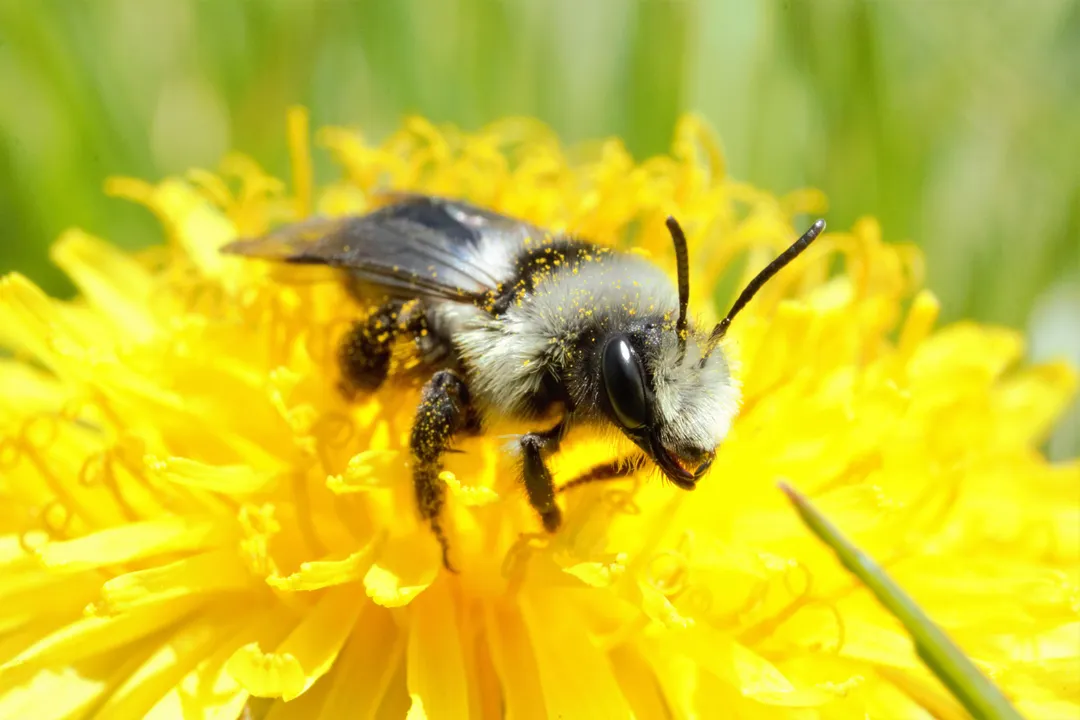
The temperament of the ashy mining bee (Andrena cineraria) is one of the most misunderstood aspects of this striking, early-season insect. Far from being a threat to garden visitors or pets, this species is overwhelmingly characterized by a docile nature. For those who encounter them actively foraging or emerging from their underground homes, the primary concern often centers on their capacity to sting. However, understanding their life structure immediately clarifies why aggressive encounters are exceedingly rare. Ashy mining bees are solitary diggers, meaning they do not live in large, hierarchical colonies like the familiar honeybee or social wasps. This fundamental difference dictates their behavior regarding defense: they possess no vast, centrally managed stores of honey or vulnerable brood to warrant a mass, territorial defense.
# Docile Nature
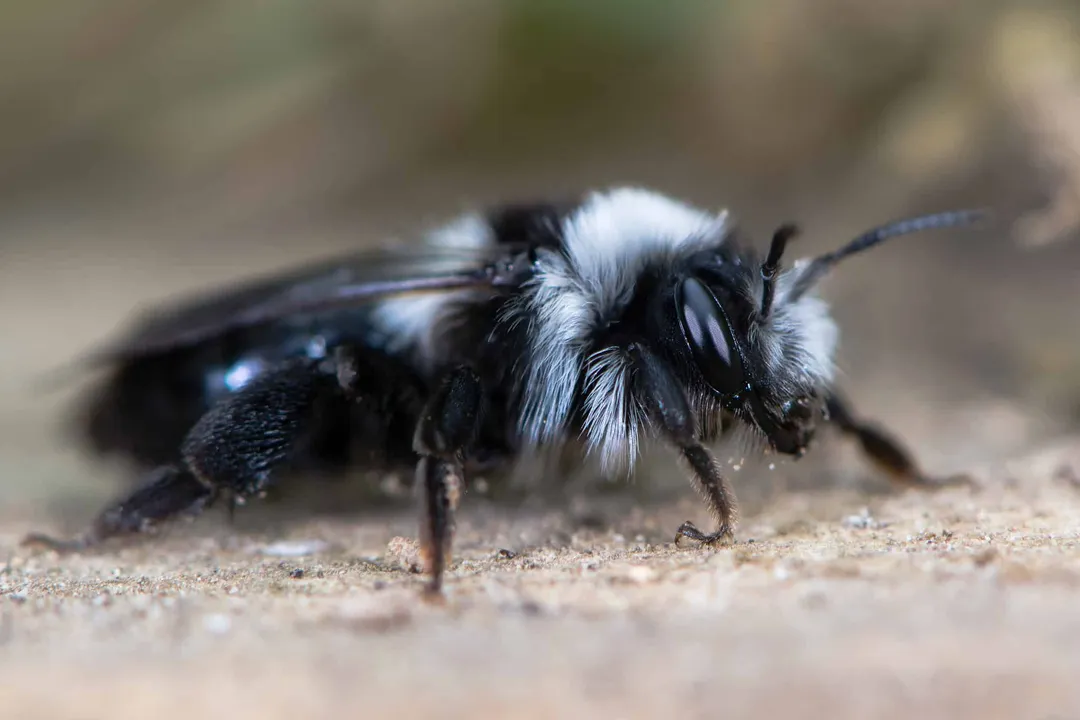
The overwhelming evidence across entomological and wildlife observation sources points toward a remarkably non-aggressive disposition. They are generally known to pay little attention to humans simply moving nearby. When they do interact with people, it is usually when they land accidentally or are investigating something new. If one happens to land on you, the general consensus is that it will likely depart on its own accord without incident. In fact, the very structure of their existence suggests that sting avoidance is paramount. The female has only one chance to provision her nest cells and lay her eggs within her brief adult lifespan, which is typically only four to six weeks during the spring. Any energy expended in a defensive confrontation is energy diverted from essential reproductive tasks.
# Stinger Capability
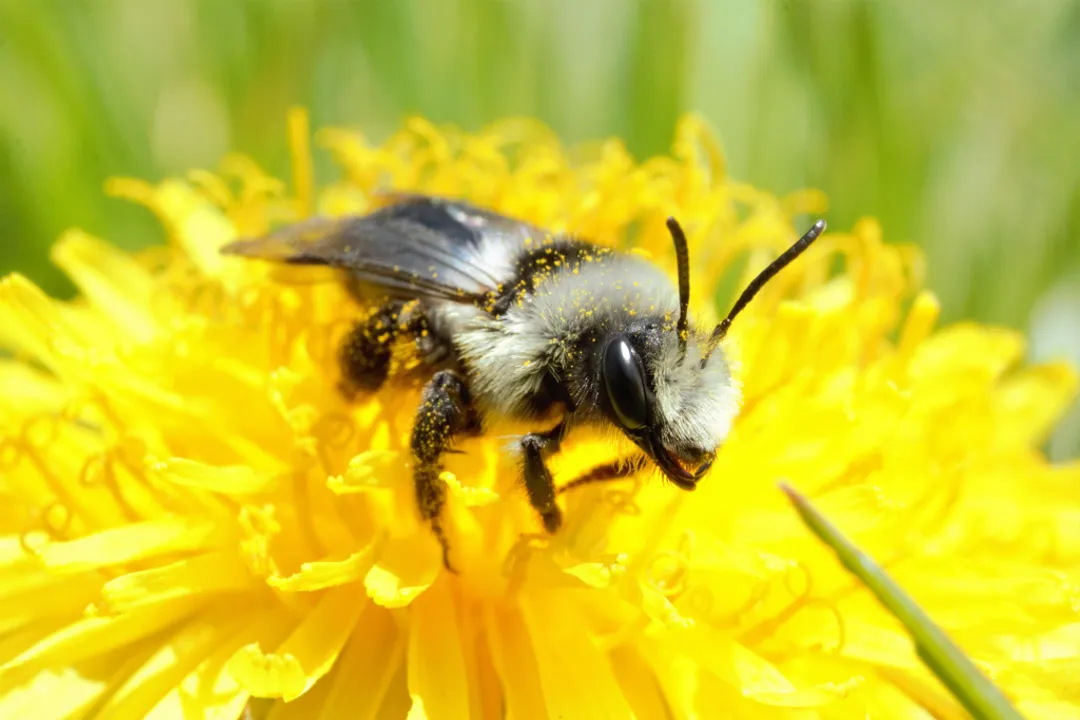
A common anxiety surrounding bees is the threat of a sting, but for the ashy mining bee, this threat is minimal. It is important to note that males do not possess stingers at all. Only the female has the capability to deliver a sting, and even then, it is usually only deployed if she feels genuinely cornered, trapped, or severely provoked. Furthermore, numerous sources suggest a physical limitation that often renders their defensive action ineffective against humans: the stingers of all Andrena bees, including A. cineraria, are often not long enough to penetrate human skin. When a sting does occur, accounts suggest the sensation is mild, significantly less painful than a wasp sting. The key takeaway for safe coexistence is simple: if you do not threaten or harass them, they will not respond defensively. They will not pursue a person who moves away from their immediate nesting area.
This inherent passivity, tied solely to self-preservation rather than group defense, is an interesting dynamic. Consider the comparative defense budget: a social wasp colony might muster hundreds of irritable defenders ready to strike to protect a massive food source or hive structure. In contrast, the female ashy mining bee is essentially defending only herself and the single, carefully provisioned nest she is currently working on. Her incentive to use her only potential weapon is extremely low, making the possibility of a painful encounter statistically insignificant compared to hazards posed by more social, colonial insects.

# Solitary Lives
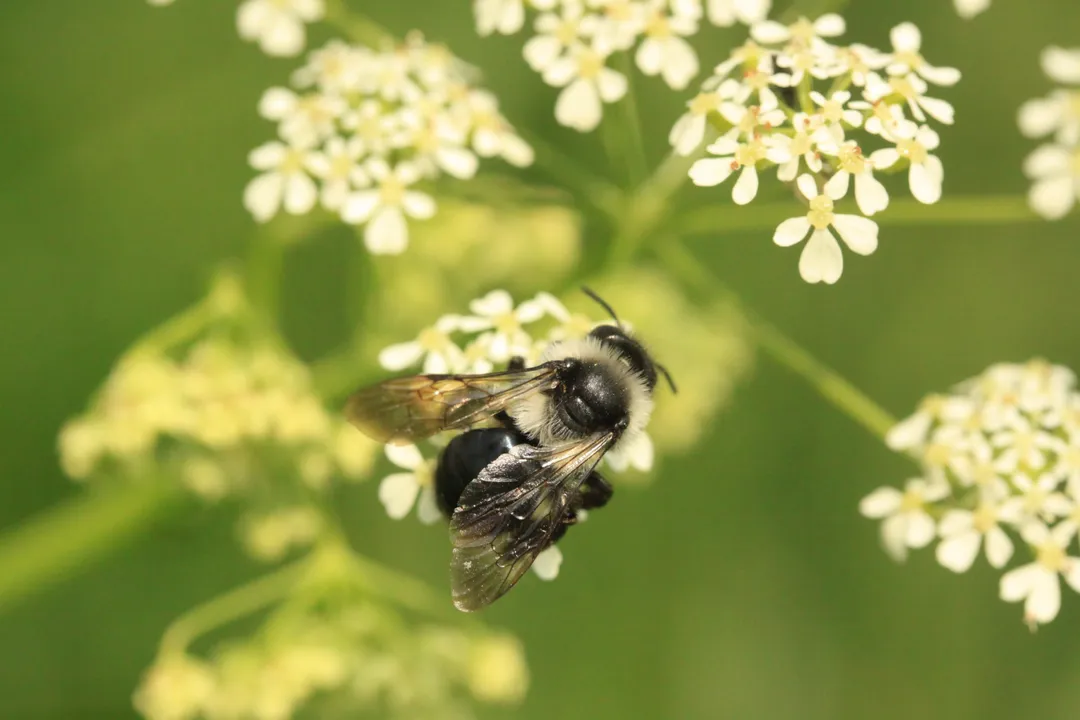
The key to understanding the ashy mining bee's gentle nature lies in its solitary classification. Nine out of every ten bees in the UK, for example, are solitary, contrasting with the widely known social species like honeybees and bumblebees. Each female A. cineraria is responsible for the entire construction, provisioning, and sealing of her own nest cells. She does not rely on a queen, nor does she have a workforce of sterile sisters to guard the hive. Because they are solitary, they do not produce or store honey. This lack of a honey store removes a major provocation point; social bees are fiercely protective of their carbohydrate reserves, but the mining bee has only pollen and nectar provisions for her immediate offspring.
While they are solitary, it is common to observe them in close proximity, sometimes leading untrained eyes to mistake the activity for a large, unified swarm. These groupings, often called aggregations, are not social gatherings but rather an acknowledgment of favorable local conditions. If the ground soil is well-drained, dry, and sunny—ideal for burrowing—many females will independently choose to excavate their tunnels nearby.
# Appearance Traits
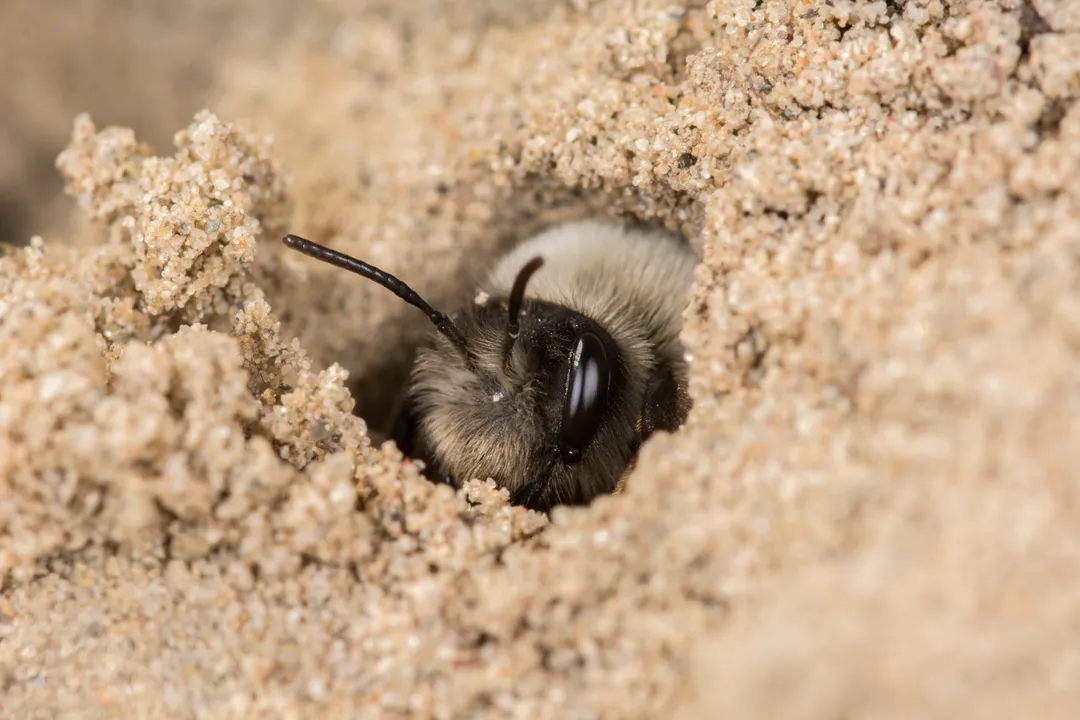
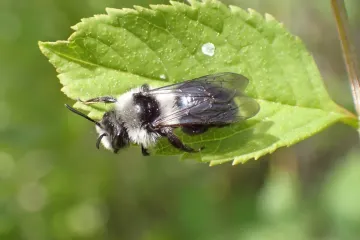
The ashy mining bee is visually distinctive within the Andrena genus, often described as the "black cat" of the bee world due to its relatively muted coloration. They are generally small to medium-sized, comparable to a honey bee in stature. Their bodies are predominantly shiny blue-black, covered in striking ash-gray or whitish hairs.
Key identifiers include:
- Coloration: Black body contrasting with gray/white hairs, particularly on the thorax and face.
- Size Variation: Females are typically larger and more curvaceous than the males.
- Pollen Collection: Females possess pollen baskets on their hind legs, though they also carry pollen on body hairs.
- Facial Features: Both sexes have light gray or white hairs on their faces, but specialized identification notes the presence of fine grooves, or facial fovea, running down from the inner eye toward the middle of the face, a feature that sets them apart from many other UK bees.
Males tend to have more widespread light gray hairs, especially on the sides of the thorax and the top of the abdomen, while the female often exhibits a glossier, hairless-looking abdomen.
# Nesting Groundwork
The "mining" in their name refers directly to their construction habits. Ashy mining bees are ground-nesters, digging individual burrows in patches of bare or sparsely vegetated earth. They prefer well-drained soil or clay and often select south-facing slopes to maximize solar warmth for their underground nurseries. Nests are typically about the size of a pencil and can reach depths of between two and eight inches underground.
A characteristic sign of their work is a small pile of soil mounded around the burrow entrance, sometimes described as resembling a miniature volcano. Once a female has dug a tunnel, she branches it into up to a dozen individual brood cells. She plasters these cell walls with a waterproof secretion before provisioning each one with a ball of pollen mixed with nectar. After depositing a single egg in each cell, she seals it and moves on to the next. Once all cells are prepared, her maternal duty is complete, and she does not participate in the development of the young.
If you notice these ground nests in your yard during the spring emergence window, it is crucial to understand that disturbing the soil in that immediate vicinity—such as through digging, deep tilling, or heavy mulching—can collapse the developing brood cells underground. The entire lifecycle, from egg to adult emerging the following spring, depends on the integrity of that burrow for almost a full year. This dependency highlights a gardening consideration: if you see evidence of nesting, consider leaving that specific patch of bare, dry soil untouched until the bees have completed their short adult phase, typically by early summer. You can easily mark the area with a small, temporary flag or stone so that mechanical gardening work can be planned around their single active season.
# Pollination Role
Despite their small size and non-aggressive nature, ashy mining bees are essential pollinators. They are known to be generalists, foraging on a wide array of flowering plants, which thankfully provides them with a broader diet than some of their more specialized Andrena relatives. They visit flowers such as dandelions, buttercups, daisies, and brambles, and are particularly fond of the blossoms of fruit trees like apple, cherry, and plum.
Their efficiency as pollinators is significant. In fact, solitary bees, as a group, often outperform honeybees in this regard because they tend to lose more pollen while foraging, acting as highly effective couriers between plants. A huge portion of our global food supply relies on native pollinators like the ashy mining bee, with one in three mouthfuls of food and drink depending on their efforts. By visiting spring blossoms, they directly contribute to the success of fruit setting in orchards and gardens.
# Seasonal Activity
The appearance of the ashy mining bee is closely linked to the seasonal calendar, making their brief tenure predictable. They are considered early bees, emerging when the weather first warms up, often as early as March, and they are most prevalent through April and June. Their emergence timing is critical; it must align precisely with the blooming period of their favored early flowers. They are adapted to cooler conditions, possessing hairy bodies to help insulate them from residual spring chill, and they can be seen foraging even when snow is still present.
Once the females have laid their eggs and sealed the cells, their work is done, and the adult bees generally perish by mid-summer, living only for a few weeks. The next generation develops slowly underground, overwintering in their sealed cells before emerging the following spring to repeat the cycle.
# Comparison: Social vs. Solitary Defense
To further contextualize the question of aggression, a direct comparison with social bees and wasps illustrates the difference in their defensive programming. Social insects must defend a permanent, shared resource—the colony, the queen, and the honey stores. This necessitates an aggressive, immediate defense mechanism that deters threats rapidly. In contrast, the ashy mining bee operates on a completely different survival model. She is her own colony, and her investment is in individual, separate cells. If she is disturbed while foraging, the loss is her single future generation, not the collective population. This individual investment paradoxically leads to a more cautious, less confrontational approach. She has no communal mandate to attack; her entire survival strategy rests on efficient provisioning, not fighting. The slight risk associated with getting too close to a burrow entrance is outweighed by the fact that the female is primarily concerned with gathering pollen and sealing her next cell, not engaging in combat. If you are observant and respectful of their small, temporary nests—perhaps by setting up a visual boundary if they are near a high-traffic area—you can observe their entire annual cycle unfold without concern for aggressive interactions. They are specialized workers focused on the singular, critical task of passing on their genes before the spring blooms fade.
Related Questions
#Citations
Ashy Mining Bee Insect Facts - Andrena cineraria - A-Z Animals
Ashy Mining Bee | The Stats & Facts You Need To Know - BeesWiki
Ashy mining bee | The Wildlife Trusts
What is this bee? : r/insects - Reddit
Mining Bee | Bee Removal & Honey Bee Removal | BeeGone
Solitary Bees: 8 facts to know plus an identification resource - Wildcare
Andrenid Bees (Miner Bees) - Missouri Department of Conservation
Ashy Mining Bee - Beevive