Xenotarsosaurus Physical Characteristics
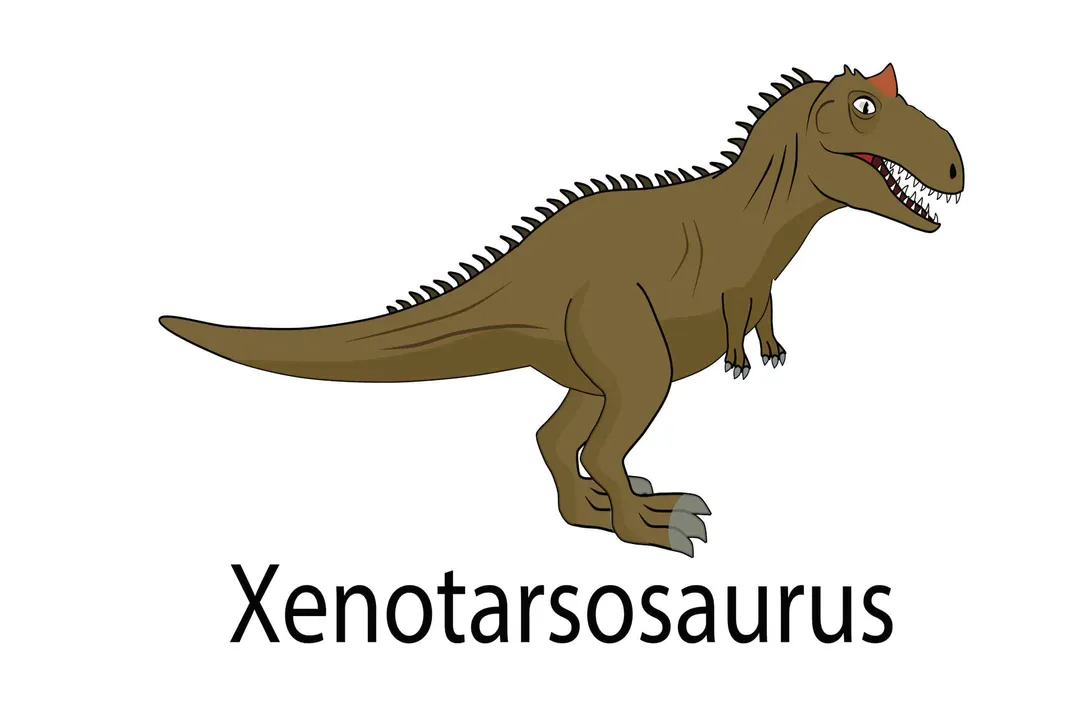
The Xenotarsosaurus bonapartei offers a fascinating glimpse into the diverse theropod landscape of Late Cretaceous South America, despite being known from frustratingly sparse fossil evidence. [1][2] Its physical characteristics are primarily defined by what has been recovered—a handful of bones that nevertheless reveal a very distinct anatomical quirk. Paleontologists first described this dinosaur in 1986, naming it based on these very remains uncovered in Argentina's Chubut province, specifically within the Bajo Barreal Formation. [2][4]
# Name Origin
The generic name itself immediately draws attention to its most notable trait. Xenotarsosaurus translates from Greek roots as the "strange tarsus lizard". [1][3] This nomenclature is derived from xenos, meaning "strange," tarso, referring to the ankle bones, and saurus, meaning "lizard". [1][2][3] The specific name, bonapartei, was bestowed in honor of the Argentine paleontologist José Fernando Bonaparte, who was instrumental in the investigations at the discovery site. [1][2]
# Fossil Evidence
What we know about the Xenotarsosaurus is derived entirely from two type specimens discovered by geologist Juan Carlos Sciutto in 1980. [2][4] These limited remains consist of two anterior dorsal vertebrae and a remarkably complete right hind limb. [2][4] Because cranial bones are entirely absent from the fossil record for this genus, scientists cannot currently describe its dentition or the specific shape of its skull. [1] The hind limb, however, provided key information, including a femur measuring 611 millimeters (about 24.1 inches) long, along with the tibia, fibula, and the ankle complex. [2]
The geological context of these fossils is also important for understanding its physical reality. While initially assigned to the Campanian Age, subsequent revisions of the Bajo Barreal Formation suggest Xenotarsosaurus lived during the earlier Cenomanian to Turonian stages of the Cretaceous Period. [2][4] This places it in an ancient South American ecosystem that featured other notable fauna, such as the hadrosaurid Secernosaurus and the titanosaurian sauropod Drusilasaura, suggesting the Xenotarsosaurus was one of the primary local predators. [1][4]
# Ankle Structure
The physical characteristic that commands the most attention, and which lends the dinosaur its name, is the ankle structure. [2] The hind limb fossil revealed an astragalus and calcaneum (the two main bones of the upper ankle) that were completely fused, lacking any visible sutures. [2][4] Furthermore, this fused element was then connected to the widened lower end of the tibia. [2] This high degree of fusion in the ankle is quite unusual among theropods, setting it apart from many contemporaries and relatives. [1][4]
This extreme fusion suggests a very specialized mechanical design for the lower leg. One might theorize that such a configuration would have resulted in an incredibly stiff or rigid ankle joint, potentially allowing for a more forceful, powerful push-off during running or while engaging with prey. [1] Considering the known fossils represent a right hind limb, it is interesting to consider how this specialization compares across the species' left side, though the fossil evidence prevents confirming whether this fusion was bilateral or merely represented a pathological condition in the single specimen. The completeness of the recovered hind limb—despite the absence of the rest of the skeleton—provides surprisingly detailed biomechanical clues about its terrestrial locomotion. [2][4]
# Size Estimates
Estimating the overall size of Xenotarsosaurus is challenging due to the fragmented nature of the fossil material, necessitating comparisons with related, more complete species like Carnotaurus. [1] Consequently, published estimations vary, reflecting the difficulty in scaling from a partial femur and vertebrae. [2]
Current figures present a range of possibilities:
| Metric | Lower Estimate (e.g., 2016) | Higher Estimate (e.g., 2010) |
|---|---|---|
| Length | 5.4 meters (18 ft) [2][4] | 6 meters (19.7 ft) [2] |
| Weight | 430 kg (948 lbs) [2] | 750 kg (1,654 lbs) [1][2] |
| Height | N/A | 10–12 ft [1] |
Dinopedia also offers a slightly broader range, citing a length between 5.1 and 5.4 meters and a weight between 300 and 1,000 kg. If we take the middle ground between the 430 kg and 750 kg figures, we might place the Xenotarsosaurus as a medium-sized predator for its time and location, significantly smaller than other contemporary abelisaurids like Ekrixinatosaurus, which reached lengths up to 32.8 feet. [1] This implies a lifestyle perhaps centered on subduing smaller prey rather than confronting larger sauropods head-on, though its role as a probable main predator of the Bajo Barreal Formation suggests significant local dominance. [1]

# Classification Debate
The initial assignment of Xenotarsosaurus to the family Abelisauridae was based on the similarities noted between its hind leg structure and that of the South American abelisaurid Carnotaurus sastrei. [1][2][4] This classification has generally persisted in many accounts. [2]
However, the scarcity of material, particularly the lack of skull features, has led to some taxonomic uncertainty. [1] As early as 1989, some researchers proposed an alternative classification, suggesting that Xenotarsosaurus might actually be an indeterminate neoceratosaurian theropod. [2][4] This uncertainty highlights a common issue in paleontology: skeletal fragments from related groups can share homologous structures, making definitive placement difficult without more complete remains. More recent phylogenetic analyses, such as those published in 2021, have tended to recover Xenotarsosaurus back within the Abelisauridae, positioning it as more derived than Eoabelisaurus. [2]
Regardless of its precise placement within the broader group, its classification as a theropod confirms it was bipedal, walking on those powerful hind limbs. [3] Like other abelisaurids, it would have possessed relatively short forelimbs, likely adapted for grasping prey or perhaps manipulating objects near the ground, though the forelimb structure itself is not described in the available summaries. [3] The incomplete nature of the Xenotarsosaurus fossils necessitates that readers view its overall profile—especially its head and arm structure—as heavily informed, but not yet fully verified, by its better-known relatives. [1]
Related Questions
#Citations
Xenotarsosaurus - Wikipedia
Xenotarsosaurus bonapartei - A-Z Animals
Xenotarsosaurus - DinoDen
Xenotarsosaurus | Dinopedia - Fandom
Xenotarsosaurus - Prehistoric Wildlife