Woodrat Locations

The presence of woodrats, often called packrats due to their tendency to collect items, is closely tied to specific geographic and structural features across their range. Understanding where these rodents reside requires looking beyond a simple map of North America and examining the microhabitats they select for their characteristic nests, or "middens." Generally categorized within the genus Neotoma, woodrats are diverse, with their specific locations varying significantly depending on the species in question, such as the Allegheny woodrat or the Eastern woodrat. [1][3]
# Species Range

Distinguishing between the various types of woodrats helps narrow down their potential locations. The Eastern woodrat (Neotoma floridana) maintains a broad distribution across the eastern United States, stretching from as far south as Florida up into New York and westward into states like Illinois. [7] In Illinois, for example, the Eastern woodrat is primarily found in the southern reaches of the state, particularly where suitable bluff habitat exists. [8]
In contrast, the Allegheny woodrat (Neotoma magister) occupies a more defined range along the Appalachian mountain chain, primarily in the eastern United States. [5] This species is frequently the focus of conservation discussions, particularly in states like Pennsylvania, where they are often found high up near rocky habitats, sometimes near the timberline. [9][4] While both are "eastern" species, the Allegheny woodrat tends to favor cooler, more rugged terrain compared to the broader distribution of the Eastern woodrat. [5][7] Montana also hosts populations, where woodrats are generally found in rock crevices and cliffs, often near or above the timberline. [4]
| Species Group | Primary Geographic Area | Key Location Feature Mentioned |
|---|---|---|
| Eastern Woodrat (N. floridana) | Florida to New York, westward extension [7] | Bluffs, rocky outcrops, abandoned structures [8] |
| Allegheny Woodrat (N. magister) | Appalachian region [5] | Caves, rock crevices, high elevation areas [9] |
| General Woodrat (MT example) | Western US (Montana) [4] | Rock crevices, cliffs, timberline [4] |
# Preferred Shelter

The most crucial factor dictating a woodrat's location is access to secure, dry shelter. These animals are notorious for building substantial, haphazard accumulations of debris known as middens, which can serve as their primary residence or a secondary cache site. [1][6] The structure and location of the midden are intrinsically linked to the local environment's geological features. [6]
In mountainous or canyon regions, the most common and preferred location is within rock crevices and caves. [2][9] The Allegheny woodrat, specifically, shows a strong affinity for these features, utilizing deep fissures in cliffs and rock shelters for protection from predators and the elements. [9] This reliance on geology means that woodrat populations in an area are often dictated by the presence of large talus slopes, exposed bedrock, or karst topography. [2]
However, woodrats are adaptable, and when natural features are scarce, they readily occupy human-made structures. This adaptability is a key reason they are sometimes considered pests. [3] In areas where rock formations are less abundant, woodrats will utilize abandoned buildings, sheds, woodpiles, and even areas beneath porches or in attics. [8][6] It is interesting to note that the Eastern woodrat seems slightly more prone to utilizing these human-altered environments compared to the Allegheny species, which maintains a stronger tie to undisturbed rock habitat, though both will take advantage of artificial structures if suitable natural ones are unavailable. [8][9] A woodrat looking for a long-term home is looking for defensibility and dryness; a deep, dark cavity that offers multiple escape routes is ideal. [6]

# Locational Habits Comparison
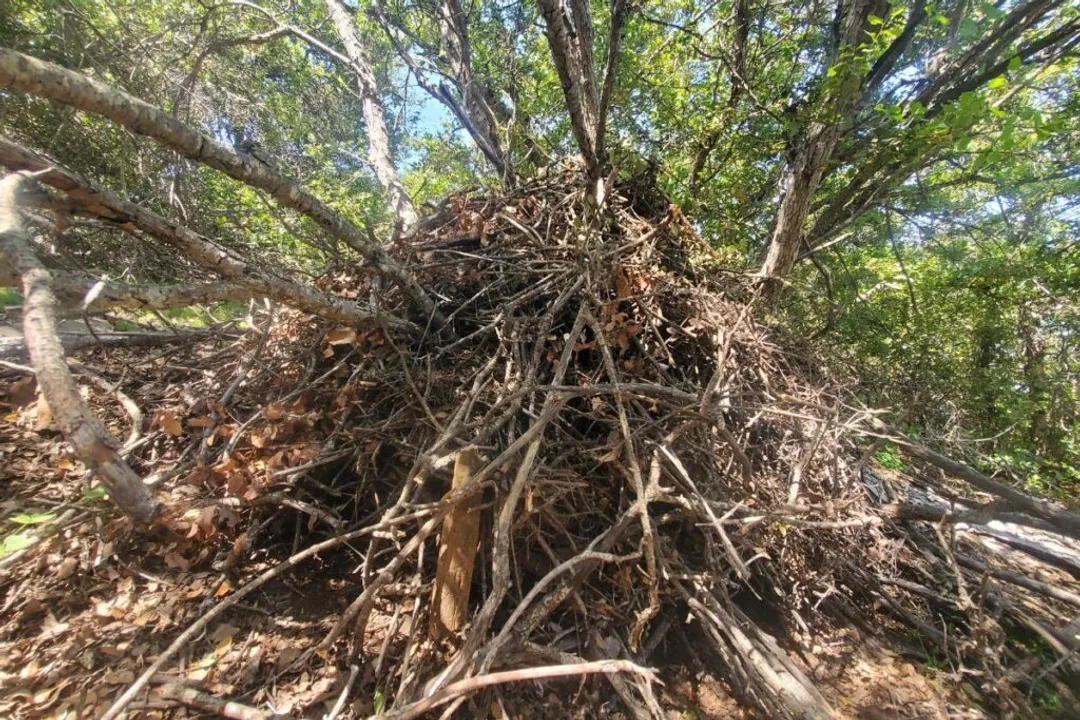
When observing an area, the underlying geology seems to be the strongest predictor of woodrat presence, especially for species like Neotoma magister. Consider two adjacent properties: one is a flat, grassy field with a few isolated barns, and the other is a steep, wooded hillside with large boulders and fissures. The latter property is exponentially more likely to host a woodrat colony simply because the rock features provide the necessary security and substrate for midden construction. [2][4]
For the general observer, a helpful heuristic to follow is that wherever you find large, stable piles of dry debris—sticks, bones, shiny objects, or dried plant matter—in a relatively protected spot, you are likely near a woodrat location. This behavior of creating middens is consistent across the genus, though the material composition might change based on local availability. [1][6]
One original consideration for anyone trying to locate a woodrat population based solely on regional data is the elevation/climate contrast between the species. If you are in the Appalachian region, finding evidence of woodrats at a high elevation (e.g., above 2,000 feet) in exposed rock faces strongly suggests the presence of the Allegheny woodrat, which is adapted to those cooler, often more rugged conditions. [9] Conversely, finding evidence in a lower, more sheltered, possibly scrubbier environment in the broader eastern range might point toward the more generalist Eastern woodrat. [7] This difference highlights that "woodrat location" is a hierarchical concept: first, the general geographic range, and second, the specific microhabitat niche within that range.
# Practical Locational Awareness

Understanding woodrat locations is not purely academic; it has practical implications, particularly when property owners or park visitors are concerned about wildlife interaction. [4] In areas where woodrats coexist with human habitation, management often revolves around making human structures less appealing as den sites. [4]
For instance, if you are managing a property in a transitional zone—perhaps a few miles west of a known bluff system—the primary action is environmental management around outbuildings. This involves sealing up gaps larger than half an inch in sheds, under porches, and around crawl spaces to deny access to these established pathways. [4] If a woodrat has already established a midden inside a shed, the location is already set; simply blocking entry may only prompt it to find a new, perhaps less accessible, hole nearby unless the existing midden is removed and the area cleaned. [1]
Here is a simple checklist derived from common management advice for making structures unattractive as woodrat locales:
- Inspect Foundation Gaps: Check for openings larger than a quarter or half dollar size near the ground level of any structure. [4]
- Secure Storage: Ensure all stored materials, especially woodpiles, are stacked neatly away from buildings, rather than leaning directly against them, to eliminate ready-made cover. [4]
- Clear Debris: Remove piles of junk, old equipment, or general clutter near the home's perimeter, as these mimic ideal natural debris cover. [6]
- Inspect Upper Levels: For species that climb well, check vents, eaves, and the roofline, as some woodrats may nest in upper cavities or attics if ground access is difficult. [1]
A second, more subtle point regarding locations relates to conservation boundaries. Because the Allegheny woodrat is often considered a species of concern, its habitat locations—specifically the cliff faces and talus slopes it occupies—are sometimes subject to stricter environmental review or protection measures compared to the more common Eastern woodrat. [9][5] Therefore, identifying which woodrat occupies a given location can sometimes translate directly into understanding the local land management context. An observer finding a nest in a cave in a state park is dealing with a different regulatory and ecological scenario than someone finding a nest in a barn foundation just outside city limits. [2][3] The location itself implies the species, and the species implies the ecological story of that specific patch of geography.
Ultimately, woodrat locations are defined by the availability of secure, dry, elevated, and defensible spaces—whether those spaces are naturally occurring rock features millions of years in the making or structures erected by humans only decades ago. [2][6] Their presence is a clear indicator of a microenvironment that provides excellent cover within the broader ecological landscape of the region. [1]
Related Questions
#Citations
Woodrat Biology - Internet Center for Wildlife Damage Management
Understanding Woodrat Distribution (U.S. National Park Service)
Woodrat - Neotoma cinerea - A-Z Animals
Living With Woodrats (Pack Rats) - Montana FWP
Neotoma magister - Allegheny woodrat - NatureServe Explorer
Woodrats: Nature's Ingenious Architects
Eastern woodrat - Wikipedia
eastern woodrat - Illinois Department of Natural Resources
Allegheny Woodrat - Commonwealth of Pennsylvania