Where did the red-billed quelea come from?
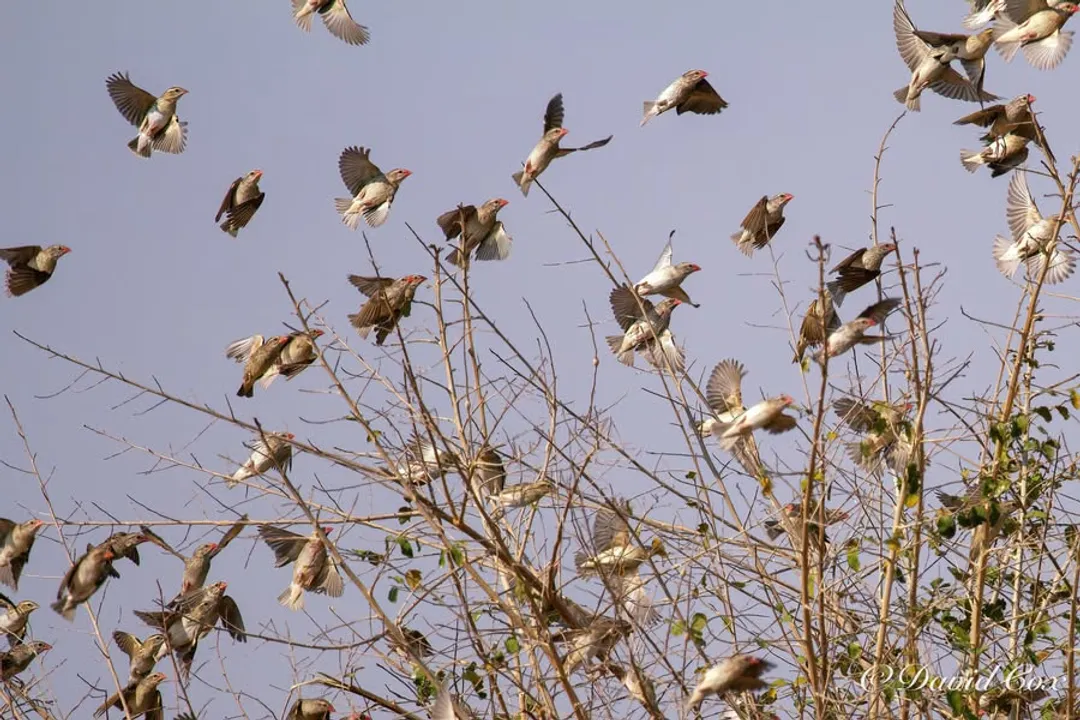
The term "most abundant wild bird in the world" carries a certain weight, and when applied to the Red-billed Quelea (Quelea quelea), it signifies a scale of life almost impossible to comprehend. [5][6] With a total population estimated in the hundreds of millions, and perhaps even exceeding a billion individuals in non-drought years, understanding where this creature originated becomes a fascinating exercise in avian geography and ecology. [1][5] While its modern ubiquity often overshadows its history, tracing its roots reveals a species perfectly adapted to the shifting landscapes of sub-Saharan Africa. [3]
# Avian Classification
To understand where the Red-billed Quelea came from, one must first place it within the scientific hierarchy. It belongs to the family Ploceidae, commonly known as the weaver-finches. [2] This family is native to the Old World, primarily Africa and Asia, and is characterized by the males' elaborate nest-building skills, though the quelea's nesting habits are often more communal and less architecturally complex than some of its relatives. [2] Specifically, the Red-billed Quelea is the type species of the genus Quelea. [1] The species itself has the scientific name Quelea quelea, a somewhat redundant but traditional scientific designation. [3] This placement within the Ploceidae firmly anchors its evolutionary origins to the African continent, which is the center of diversity for this bird family. [2]
# Native Distribution
The Red-billed Quelea's historical and current breeding range is almost entirely restricted to sub-Saharan Africa. [1][3] It thrives across a vast swathe of the continent, generally inhabiting areas south of the Sahara Desert. [3] The distribution is wide, stretching from Senegal and Mauritania in the west, across the Sahel region, down through East Africa, and southward into parts of Southern Africa, including countries like Botswana, Zimbabwe, and South Africa. [1][3]
It is crucial to note the distinction between its native range and where massive flocks are seen today. The species is generally absent from the deep rainforests and the extremely arid deserts of the extreme south and north. [1] Instead, its ancestral home seems to be associated with the savannas and grasslands—environments that offer large quantities of grass seeds, their staple diet. [3][9] These areas represent the ecological niche where the species was able to develop its extraordinary reproductive potential. [9]
Interestingly, while the species is broadly African, its distribution is not uniform. It tends to be more concentrated in the drier, central regions of the continent where these savanna ecosystems are dominant. [1] Some accounts suggest that the ancestral populations may have been more restricted to these core zones, with later environmental or anthropogenic changes allowing for expansions that led to the current massive, migratory numbers. [3] The sheer biomass it represents—some researchers suggest the total weight of Q. quelea flocks can rival that of all wild mammals in the region—points to an evolutionary path heavily favored by resource exploitation within this specific African biome. [5][6]
# The Historical Shift
Tracing the exact moment the Red-billed Quelea evolved into the super-abundant species we know today is difficult, as precise historical population data is sparse. [3] However, the key to its origin story lies in its relationship with agriculture. The species’ genus name, Quelea, is derived from the Latin word quaerere, meaning "to seek out" or "to search for," suggesting an early association with foraging. [3]
Before widespread cultivation of cereal crops, the Quelea likely relied solely on wild grass seeds, which meant its population dynamics would have been tightly coupled with natural cycles of rainfall and seed availability. [9] This dependence would have naturally kept populations fluctuating but likely within manageable bounds relative to the carrying capacity of the natural grasslands. [3]
The expansion of colonial and modern agriculture across Africa, particularly the cultivation of crops like sorghum, millet, and wheat, inadvertently provided the Quelea with an incredibly reliable and nutrient-rich supplementary, or perhaps even primary, food source. [3][4] This is a common theme in pest species—an ecological opportunity arises, and the species best equipped to exploit it thrives exponentially. [9]
A comparative look at the weaver family highlights this evolutionary pressure. While many Ploceidae build intricate, single-pair nests to defend a small territory, the Quelea has opted for numerical superiority. Instead of investing energy in complex defense mechanisms for a few offspring, it invests in mass reproduction and large, overwhelming flocks, a strategy that capitalizes on abundant, open feeding grounds rather than scarce, defensible resources. [3] This represents a behavioral divergence that suited the introduction of widespread, uniform food sources like grain fields.
This agricultural shift, which began centuries ago and accelerated dramatically in the 20th century, likely allowed the species to break free from the hard limits imposed by purely wild seed cycles. The introduction of reliable, concentrated food sources acted as a massive population sink, allowing numbers to surge far beyond what the natural savanna could support, effectively cementing its origin as an African bird that became an agricultural phenomenon. [4]
# Breeding and Migration Patterns
The origin of the bird's behavior is rooted in its need to follow resources. Red-billed Queleas are highly nomadic and migratory, undertaking immense seasonal movements tied to the rains and the resulting availability of seed crops. [1] They breed primarily during the wet season. [1] In East Africa, breeding might occur between November and March, while in Southern Africa, it often happens between December and April. [1]
Their breeding strategy involves forming enormous colonies, sometimes containing millions of birds, which construct their nests close together in trees, reeds, or shrubs. [1][7] The sheer density of these breeding grounds is startling. [7] The females typically lay between two and five eggs. [1]
The migratory movements are less a fixed north-south route and more a constant search pattern across the savanna belt, dictated by local weather phenomena. [3] This fluid geography means that what seems like a permanent resident population in one area one year might disappear the next, having moved hundreds of kilometers in search of the next harvest or rainy-season grass bloom. [1] This highly mobile life history is perhaps the key survival trait that allows Quelea quelea to maintain such staggering numbers across such a large, yet variable, habitat. [3] If they were restricted to a small, localized area, even their high reproductive rate might not sustain them through regional droughts, but their ability to move en masse mitigates this local risk by spreading the risk across the continent.
# The Question of Abundance
While the Red-billed Quelea’s origins are geographically centered in Africa, the scale of its current population remains the most defining characteristic that requires explanation. [6] It is not just a common bird; it is the most common. [5][6] Sources estimate that the population is roughly 1.5 billion, though this figure fluctuates wildly. [1][5]
One perspective, supported by historical context, suggests that control efforts have inadvertently strengthened their hold. In regions where large-scale culling or control measures were implemented, sometimes the attempt to eliminate the birds only served to scatter the massive flocks, causing them to breed elsewhere with less natural predation or competition, thereby maintaining or increasing the overall continental count. [3] This is a classic example of a control effort failing to account for metapopulation dynamics; you remove them from Location A, but they simply bolster the population in Location B. [9]
The sheer biomass of the Red-billed Quelea has led to it being one of the most significant avian pests in Africa, causing major damage to grain crops, sometimes leading to famine threats in vulnerable agricultural communities. [4] This destructive capacity is directly linked to its origin as a grassland seed-eater that successfully adapted to anthropogenic (human-caused) food subsidies. [3][4] The challenge facing ecologists and agriculturalists is not how to stop them from existing—their ecological niche in the seed cycle is established—but how to manage their localized, devastating impacts without negatively affecting the broader ecosystem of which they are now an undeniable, if controversial, part. [9]
# Habitat Preference and Biome Link
The specific biome the Red-billed Quelea inhabits provides a final clue to its origins. They are creatures of open, often dry, habitats: savanna, open woodland, and cultivated lands. [2][9] These environments are characterized by a strong seasonality in seed production, which necessitates the Quelea’s nomadic existence. [3] They are not birds of deep, stable forests; they are birds of the productive, fluctuating edge lands.
If you were to create a map of historical wild grass seed availability across Africa, it would likely overlay closely with the bird's historical range. The Red-billed Quelea, therefore, is a product of the African savanna ecosystem—a system defined by boom and bust cycles. [3] Their evolutionary success has been their ability to synchronize their reproduction with the "boom" periods so effectively that they can survive the ensuing "bust" periods, a feat now amplified by man-made "booms" provided by farming. [9] Understanding that they are savanna specialists, rather than forest or desert dwellers, clearly defines their geographical beginning. [1][2]
In essence, the Red-billed Quelea came from the great African grasslands, evolving specialized adaptations for mass movement and high-volume seed consumption, adaptations that have proven exceptionally advantageous in a world increasingly dominated by agriculture. [1][3] They are not newcomers to the continent; they are exceptionally successful natives adapting to changing resource availability. [4]
# Ecological Role and Future Perspective
While much attention focuses on their pest status, it is important to consider their natural ecological function outside of crop destruction. [4] In their native, uncultivated habitats, they act as primary consumers, converting vast amounts of wild grass seed into avian biomass, which in turn feeds numerous predators, including various birds of prey and mammalian carnivores. [9] Their enormous flocks, though potentially destructive to a farmer's yield, represent a massive transfer of energy through the food web. [5]
The Red-billed Quelea is a living testament to evolutionary plasticity. It has not had to invent new feeding mechanisms; it has simply found a way to exploit existing ones, like grass seed, on a scale previously unseen in the avian world. [6] Its origin story is less a tale of divergence from a specific point on a map and more a story of optimization within a vast, productive biome—the African savanna—that proved ready to support an unprecedented density of birdlife when the right food source became available. [3] Their very name, Quelea quelea, echoes their fundamental existence: seekers of seeds across the African plains. [3]
The continuing pressure to control these birds, often involving methods that target local concentrations, highlights a management challenge that stems directly from their origin: how do you manage a species whose very survival strategy is based on being everywhere at once?. [4][7] For any species so successful, the answer usually involves accepting their presence while mitigating the damage to human interests, acknowledging that in the great expanse of sub-Saharan Africa, they are firmly established as the continent's (and the world's) most numerous bird. [1][6]
Related Questions
#Citations
Red-billed quelea - Wikipedia
Quelea | African, Red-Billed, Ploceidae | Britannica
Red-Billed Quelea (Quelea quelea) Historical Profile – Jonny Marks ...
Quelea - Africa's most hated bird - The New Humanitarian
The Most Abundant Bird in the World The Red-billed Quelea
What Is the Most Abundant Wild Bird in the World? | Audubon
Red-billed Quelea – Unity Unplugged
Red Billed Quelea are the most abundant wild bird species on the ...
Red-Billed Quelea - an overview | ScienceDirect Topics