Where did Rhamphosuchus live?
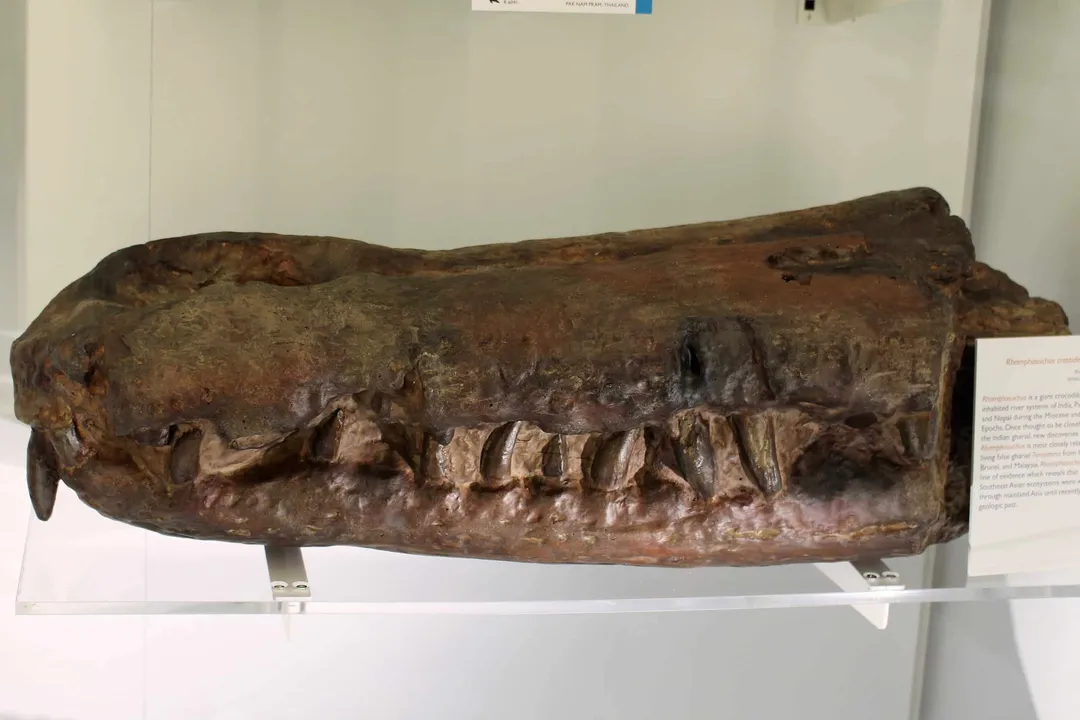
The massive extinct crocodyliform known as Rhamphosuchus calls to mind images of truly colossal prehistoric predators. When considering where such a giant might have thrived, the fossil evidence points with remarkable consistency to a specific corner of the ancient world. This creature, whose name fittingly translates to "beaked crocodile," was an inhabitant of South America, specifically documented from deposits found in Brazil. [1][2][7] Pinpointing its existence is an exercise in tracing fossil remains back to the Miocene epoch, marking it as a dominant aquatic reptile during a significant period of Cenozoic South American history. [2][7]
# Brazilian Remains
The primary, and indeed defining, geographic marker for Rhamphosuchus is Brazil. [1][3][6][7] Paleontologists have unearthed the remains of this immense animal within Brazilian strata, solidifying this nation as the known locus of its existence. [1][7] This finding is crucial because it anchors the species to a specific landmass during a time when continents were largely in their modern configuration, though the specific river systems and coastlines would have differed considerably from today. [1]
The discovery site location within Brazil suggests a particular paleoenvironment. While many massive fossil finds are often associated with vast inland river basins, the presence of such a specialized, giant crocodyliform in the fossil record implies access to significant, stable aquatic habitats capable of sustaining a creature that reached enormous sizes. [3][7] This isn't just a matter of finding a bone fragment; it points to an entire ecosystem capable of supporting its massive caloric needs. [1]
# Continental Setting
While the specific country is Brazil, it is important to situate this within the broader context of South America. [2][7] During the Late Miocene, the continent was relatively isolated, leading to unique evolutionary paths for its fauna. [1][6] This isolation often resulted in the evolution of incredibly large endemic species, a phenomenon seen clearly in the megafauna that evolved in South America, whether they were mammals like the giant sloths or reptiles like Rhamphosuchus. [7]
Understanding its location means understanding the South American environment of that time. Unlike some of the earlier, enormous crocodilians found in North America or Africa, Rhamphosuchus was part of a distinct South American radiation of these reptiles. [2] Its classification within the Goniolophidae family further isolates it as a specialized lineage adapted specifically to these South American freshwater or perhaps even brackish water systems. [2][6][7]
We can look at the known distribution of its close relatives, the Goniolophids, to infer a probable habitat type. These relatives, often found in similar geological contexts, suggest large, complex riverine or swamp environments that provided the necessary depth and resource availability for an apex predator of this scale. [7] If we were to map the likely territory of Rhamphosuchus, it would almost certainly encompass the major river drainage systems that existed in what is now eastern or central Brazil during that time frame. [1]
# Comparing Ancient Habitats
It is useful to contrast the likely environment of Rhamphosuchus with that of its contemporaries elsewhere. For instance, while North America had its own large crocodilians, they belonged to different groups. Rhamphosuchus, being a Goniolophid, represents a specialized evolutionary success story unique to this isolated continent. [2][7] This suggests that the pressures, prey availability, and hydrological conditions in Miocene Brazil fostered a different evolutionary outcome than those in the Laurasian continents. [1] While we lack explicit details on the exact river system—such as comparing the paleo-Amazon to a paleo-Paraná equivalent—the sheer bulk of Rhamphosuchus demands an ecosystem of immense productivity. [3]
| Feature | Rhamphosuchus Habitat Context | General Miocene South America |
|---|---|---|
| Continent | South America | Isolated, leading to endemic evolution [2][7] |
| Known Location | Brazil [1][7] | Developing unique megafauna [1] |
| Time Period | Late Miocene [1][6] | Significant ecological turnover |
| Ecosystem Type | Large, high-productivity aquatic system | Dominated by large endemic reptiles and mammals [7] |

# Timing Its Life
The temporal setting of Rhamphosuchus is as important as its physical location, as the climate and geography dictated the environment it lived in. [1] It existed during the Miocene epoch, [2][7] more specifically, the Late Miocene. [1][6] This places it roughly between $11.6$ and $5.3$ million years ago. [1]
The Late Miocene world was generally warmer than today, but South America was undergoing complex changes, setting the stage for the eventual Great American Biotic Interchange. [6] For a creature as large as Rhamphosuchus, stable, warm conditions with abundant water and prey—typical of the climate suggested for that time across much of tropical South America—would have been essential for survival and growth to such gigantic proportions. [7] A slight dip in global temperatures or a major shift in regional rainfall could have significantly impacted the river levels and the populations of fish, turtles, and mammals it preyed upon. [1]
# Niche Occupation
The sheer size attributed to Rhamphosuchus—often cited as potentially one of the longest crocodyliforms ever—immediately defines its ecological role in its Miocene Brazilian home. [1] It was not merely another large crocodile; it was an animal at the very top of the aquatic food chain in its locale. [3]
Its unique skull shape, often described by its "beak," suggests adaptations for a particular feeding strategy, perhaps targeting large, slower prey or specializing in moving through dense vegetation compared to deeper-diving contemporaries. [3] The presence of such a dominant aquatic reptile suggests that terrestrial predators, while present, had a distinct separation of niches, with Rhamphosuchus reigning supreme in the waters of its region. [7] This apex status implies a relatively stable environment over long periods, allowing for the slow, massive growth required to reach such an extreme size.
A key consideration for any apex predator, especially one whose remains are found in a specific location like Brazil, is the availability of prey that can fuel its metabolism. Given the size estimates for Rhamphosuchus, the rivers it inhabited must have been incredibly rich, potentially supporting large populations of Miocene South American freshwater fish or ground sloths that might have ventured near the water's edge. [1] The existence of a predator this large is a testament to the vast resources of the Late Miocene river systems that coursed through ancient Brazil. [6]
This leads to an interesting consideration regarding taphonomy, the study of how organisms become fossilized. For an animal of this magnitude to be preserved well enough for its location to be so firmly established in Brazil, the conditions of its death and burial must have been highly specific—likely rapid sedimentation in an anoxic environment, such as a deep river channel or swamp that dried down periodically. [3] The fact that we know where it lived hinges on these fortuitous geological events in that precise South American locale millions of years ago. [7]
Another insight that arises from its known geographic and temporal placement involves its evolutionary isolation. Because Rhamphosuchus is confined to the Miocene of South America, it suggests that the evolutionary pressures and genetic pool that created this lineage were entirely contained on that continent until major land connections formed later. [2][6] This species represents a unique chapter in crocodyliform evolution that occurred in relative isolation, far removed from the diversification seen in Africa or Asia at the same time. [7] Its very existence in Miocene Brazil underscores the continent's role as a crucible for extraordinary, large-bodied endemic fauna during that era. [1]
Related Questions
#Citations
Rhamphosuchus - Wikipedia
Rhamphosuchus crassidens - A-Z Animals
Rhamphosuchus ("Beak crocodile") is an extinct relative of ... - Reddit
Rhamphosuchus - Mindat
A lesser known mega croc, Rhamphosuchus a genus of Gavialidae ...
Rhamphosuchus | Dinopedia - Fandom
Rhamphosuchus - Prehistoric Wildlife
Rhamphosuchus - Zoo Tycoon Community Information Site