What does a wryneck eat?

The wryneck, though classified within the woodpecker family (Picidae), presents a fascinating divergence from its more famous relatives, particularly when it comes to the contents of its menu. While many people picture woodpeckers chiseling away at hardwood for grubs, the wryneck, whether the migratory Eurasian species or the resident Red-throated variety, shows a strong preference for smaller, ground-dwelling fare, making insects, rather than borers, the cornerstone of its existence. [1][3][7] The unifying element across the Jynx genus appears to be a profound specialization in consuming ants. [1][3][7]
# Primary Prey Focus

For the Eurasian wryneck (Jynx torquilla), ants are unequivocally the main course. [1][3][5] This preference dictates much of its behavior during the breeding season and migration stopovers. Observers have noted that these birds actively seek out locations where ant colonies are abundant, such as in old pear orchards where ant nests thrive beneath sparse ground cover. [1] This contrasts with the typical niche of many other woodpeckers, which spend significant time clinging to vertical trunks, excavating for wood-boring beetles or larvae. [1] The wryneck, conversely, spends the majority of its foraging time on the ground, moving about with a characteristic series of short hops. [1][4][5]
The mechanism for harvesting this subterranean bounty is key to understanding its diet. Unlike excavators, the wryneck employs a highly specialized tongue—long, sticky, and capable of rapid extension and retraction—to pluck its targets directly from the ground or from shallow crevices. [1][4] It does not use its beak to hammer wood to get to food; rather, the beak is relatively slender, though still pointed, adapted more for delicate probing than heavy striking. [1] Even when found in the upper branches of trees, its feeding strategy remains focused on insects found on the surface or under loose bark, rather than deep wood excavation. [1]
While ants are paramount, the diet is not entirely singular. When necessary, or perhaps when ants are less available, the Eurasian wryneck supplements its intake with a variety of other small invertebrates. [1][3][5] This secondary menu includes beetles, the larvae of beetles, spiders, woodlice, and moths. [1][3][5] There is a slight divergence in reports, with one source suggesting that fruits and seeds might occasionally be taken, though this is certainly a minor addition compared to the insect biomass consumed.
# Red-throated Specialist
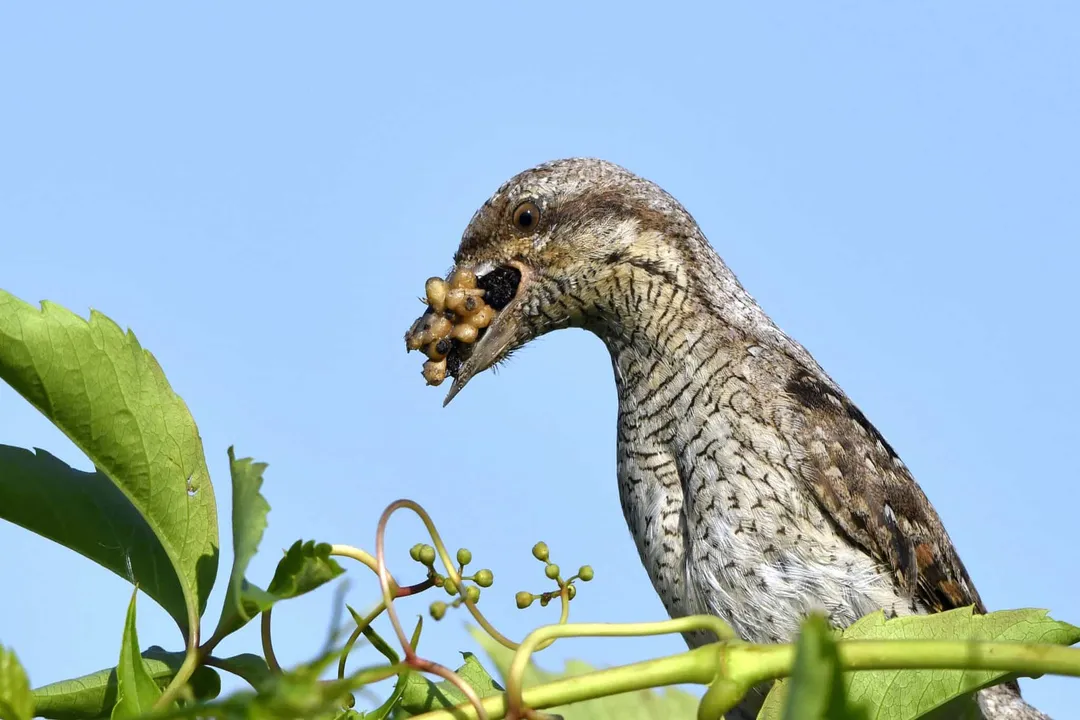
The Red-throated Wryneck (Jynx ruficollis), resident in sub-Saharan Africa, takes this ant-centric diet to an even higher level of specialization. [3][7] It is frequently described simply as an ant-eating specialist. [7] This bird possesses an extraordinary tongue, which is not only long but also coated in a sticky mucus secreted by its salivary glands. [7] This biological tool is so effective that the bird can flick it out over 60 millimeters beyond the tip of its bill, gathering massive quantities in a single movement. [7]
What's remarkable about this efficiency is the sheer volume; the Red-throated Wryneck is capable of collecting hundreds of ants or ant larvae in one beakful. [7] One can easily picture the resulting chaos, as the sheer number of insects means some inevitably crawl around the bird’s beak and head as it returns to deliver the load to its demanding chicks. [7] This contrasts nicely with the generalist approach of the Eurasian species, which likely consumes ants in smaller, more manageable batches during its foraging trips. [1]
# Foraging Niche vs. Family Ties
The wryneck occupies an intriguing ecological niche. It is a member of the Picidae family, which shares common ancestry with true woodpeckers. [1][7] However, its morphology and behavior have adapted it for a life spent largely on the ground or clinging lightly to branches, rather than hammering wood. [1][5] This means that while it shares the characteristic zygodactylous feet—where the first and fourth toes point backward, aiding in clinging—with its relatives, its method of acquiring food relies on stealth, probing, and quick-tongued capture, a strategy much closer to that of an antbird than a typical sapsucker. [1][7] It is an evolutionary path that favored the sticky snare over the percussive strike.
Considering the preferred habitat of the migratory Eurasian Wryneck—open countryside, orchards, and parkland—the link between environment and diet becomes clear for anyone hoping to observe them during their passage through areas like the UK. [1][5] The bird assesses the landscape not for the quality of old, hard timber, but for the presence of rich, accessible ant nests near the ground or in low shrubs. [1][4] If you are looking for a visiting wryneck on migration, focusing your search near areas with exposed soil, low grassy cover, or known ant heaps is far more productive than scanning high up on mature oak trunks, which might be the primary focus for a Green Woodpecker or Great Spotted Woodpecker. [1][4]
# Conservation and Diet Interplay
The dependence on ground-dwelling ants introduces a critical vulnerability, especially for the Eurasian population facing agricultural pressures in its breeding grounds. [1] Modern farming techniques that involve the widespread application of pesticides or the removal of habitat features like hedgerows and isolated trees directly threaten the wryneck's primary food source. [1]
If we consider a hypothetical scenario on farmland where standardized crop protection is heavily used, the resulting decline in ground invertebrates—not just ants but also woodlice and beetles—creates a clear bottleneck for breeding success. [1] While nest site availability is also a limiting factor, the most consistent food source must be present in high densities to support raising chicks. [1] Therefore, any conservation effort aimed at maintaining suitable farmland habitat, such as encouraging areas of bare ground or reducing chemical input near foraging zones, directly supports the bird’s ability to feed its young effectively. This makes the wryneck a sensitive indicator species for healthy soil invertebrate populations in agricultural landscapes. [1]
# A Summary of Invertebrate Preferences
To better visualize the insect-heavy nature of the wryneck diet, a comparative look at documented prey items highlights the consistent theme:
| Prey Category | Examples Consumed | Primary Species Association | Notes |
|---|---|---|---|
| Hymenoptera | Ants, Ant Larvae | Eurasian & Red-throated | Primary food source for both species. [1][7] |
| Coleoptera | Beetles | Eurasian | Secondary intake item. [1] |
| Arachnida | Spiders | Eurasian | Consumed when available. [1][5] |
| Myriapoda | Woodlice | Eurasian | Part of the general invertebrate snack list. [1][3] |
| Lepidoptera | Moths | Eurasian | Minor dietary component. [1] |
| Other Insects | Beetle Larvae | Eurasian | Larval stages provide soft, nutritious matter. [1] |
It is worth noting that while the Red-throated Wryneck is described as having adaptations to mop up large numbers of ants, [7] the Eurasian Wryneck's method, involving frequent probing with its sticky tongue across the ground plane, suggests a broader, though still ant-dominated, daily intake strategy. [1][4]
# Catching Flight
While the vast majority of the wryneck's feeding activity occurs near the ground or on vertical surfaces where insects hide, there is a documented secondary feeding style employed by the Eurasian species that involves aerial capture. [1] On occasion, the bird will snatch insects while on the wing. [1] This suggests that during periods of high insect emergence, the bird is opportunistic enough to briefly switch from its terrestrial hunting mode to a short aerial pursuit, adding a small variety of flying insects to its daily tally. [1] This adaptability, even in a niche specialist, ensures maximum energy gain during short breeding periods or arduous migrations. [1][4]
The dietary structure of wrynecks—a near-exclusive reliance on ants, supplemented by other slow-moving ground arthropods, gathered via a unique sticky tongue mechanism—firmly distinguishes them within the woodpecker family. They are master exploiters of the forest floor and open ground insect life, perfectly equipped for the task of clearing ant colonies with remarkable efficiency. [1][7]
Related Questions
#Citations
Wryneck Bird Facts - A-Z Animals
Brief encounters with wrynecks - Anthony Baines Photography
Eurasian wryneck - Wikipedia
Wryneck - NatureSpot
Red-throated Wryneck – ant-eating specialist. - BirdInfo
Wryneck | Identification Guide - Bird Spot
Eurasian Wryneck Facts For Kids | AstroSafe Search - DIY.ORG