What does a Hyaenodon look like?
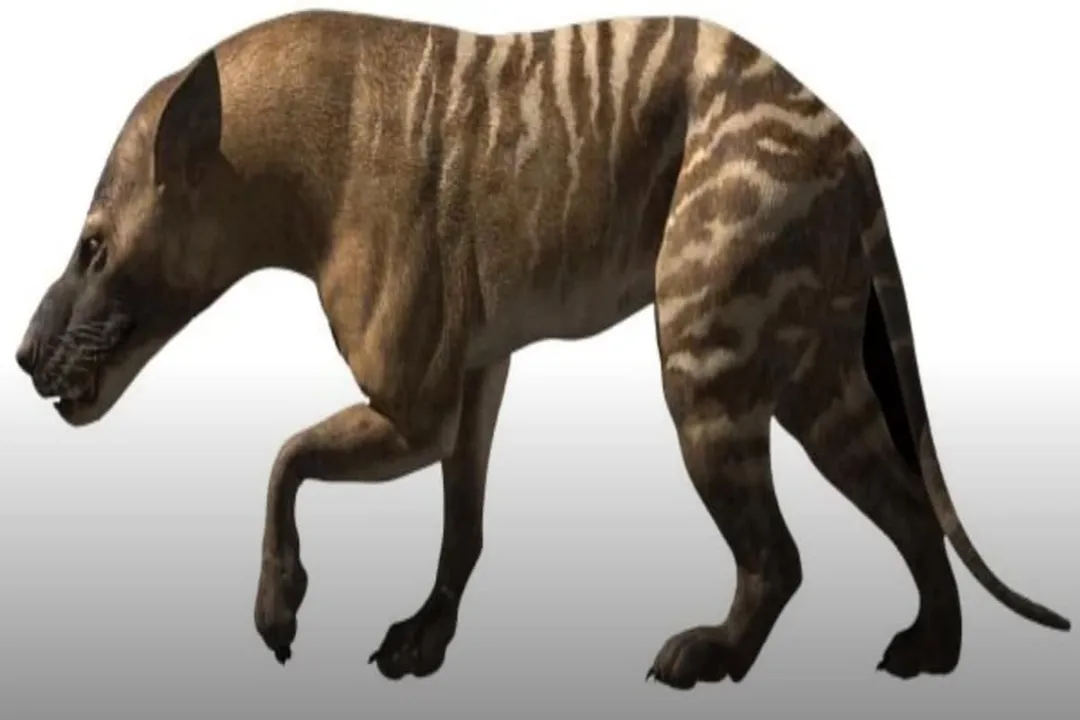
The creature known as Hyaenodon cuts a formidable figure in the fossil record, often sparking immediate comparisons to modern hyenas due to its name, yet its actual appearance was quite distinct from any contemporary carnivore. [2][6][9] This extinct group of mammalian predators, which dominated parts of the Eocene and Oligocene, presented a build that was immensely powerful, blending features that might suggest a mashup between a large bear, a powerful dog, and an ancient, specialized meat-eater. [4][5][6] When visualizing a Hyaenodon, one should picture a stocky, muscular animal with a proportionally massive head, designed for delivering devastating bites to large prey across the ancient landscapes of North America, Europe, and Asia. [1][4][5]
# General Shape
The overall impression Hyaenodon gives is one of raw, blunt force. [6] It was built low to the ground relative to its weight, suggesting substantial muscle mass supporting a heavy frame. [4] Unlike the more gracile predators that evolved later, this animal possessed a robust physique optimized for wrestling and overwhelming prey rather than sustained, high-speed chases. [1] The name itself, meaning "hyena tooth," derives from the appearance of its specialized teeth, but experts stress that Hyaenodon belongs to the entirely separate order Creodonta, making the visual similarity a case of extreme convergent evolution rather than close kinship with modern true hyenas. [1][6][9] These ancient beasts were apex predators in their ecosystems for vast stretches of time, and their appearance reflects that dominance. [6]
# Size Spectrum
One of the most striking aspects of the Hyaenodon lineage is the sheer variation in size across its different species. [1] It was not a single creature but a genus that adapted to various niches over millions of years. [2] At the small end of the scale, some species were comparable in size to a modern coyote or a medium-sized dog, perfectly capable of handling smaller mammals endemic to the Paleogene environment. [1][2]
However, the genus reached truly gigantic proportions in its later forms. [6] The largest known species, Hyaenodon gigas, was truly immense for a terrestrial predator of its time. [1] Reconstructions suggest this colossal form could weigh hundreds of kilograms, potentially rivaling the mass of a modern rhinoceros or a very large bear species. [5][6] This extreme size differentiation across the genus is fascinating; it mirrors the way modern mammalian carnivores occupy niches ranging from the small fox to the massive polar bear, but Hyaenodon genus spanned that entire spectrum over its existence. [1][2]
To provide a clearer frame of reference, if we consider the smaller species of Hyaenodon to be roughly the size of a large wolf, the transition to the truly massive H. gigas represents a leap in scale that few predatory mammals outside of large canids and ursids have achieved since. [1][5]
# Skull Power
The head of the Hyaenodon is perhaps its most defining and terrifying feature. [4][6] The skull was disproportionately large compared to its body mass, heavily built, and housed jaw muscles capable of generating tremendous biting force. [4] The snout itself was long, giving the creature a somewhat elongated, powerful look when viewed from the side. [1]
The dental arrangement is key to understanding its feeding style. [1][9] While the name suggests hyena-like crushing capabilities, the teeth of Hyaenodon were more akin to a colossal pair of scissors. [1][6] They possessed specialized, shearing carnassial teeth designed not primarily for crushing thick bone, like true hyenas, but for slicing through hide, muscle, and sinew with incredible efficiency. [1][6] The large canines served as lethal stabbing or gripping implements. [1] The sheer depth and robust nature of the lower jaw provided the necessary mechanical advantage to support these cutting edges under the strain of subduing large animals. [4] This specialization suggests an ecological role focused on processing flesh rapidly, perhaps similar to large saber-toothed cats, rather than the bone-crunching niche occupied by its namesake modern hyenas. [6]
# Limb Structure
Moving away from the head, the body posture and limbs show adaptations that contrast with the stocky appearance of the torso. [1] While the body was heavy-set, the legs were relatively long for the animal’s overall bulk. [1] Paleontologists generally interpret this limb structure as indicating a digitigrade stance—meaning the animal walked on its toes, much like cats and dogs today, rather than the plantigrade stance of bears or humans who walk flat-footed. [1]
This digitigrade posture, combined with the leg length, suggests that at least some species were capable of sustained movement, perhaps indicating they were active hunters traversing the Miocene badlands where their fossils are often found. [1] However, when considering the sheer bulk of the largest individuals, one must temper the image of a swift runner. While the legs provided reach and efficiency for covering ground, the overall mass implies that while capable of moving quickly, a Hyaenodon gigas would likely have relied on ambush or powerful, short bursts of speed to overcome prey, leveraging its immense jaw strength over pure, drawn-out velocity. [4]

# Epoch Resident
Understanding the look of Hyaenodon is inseparable from understanding when and where it lived. [5] These creatures roamed the Earth primarily during the Eocene and Oligocene epochs, spanning roughly 40 to 20 million years ago. [1][5][6] This was a time when the world was recovering from mass extinctions and mammal groups were diversifying rapidly before the full rise of modern groups like cats and dogs. [1][5]
Fossils are geographically widespread, appearing across North America, Europe, and Asia. [1][5] This extensive range suggests that the ancestral form or a successful early species adapted quickly to varied environments, allowing subsequent species to specialize, resulting in the size variation described previously. [1] The environment they looked out upon was likely semi-arid or open woodland in many regions, making a powerful, quick-striking predator an effective survivor. [5] Therefore, the Hyaenodon appearance—the massive head, the shearing teeth, the powerful legs—is a direct physical manifestation of evolutionary success during this crucial transition period in Cenozoic history. [1][6]
Related Questions
#Citations
Hyaenodon
Hyaenodon - Prehistoric Earth: A Natural History Wiki
Hyaenodon: Extinct Mammalian Carnivore with Unique Teeth
Hyaenodon, the headhunter of the Paleogene badlands
Hyaenodon Animal Facts
Hyaenodon – @thecreaturecodex on Tumblr
Hyaenodont Facts for Kids
Hyaenodon - Carnivores Wiki - Fandom