Why does saiga look like that?

The first thing anyone notices about the Saiga antelope is that it looks entirely out of place, like a creature misplaced from a different planet or perhaps a forgotten era. [5] Its appearance is dominated by a truly singular feature: a massive, bulbous nose that hangs down over its mouth, giving it an almost comical or alien visage, leading some to call it the "alien of the grasslands". [2][5] To understand why this antelope looks so strange, one must look past the immediate shock of its appearance and examine the extreme environment it has called home for millennia.
# Proboscis Puzzle
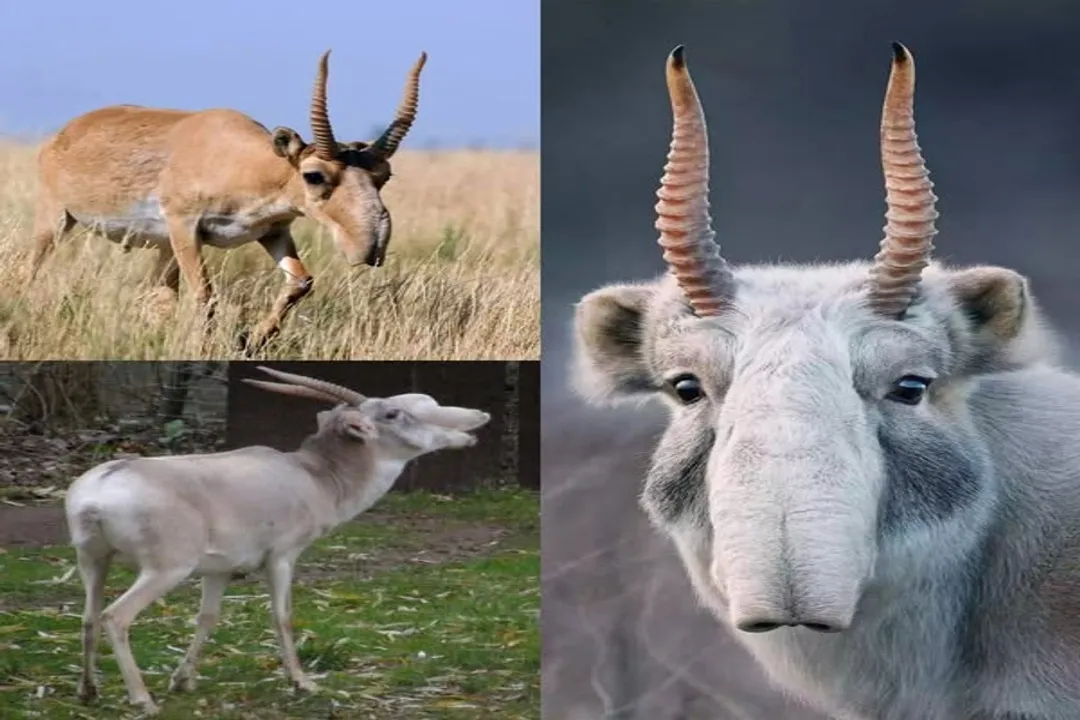
The key to the Saiga's bizarre look lies in that distinctive, flexible snout, often described as a short proboscis. [1] This structure is far more than just an aesthetic quirk; it is a finely tuned instrument essential for survival in the arid and semi-arid steppes where the Saiga roams. [3][4] Its function adapts precisely to the violent seasonal shifts of its habitat.
During the hot, dry summers, the steppes become dusty arenas where vast herds move across the landscape, stirring up fine particulate matter with every step. [1] The internal structure of the Saiga’s specialized nose acts as a highly effective filtration system. [1][3] The complex folds and extensive surface area inside this fleshy extension trap much of the abrasive dust before it can enter the animal’s lungs, offering crucial protection to its respiratory system. [1]
When winter arrives, the challenge flips from choking dust to freezing temperatures. The same nose is then repurposed to act as a natural air conditioner—or rather, a heater. [3] As the Saiga inhales the frigid steppe air, the air passes over the well-vascularized tissues within the large snout. [1] This allows the air to be warmed and somewhat humidified before it reaches the delicate lung tissues, minimizing the risk of cold-induced damage that a more conventionally-shaped nose might allow. [1] This dual-purpose mechanism—a dust filter when necessary and a pre-warmer when needed—demonstrates an extraordinary level of evolutionary specialization tailored to a climate of extremes. [3]
# Ancient Lineage

The strange look of the Saiga is not a recent evolutionary experiment; rather, it is a remnant of deep time. This species is a genuine relic, one of the few megafauna survivors from the Pleistocene Ice Age. [2][8] While its neighbors, such as the woolly mammoth and the saber-toothed cat, disappeared when the climate warmed, the Saiga persisted. [8] This longevity underscores that its unusual anatomy is not a developmental anomaly but a highly successful, time-tested adaptation. [4]
Their continued existence in environments that were once home to these giants suggests their survival toolkit, headlined by that unique nose, proved superior to many other contemporaries in the long run. [8] They adapted to the open grasslands, preferring the drier regions that stretch across Central Asia, including parts of Kazakhstan, Russia, and Mongolia. [4] The physical characteristics we observe today, including their light, stocky build and specialized respiratory system, are hallmarks of an animal built for endurance across vast, open terrains. [4]
# Anatomic Trade-Offs
The Saiga is generally described as a medium-sized antelope, with males sometimes weighing in around 120 pounds. [4] While they are agile runners, capable of maintaining good speeds, the presence of such a large, drooping nose presents an interesting evolutionary puzzle regarding energy expenditure and practical mechanics. [1]
Consider the biomechanics: maintaining a large, highly vascularized organ like this requires a steady supply of blood, demanding more energy from the animal’s overall metabolic budget. [1] Furthermore, while excellent for filtering, it must be carefully managed during high exertion. If an animal is fleeing a predator, the high airflow needed for sprinting could potentially overwhelm the warming capacity, causing the animal to lose too much heat, or conversely, if the structure is too restrictive, it could limit oxygen intake necessary for maximum speed. [3] Therefore, the internal architecture must possess a very precise balance: maximizing filtration and warming without becoming an aerodynamic liability or an energy sink during critical moments of movement. [1] It is an evolutionary compromise where the benefits of atmospheric protection clearly outweigh the costs of structure and maintenance in their specific ecological niche.
Beyond the strict necessities of air quality and temperature, the sheer visual impact of the nose could play an ancillary role. In the featureless, expansive plains environment, distinctive physical traits are often co-opted for social signaling. [4] It is plausible that the exaggerated profile of the nose serves as a long-distance visual cue among herd members, potentially signaling health, maturity, or dominance in a landscape where sound or scent might be easily lost to the wind. [5]
The distinctive look of the Saiga antelope is not arbitrary; it is the product of millions of years spent navigating an environment characterized by the most severe swings between heat, cold, and dust storms. The nose is the physical manifestation of this incredible adaptability, a living piece of Ice Age history perfectly engineered for the challenges of the modern steppe. [2][8]
#Videos
This Alien-Looking Animal Has the Strangest Nose on Earth
Related Questions
#Citations
This Odd-Nosed Antelope Is Experiencing a Mass Die-Off
The saiga's oversized nose acts like a natural air filter, protecting its ...
The bulbous noses of saiga antelope help in their changing habitats ...
Saiga antelope - Wikipedia
This Alien-Looking Animal Has the Strangest Nose on Earth
Saiga Antelope - Yukon Beringia Interpretive Centre