What does a Gordon Setter look like?
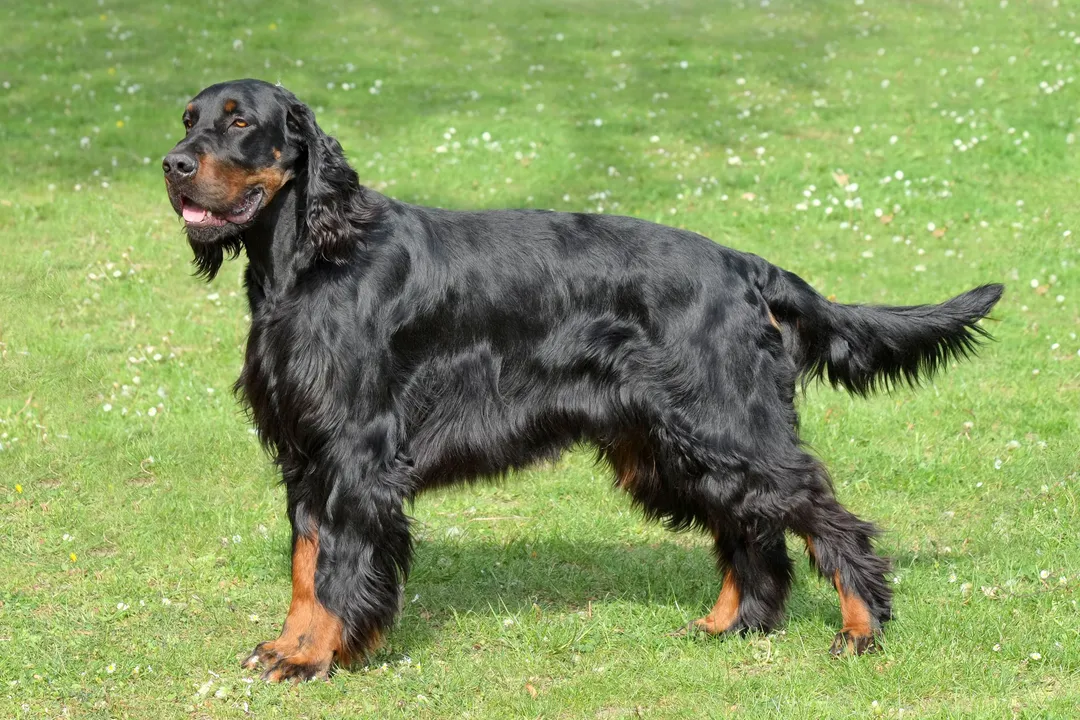
The Gordon Setter presents a handsome, sturdy silhouette, distinctly different from its lighter-boned relatives in the Setter family. [1][2] They are a powerful breed, proudly representing their Scottish heritage, where they were developed to work long days in often harsh terrain requiring endurance above all else. [4][6] Their striking black and rich tan markings immediately set them apart visually when they are seen standing or moving. [1][3]
# Build Stature

When observing a Gordon Setter, the immediate impression should be one of strength, substance, and proper balance, designed for utility rather than fragility. [2][6] They are recognized as the heaviest and most substantial of the setter breeds. [1][3] In terms of height, a mature male typically stands between 25.5 and 27 inches at the shoulder, while females are usually slightly smaller, measuring around 23.5 to 25 inches. [1][2][5] Their weight generally falls within the 45 to 80-pound range, depending on sex and conditioning. [1][5] The overall frame must convey power and the ability to sustain hard work over long distances. [2] An interesting visual comparison is that while they possess the elegance associated with setters, the Gordon’s bone structure is noticeably heavier, giving them a lower center of gravity than the Irish or English Setter, which translates to stability when traversing uneven Scottish moors [Original Insight 1].
# Color Pattern
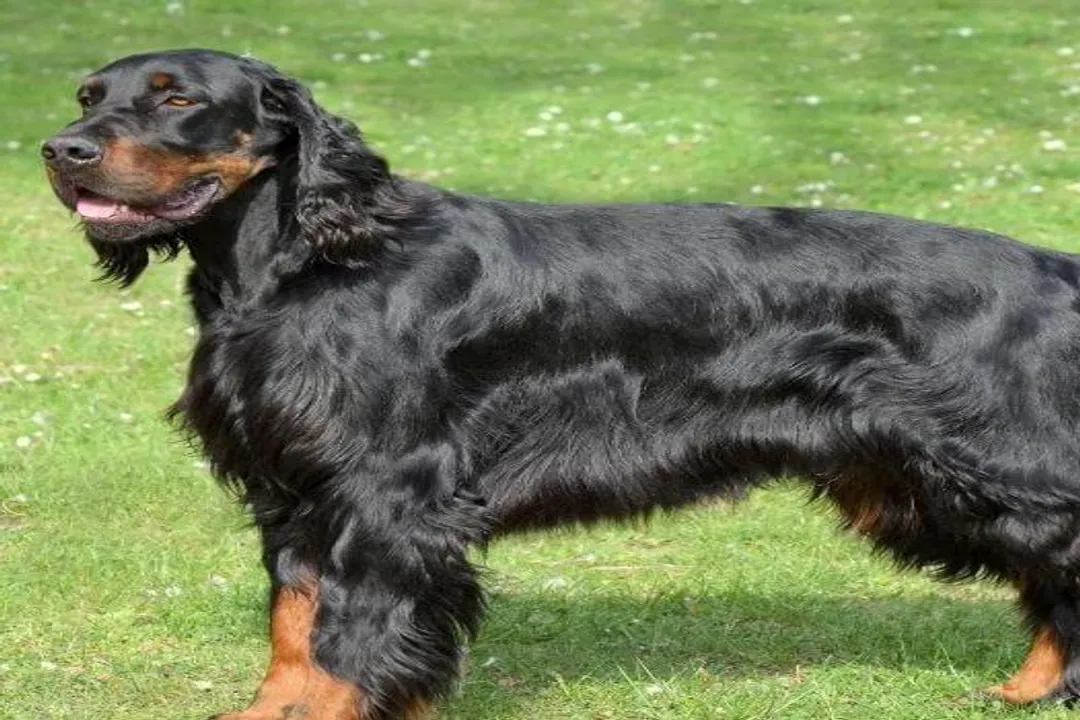
The Gordon Setter’s coat color is perhaps its most recognizable feature, being strictly defined as black and tan. [1][3][6] The primary body color must be a solid, deep, lustrous black. [2][3] This deep black contrasts sharply with the required tan points, which must be rich and clearly defined across the dog’s structure. [3]
These tan markings appear in specific locations:
- Over the muzzle.
- As distinct spots, often called 'pips' or 'eyebrows,' above the eyes.
- On the chest.
- On the lower portions of the legs and feet.
- Surrounding the vent.
- Occasionally, a small amount of tan may appear on the sides of the muzzle. [1][2]
A subtle but important detail for connoisseurs relates to the shade of the tan; it is ideally a deep, reddish-brown, sometimes described as mahogany, rather than a pale or yellowish-tan. [3]
# Coat Texture
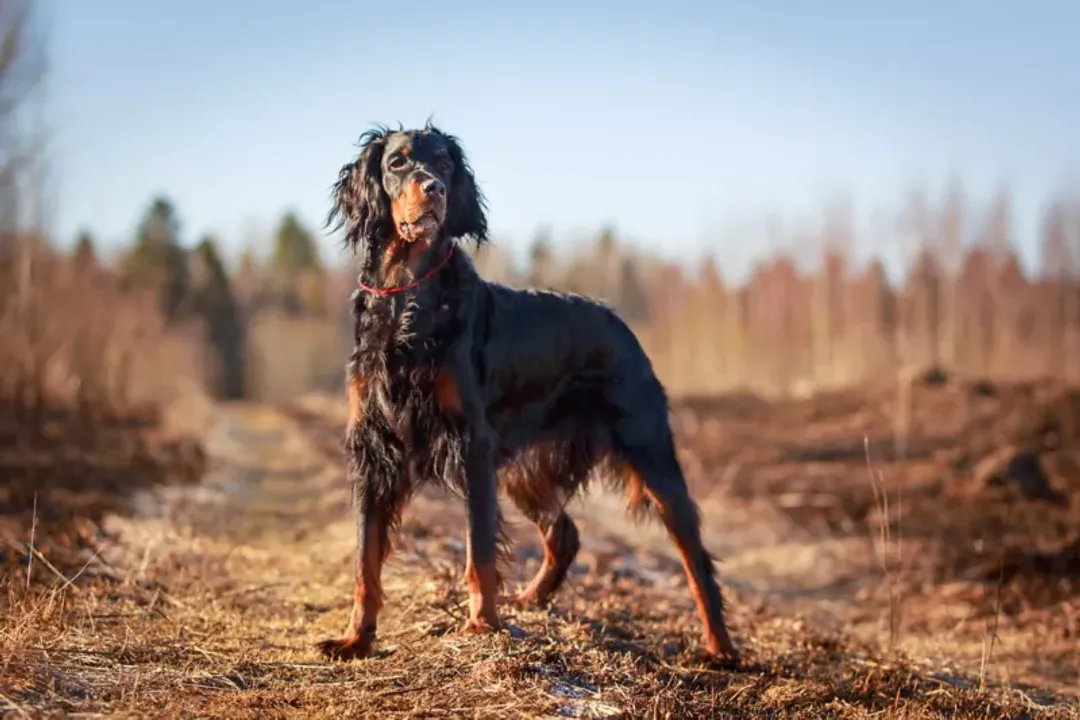
The texture and quality of the coat are essential, as they provided necessary protection from the often-wet and cold environments of their native Scotland. [2] The outer coat should be straight or exhibit only a slight wave; a distinctly curly coat is undesirable. [1][3] The hair lies flat against the body, appearing fine and silky. [3] While they possess feathering, it should be present without being excessive or shaggy. [2] This longer hair develops naturally on the backs of the legs, the underside of the tail, the chest, and behind the ears. [1][6] The breed standard also emphasizes the presence of a dense undercoat, which serves as crucial insulation against inclement weather. [2] While many think of the Gordon's coat as simply long, the density of the undercoat, necessitated by their Scottish origins, means that shedding, though seasonal, requires thorough brushing—often down to the skin—to prevent matting, especially in the feathering around the stifle and hocks, which differs from the more flowing, less dense coats of some other setter types [Original Insight 2].
# Head Profile
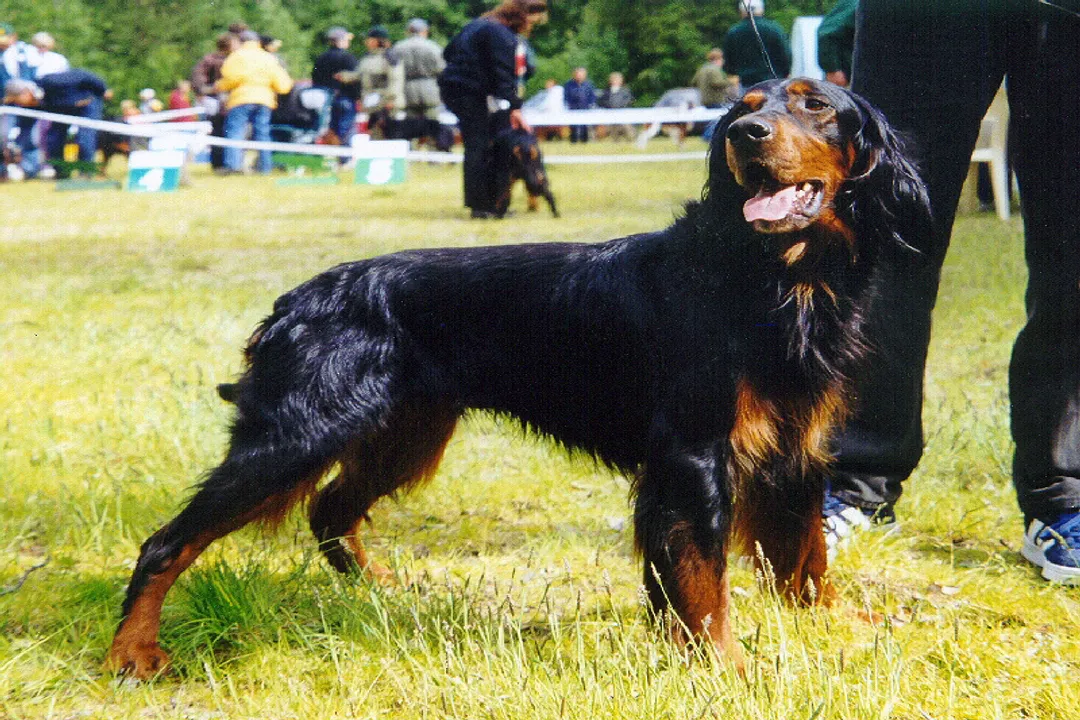
The head structure contributes significantly to the breed's noble appearance. [2] It should appear broad between the ears and deep, rather than narrow or chiseled. [2] The stop, the slight indentation where the muzzle meets the skull, should be well-defined but not abrupt. [1] The muzzle itself is relatively long and described as square-cut, tapering gently toward the nose. [3]
The eyes are highly expressive, meant to convey intelligence, kindness, and alertness. [2][3] They are dark brown in color and are typically almond-shaped, set neither too deeply into the socket nor protruding. [1] The ears are long, fitting neatly close to the side of the head, and are set low. These ears are covered with fine, silky feathering that blends into the neck coat. [2]
# Body and Movement
Looking at the overall body shape, the Gordon Setter should exhibit a level topline running from the shoulders to the croup. [2] They require a deep chest, which allows for the lung capacity necessary for an active hunting dog. [2][6] The neck should be long and clean, blending smoothly into the shoulders. [1]
Their structure is strongly athletic. The forequarters must show good layback in the shoulder blades, enabling free movement, while the hindquarters are powerfully muscled to provide the essential driving force during the trot. [1] When moving, the Gordon Setter should display a gait that is strong, smooth, and purposeful, covering ground with a long, free stride. [2] The dog’s movement should appear easy and efficient, maintaining straight lines both coming and going, indicative of correct angulation. [1]
The paws should be compact, well-rounded, and tight-knit, often referred to as 'cat-like,' which helps protect them while working on rough ground. [2]
In summary, the visual presentation of the Gordon Setter is one of dignified strength. It blends the traditional, elegant outline of a gun dog with the necessary substance and dense coat to thrive in challenging environments, resulting in a classic, imposing, and functional appearance defined by its deep black and mahogany tan coloring. [3][6]
#Videos
Dog Breed Video: Gordon Setters - YouTube
A Dog's Life - Gordon Setters - YouTube
Related Questions
#Citations
Gordon Setter Dog Breed Information | Purina UK
Breed Standard – Gordon Setter Club Of America, Inc.
Gordon Setter - Wikipedia
Dog Breed Video: Gordon Setters - YouTube
Gordon Setter - All About Dogs | Orvis
Gordon Setter Facts - Dog Breeds - Wisdom Panel
A Scottish Treasure Meet the Gordon Setter, a breed as bold and ...
Gordon Setter: Dog Breed Characteristics & Care - The Spruce Pets